Social Media Trends for 2027: 9 Shifts That Change How You Post
Nine 2027 social media shifts backed by data: originality rules, AI slop limits, YouTube's Feb 2027 thresholds, TV video, social search, and what to change.

Every November the trend reports arrive, and most read like horoscopes: "authenticity will matter," "AI will change everything." This year there is more to work with. Platforms changed real rules in 2026, several of which take effect in 2027, and the big annual datasets landed in October with hard numbers attached.
So this list has one rule. Each shift is backed by at least one number from a platform, a measurement firm or a published survey, with what it means for how you post. Trends we could not back with data (digital detox, micro-dramas, fandoms) are left out.
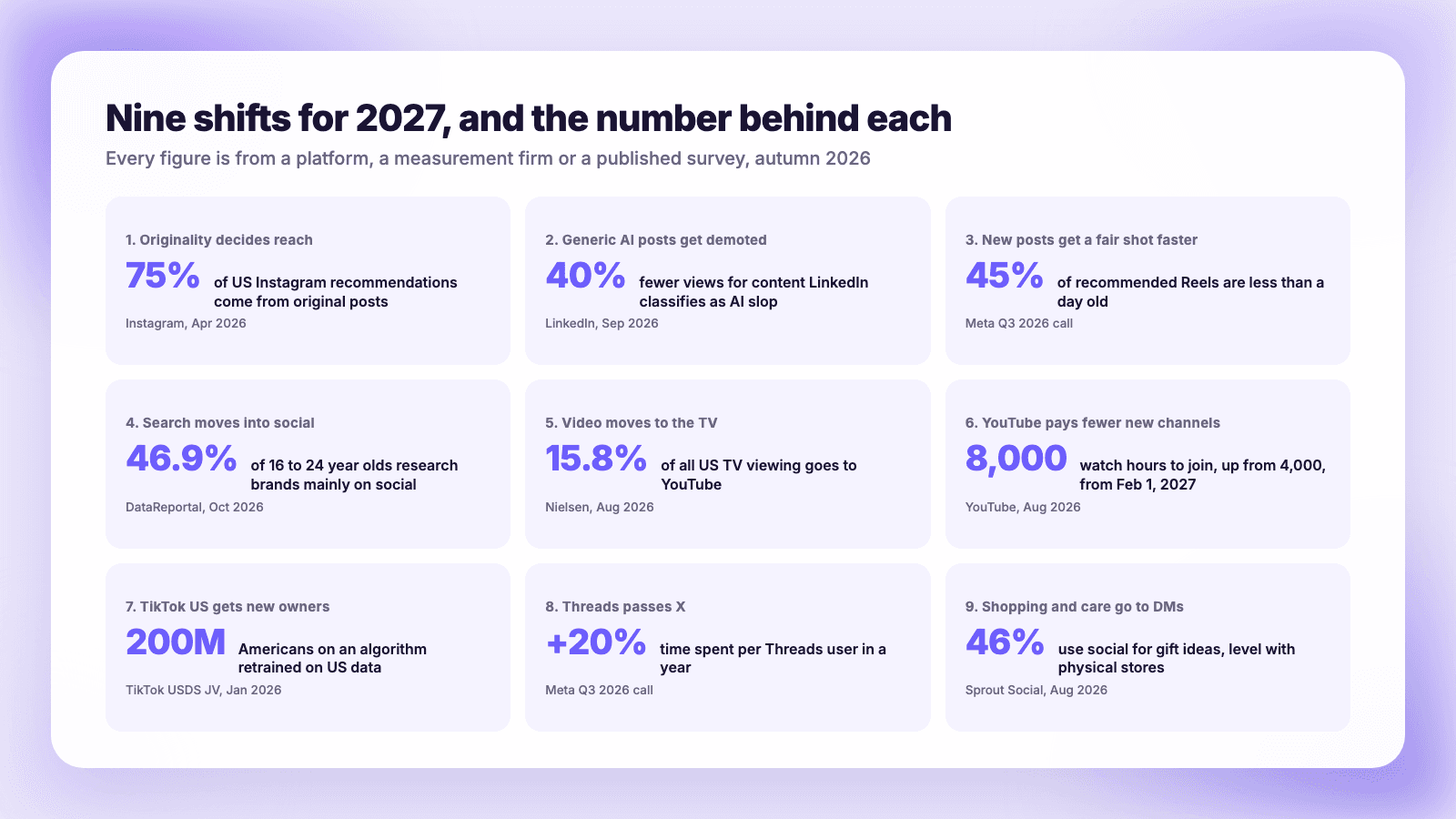
The short version: Social media keeps growing in 2027, just more slowly. There are 5.81 billion social media user identities, up only 2.7% in a year, while generative AI users jumped 57.2% to 3.24 billion. The changes that matter for posting are about rules, not apps: Instagram, YouTube and X now reward original content and cut reach or pay for reposts; LinkedIn says it cut views of "AI slop" by 40%; YouTube doubles its monetization thresholds for new creators on February 1, 2027; and video is getting longer and moving to the TV, where YouTube already takes 15.8% of all US viewing. Post your own work, make it specific, give each platform a version that fits it, and stop relying on a single app.
The backdrop: still growing, but the easy growth is over
The headline numbers come from DataReportal's Digital 2027 report, published October 21, 2026 with Meltwater and We Are Social:
- 5.81 billion social media user identities, 69.9% of the world's population, up 2.7% in a year.
- 19 hours 18 minutes a week on social and video platforms for the typical internet user, up 3.8%.
- 3.24 billion active users of generative AI platforms, up 57.2% in a year.
- Across the world's top 10,000 websites, total monthly web traffic has fallen more than 10% since ChatGPT launched, according to Meltwater's release.
Money is still pouring in. WARC's October 2026 forecast puts social media ad spend at $394.6 billion in 2026, up 21.3%, the fastest of any channel. But WARC expects total ad growth to slow to 8.4% in 2027, and WPP Media's midyear forecast says social's growth "will decelerate to single digits from 2027," citing three headwinds: time spent plateauing, age restrictions for teens, and AI chatbots competing for attention.
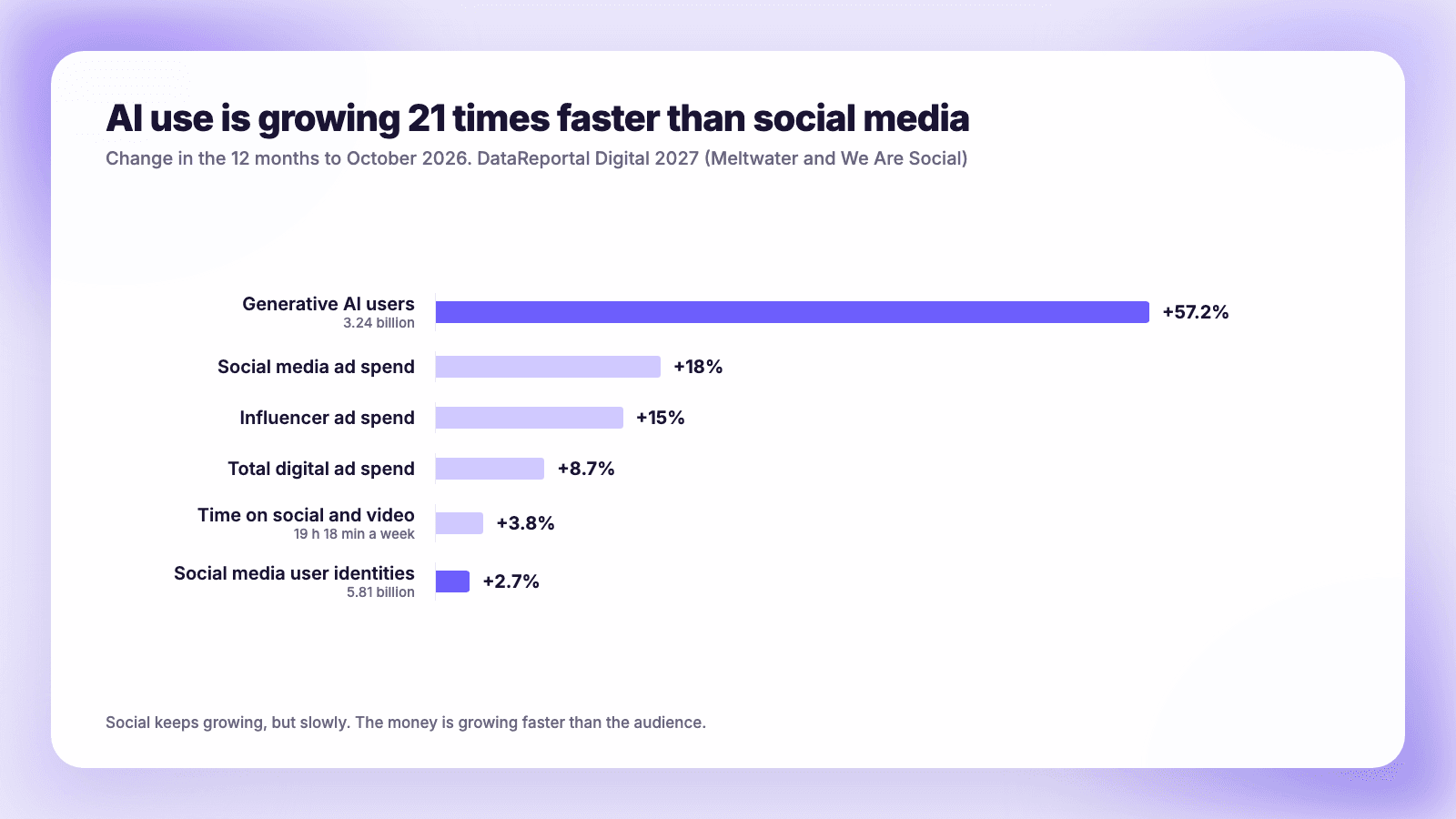
What that means for you: platforms no longer grow by adding people. They grow by keeping the people they have for longer, so they reward content that keeps viewers around and push out anything that makes the feed feel cheap. Most rule changes below follow from that.
What the big 2027 forecasts say
The major trend reports published in October and November 2026 overlap more than their headlines suggest.
| Report | Published | Headline calls for 2027 |
|---|---|---|
| eMarketer, 11 Top Trends to Watch in 2027 | Nov 13, 2026 | Ads that chat back; TikTok will keep more of the sales it inspires; YouTube's split across TV, social and AI visibility |
| Forrester, Predictions 2027 | Oct 2026 | Conversational ads become a real channel; Meta looks for growth beyond Facebook and Instagram after its $17 billion youth settlement |
| Battenhall, Year Ahead in Social 2027 | Nov 12, 2026 | Private sharing in DMs, AI "slop," the rise of Reddit, zero-click AI search, creator-first social |
| WPP Media, This Year Next Year | Jun 2026 | Social stays the largest ad channel but slows to single-digit growth from 2027 |
Most of these reports are paywalled, so the shifts below rely on the public data underneath them.
1. Original content gets recommended. Reposts don't
This is the biggest change for everyday posting, and three platforms made it in 2026.
- Instagram, April 30, 2026: accounts that "primarily post unoriginal content in photos or carousel posts, in addition to reels, will no longer be shown in places where we recommend content," according to Instagram's creator blog. Instagram says 75% of US recommendations now come from original posts. Adding "a border, watermark, subtitles, or a credit in the captions" does not make a repost original.
- YouTube, July 16, 2026: the monetization policy now spells out three kinds of "inauthentic content" that cannot earn money, starting with "generic, repetitive, or template-based content," TechCrunch reported.
- X, August 2026: X replaced its revenue sharing program with Original Content Rewards, which requires 500 verified followers and 500,000 verified Home Timeline impressions in 90 days, and excludes posts copied or re-uploaded "without meaningful transformation" (TechCrunch).
What to do in 2027: If your feed is built on reposted clips, screenshots of tweets or "best of" compilations, that strategy now has a ceiling on Instagram and no payout on YouTube or X. Use collabs and remix for other people's material, and put your own footage, design or commentary in the post itself. Note that posting your own video to several apps is not the same as reposting someone else's; do platforms penalize AI content covers where the lines are drawn.
2. Platforms are pushing back on generic AI posts
AI generation tools got much better in 2026. On November 11, TikTok extended its Symphony ad tool to generate 30-second videos from up to 50 image, video and audio references, up from nine, Net Influencer reported. Symphony output carries AI labels, invisible watermarks and C2PA Content Credentials so other platforms can identify it.
The platforms are also getting better at spotting low-effort AI posts and showing them to fewer people. LinkedIn said in September 2026 that more than 1 million members used its new "Seems like AI slop" button within two weeks of launch, and that its efforts "reduce views of content classified as AI slop by 40%." It defines slop as content that "may sound polished on the surface but lacks a clear point of view, unique perspective, or substance."
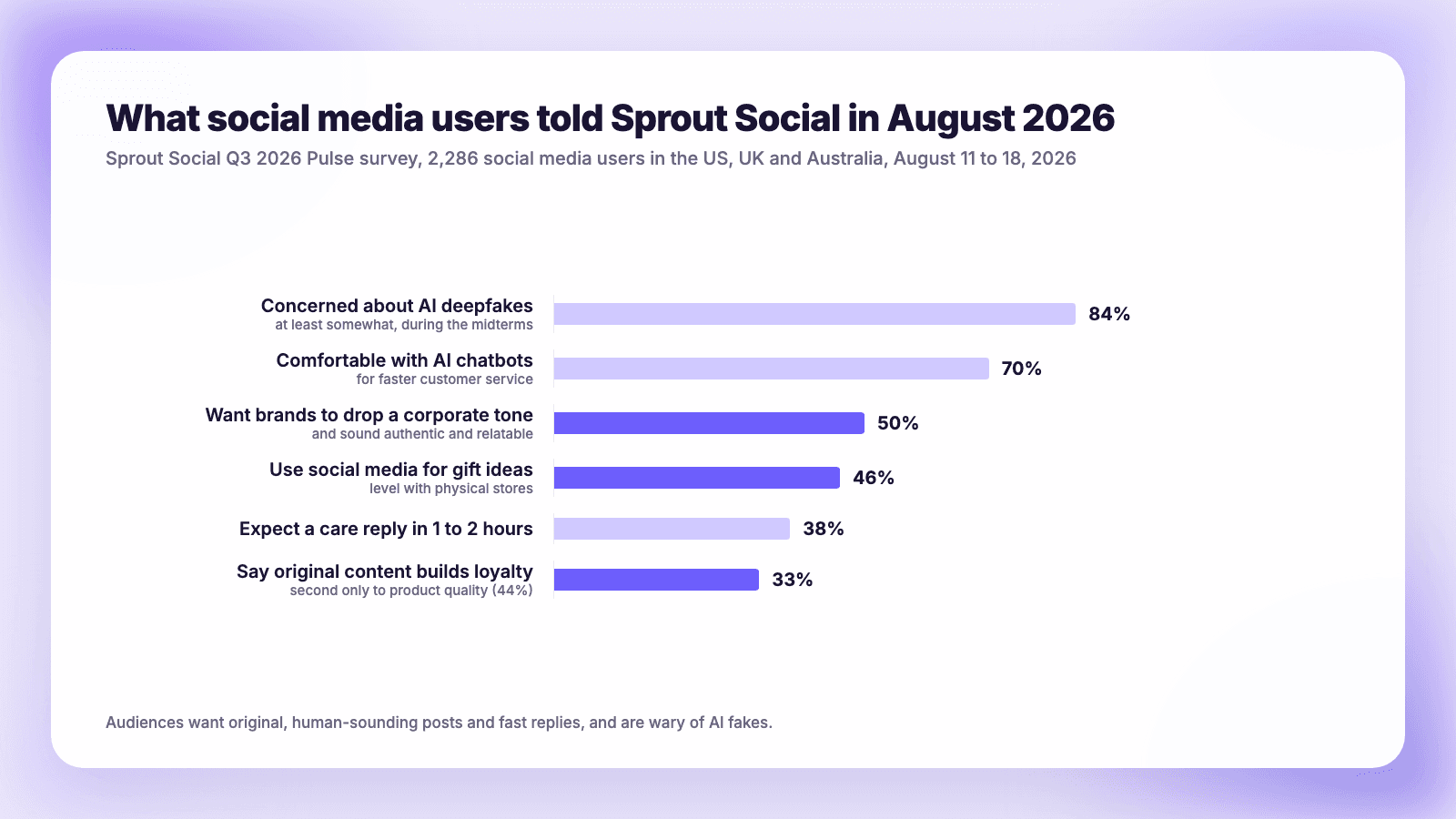
Audiences are wary too. In Sprout Social's Q3 2026 Pulse survey of 2,286 social media users in the US, UK and Australia, 84% were at least somewhat concerned about AI deepfakes during the midterms, and 50% wanted brands to drop a corporate or salesy tone.
What to do in 2027: Use AI for the work around the post (drafts, captions, cutting, proofreading), not as a substitute for having something to say. A post with a specific number, a real example or a clear opinion is very hard to mistake for slop.
3. New posts get a fair shot faster
This is a quieter shift, but it changes how often you need to post. On Meta's Q3 2026 earnings call, CFO Susan Li said almost 45% of recommended Instagram Reels are now less than one day old, up more than 11 percentage points from the previous quarter, Social Media Today reported. On Facebook, Meta rolled out a new recommendation system that helps "surface relevant new posts before they've accumulated significant engagement."
In plain terms, a new post can be recommended before it has many likes, because the system judges what it is about rather than waiting for engagement. The catch: what you posted today has a better chance than what you posted last month.
What to do in 2027: A steady rhythm beats occasional bursts. You do not need to post more than you can sustain; how often to post on social media has the platform-by-platform numbers.
4. Search moves into social apps and AI answers
People increasingly look things up inside social apps and AI chatbots, not on websites. According to Digital 2027, 46.9% of internet users aged 16 to 24 use social networks as their primary source when researching brands and purchases, according to Meltwater's summary of the report. Meanwhile, total time spent on the web has fallen 11.2% in 24 months.
Forrester expects this to reach advertising in 2027, predicting that "conversational ads will no longer be niche experiments" as Google, Meta, Amazon, TikTok, Microsoft and OpenAI sell ads in and around AI answers.
What to do in 2027: Write captions, on-screen text and spoken intros with the words people actually type: the product, the place, the problem. A video called "3 mistakes" is invisible to search; "3 mistakes when repotting a monstera" is not. Our guide to social media SEO walks through it.
5. Video gets longer and moves to the TV
For years the advice was "shorter is better." In 2027 the bigger platforms are pulling in the other direction.
Nielsen's August 2026 Gauge put YouTube at a platform-record 15.8% of all US TV viewing, ahead of every media company it measures. YouTube's own Partner Program update says it now sees "over a billion hours of watch time on TV everyday."
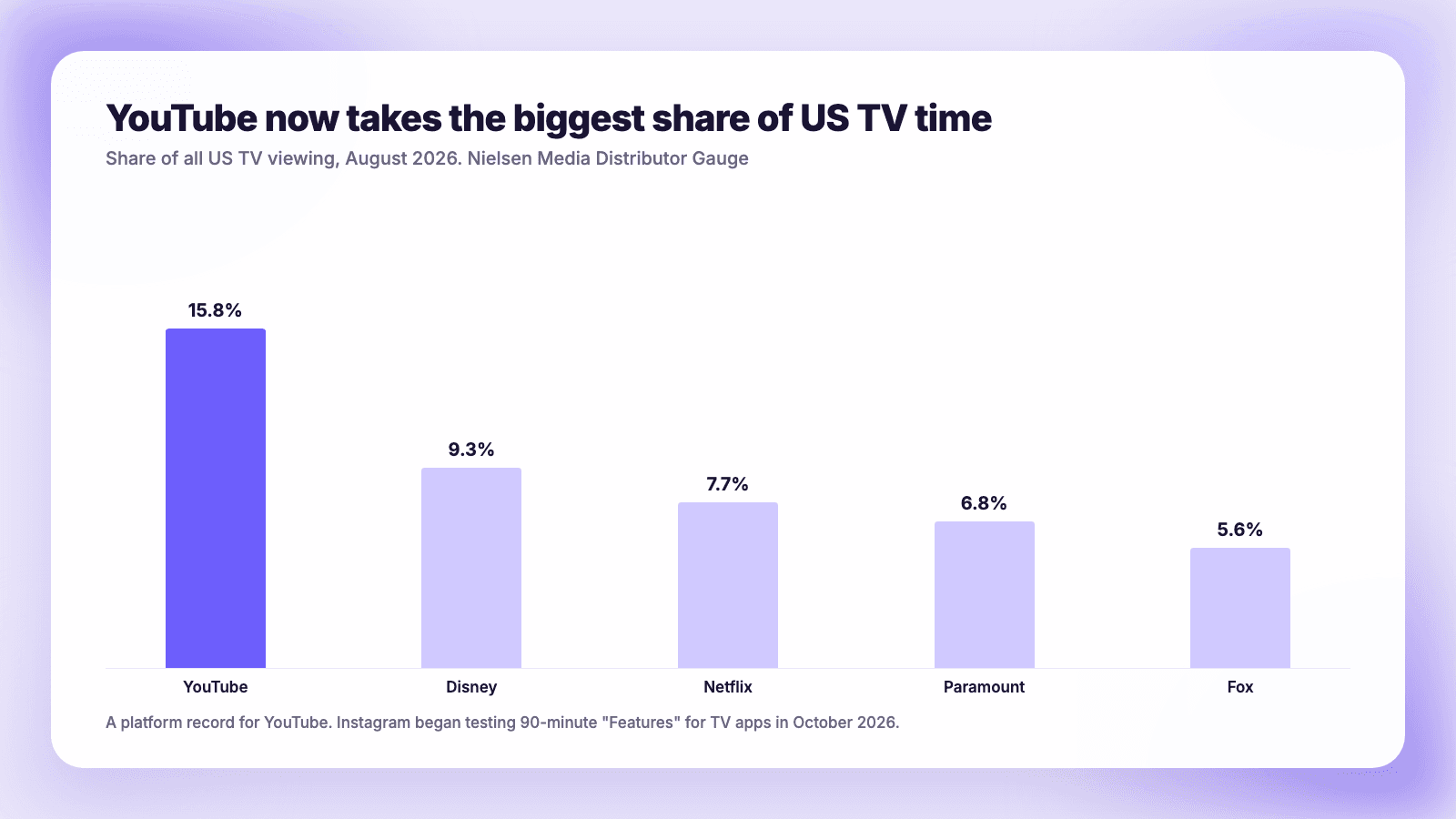
Instagram wants a share of that. In October 2026 it began testing "Features," a horizontal format for videos up to 90 minutes long, aimed at podcasters and comedians and designed for its TV apps, Engadget reported. The test is US-only and limited to creators with individual deals. We cover what it means for Reels in Instagram Features and Clips as Reels explained.
What to do in 2027: Short clips are still how new people find you, but the longer piece behind them (the full episode, tutorial or review) is where TV viewing is growing. Plan one long piece and cut the shorts from it. For where the short clips should go, see TikTok vs Reels vs Shorts.
6. YouTube monetization gets harder on February 1, 2027
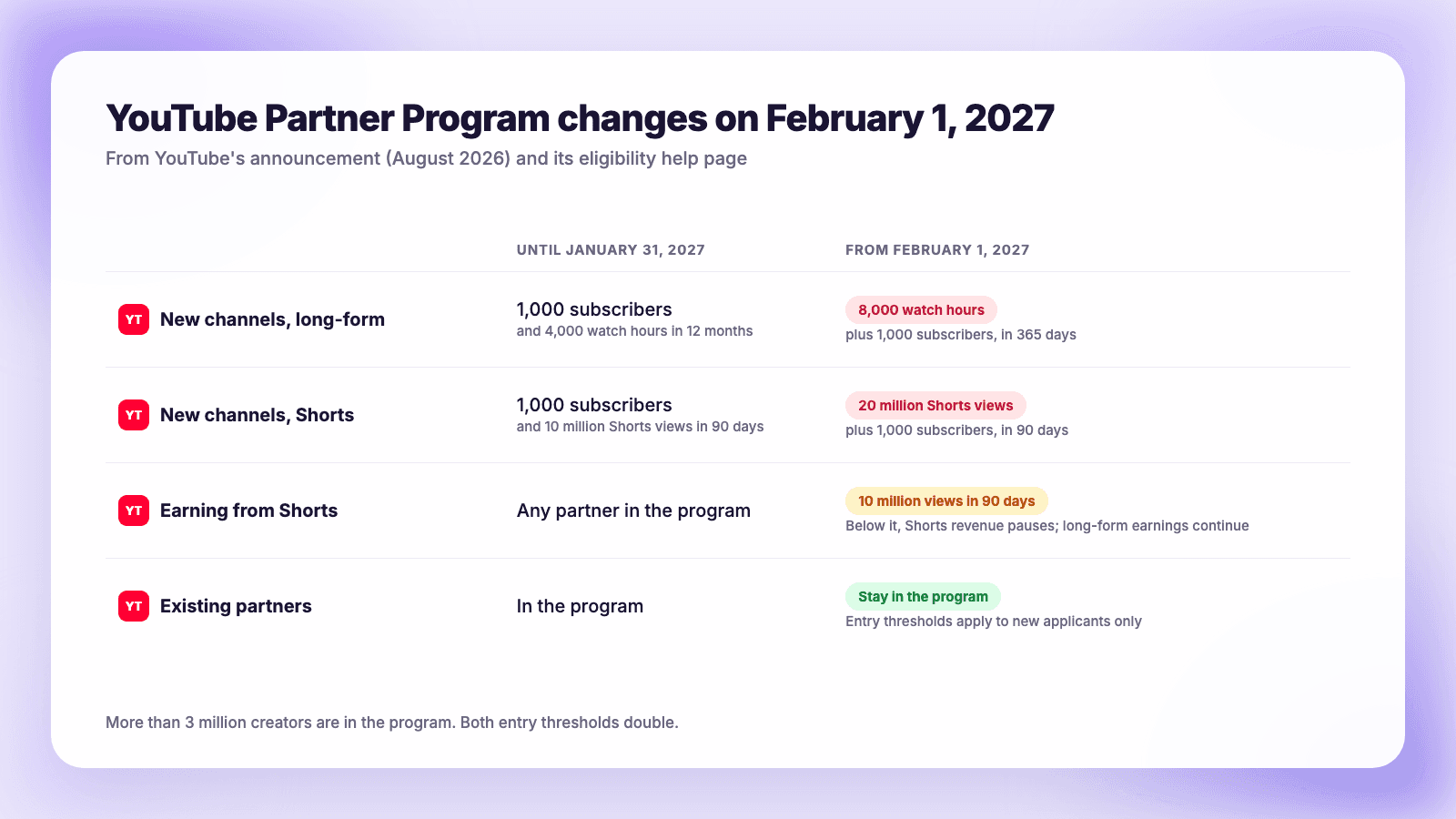
YouTube announced the first major changes to its Partner Program since 2018. From YouTube's announcement and its eligibility help page:
| Requirement | Until January 31, 2027 | From February 1, 2027 |
|---|---|---|
| New channels, long-form route | 1,000 subscribers and 4,000 watch hours in 12 months | 1,000 subscribers and 8,000 watch hours in 365 days |
| New channels, Shorts route | 1,000 subscribers and 10 million Shorts views in 90 days | 1,000 subscribers and 20 million Shorts views in 90 days |
| Earning from Shorts (all partners) | Any partner in the program | 10 million qualified Shorts views in the last 90 days |
Channels already in the program keep their place. But any partner who falls below 10 million Shorts views in 90 days stops earning Shorts ad and subscription revenue until they cross it again, while long-form earnings continue. YouTube says more than 3 million creators are in the program and that it expects to pay creators more in 2027 than in 2026.
What to do in 2027: If you are a small channel counting on Shorts income, plan for it to stop. Long-form watch hours are now the steadier route into, and through, the program.
7. TikTok in the US gets a retrained algorithm
On January 23, 2026, the TikTok USDS Joint Venture was formed to keep the app running for "more than 200 million Americans and 7.5 million businesses." Silver Lake, Oracle and MGX hold 15% each, and ByteDance keeps 19.9%. The venture says it "will retrain, test, and update the content recommendation algorithm on U.S. user data," secured in Oracle's cloud.
eMarketer's 2027 list also expects TikTok to "keep more of the sales it inspires," which points to more buying inside the app itself.
What to do in 2027: A retrained algorithm can shift what gets reach without any announcement. Watch your own TikTok numbers month by month rather than relying on 2025 advice, and keep a second short-video channel active so a bad month on one app is not a bad month for your business.
8. Text social splits: Threads passes X
On Meta's Q3 2026 call, Mark Zuckerberg said Threads has overtaken X in monthly active users, and Susan Li said time spent per user on Threads grew more than 20% in a year (Social Media Today). X does not publish comparable audited user figures, so treat this as Meta's claim rather than an independent count.
What to do in 2027: If text posts are part of your mix, Threads is no longer optional, and X's new payout rules favor original posts over aggregation. Most people now need a version for each. Our comparison of Threads vs X covers the differences in tone and format.
9. Conversations and shopping move to DMs and customer care
Battenhall's first prediction for 2027 is "Slide into my DMs": public posting is declining while private sharing grows. The public numbers back the direction. In Sprout Social's August 2026 survey, 46% of people said they use social media for gift ideas, level with physical stores and ahead of friends and family. 27% plan to use social media more for customer service questions than in 2025, and 38% expect a reply within one to two hours.
What to do in 2027: Treat comments and DMs as part of the post. Inviting people to message you ("reply with your size and I will send the link") turns private sharing into something you can see. Answer within hours, not days.
What to change in your posting for 2027
The nine shifts point to a short list:
- Make it yours. Original footage, design or commentary in every post.
- Be specific. Specific details beat slop classifiers and help search.
- Post steadily. Fresh posts get recommended sooner.
- Build one longer piece a month and cut short clips from it.
- Spread your reach. Depending on one platform is a bigger risk than it was in 2025.
- Answer in private. Reply to DMs and comments within hours.
Spreading across platforms is easier if you do not rebuild every post by hand. Plumefy lets you upload your own video or image once and publish it to up to 11 networks, with a caption written for each. The free plan covers six connected accounts.
FAQ
What are the biggest social media trends for 2027?
Original content being favored over reposts, platforms limiting generic AI posts, faster recommendation of new posts, search moving into social and AI apps, longer video on TV screens, YouTube's stricter monetization rules from February 1, 2027, TikTok's retrained US algorithm, Threads overtaking X, and more conversations and shopping happening in DMs.
Is social media still growing in 2027?
Yes, but slowly. DataReportal counts 5.81 billion social media user identities in October 2026, up 2.7% in a year, while time spent rose 3.8%. Generative AI use grew far faster, by 57.2%. WPP Media expects social ad growth to slow to single digits from 2027.
What changes on YouTube in February 2027?
New channels will need 1,000 subscribers plus 8,000 watch hours in a year or 20 million Shorts views in 90 days to join the Partner Program, double the old thresholds. Existing partners need 10 million Shorts views in 90 days to keep earning from Shorts.
Will AI-generated content be penalized in 2027?
Not for being made with AI as such. What platforms limit is generic, repetitive or reused content. YouTube will not monetize it, Instagram stops recommending accounts that mostly repost, and LinkedIn says it has cut views of "AI slop" by 40%.
Post everywhere, once.
Start on the free plan. No card needed; upgrade when you need scheduling.
Start free