The LinkedIn Algorithm in 2026: Why Reach Dropped and What Works
LinkedIn now matches posts to readers by topic and profile. The typical creator lost 15%+ of reach in 2026. Documents, clear expertise and replies still work.
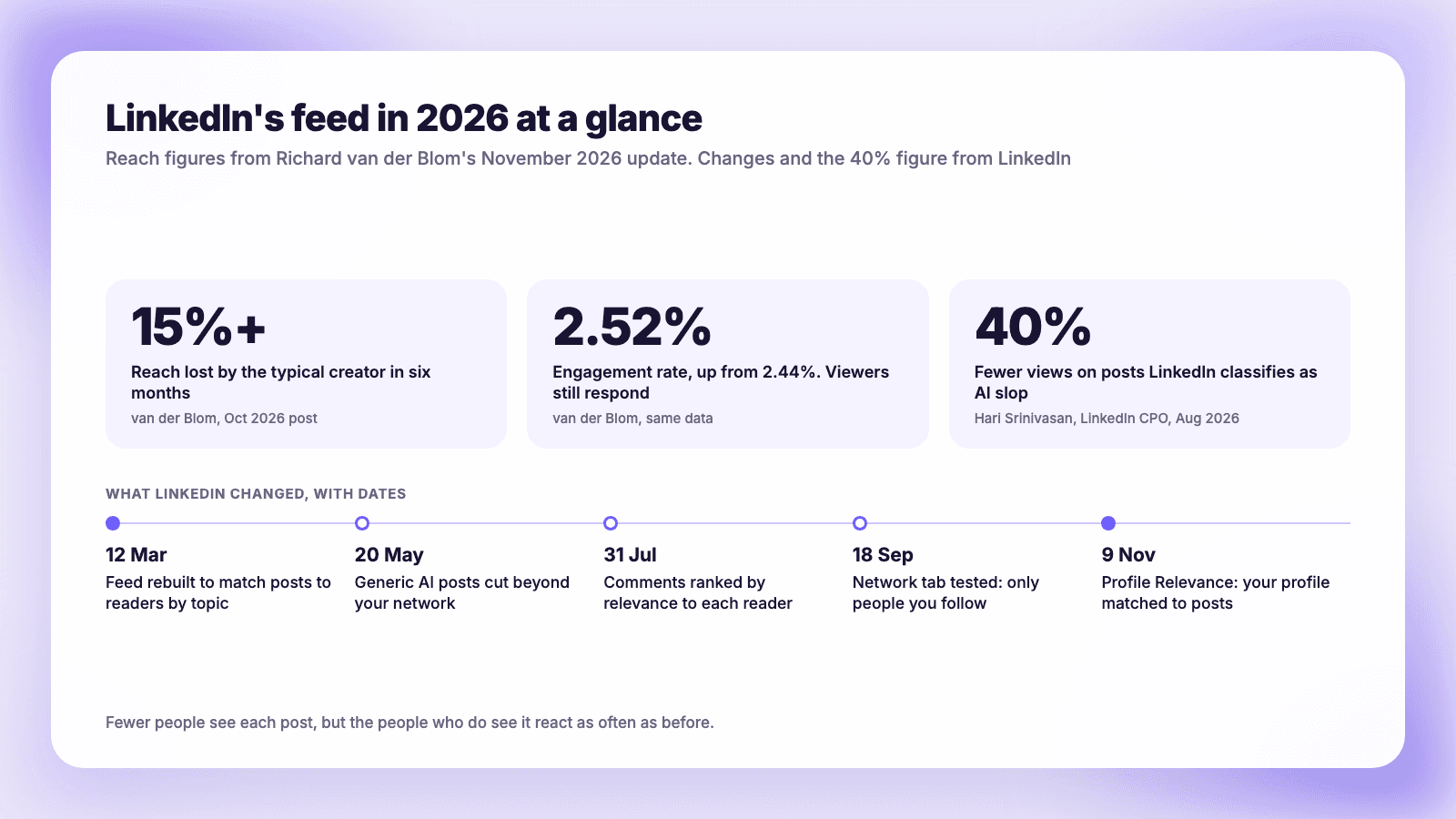
If your LinkedIn posts reach fewer people than they did a year ago, you are in the majority. Richard van der Blom, who has studied LinkedIn reach since 2020, says six in ten creators are below where they were six months ago. LinkedIn rebuilt its feed in March 2026, started cutting the reach of generic AI posts in May, began ranking comments in July and, in November, explained how it reads your profile to decide who sees your posts.
Most articles on the subject mix those real changes with numbers nobody can trace. This one separates what LinkedIn has said on the record, what large studies measured, and which popular rules have no source at all.
The short version: LinkedIn's feed now picks posts by meaning and matches them to readers by their profile and their reading history, not mainly by who is connected to whom. Reach fell for most accounts in 2026 (the typical creator lost more than 15% in six months, per van der Blom), but engagement rates held, which means the people who do see your posts still respond. What still works is narrow and boring: post about one or two subjects your profile backs up, write something with a real point of view, use document posts for teaching, reply to every comment, and post two to five times a week. Links, hashtags and scheduling tools are not the problem LinkedIn's rumor mill says they are.
What LinkedIn actually changed in 2026
In 2026 LinkedIn said more about its feed than in any recent year. These are the changes with a date and a primary source:
| Date | What changed | Source |
|---|---|---|
| 12 March | Feed rebuilt on LLM-based retrieval and a sequence ranking model; less engagement bait and "recycled" posts | LinkedIn newsroom and engineering blog |
| 20 May | Posts that look AI-generated and lack a clear perspective are "less likely to be widely distributed beyond a person's immediate network" | LinkedIn, "Keeping conversations real" |
| 30 July | "Seems like AI slop" button added to every post; LinkedIn's own AI post writer retired | TechCrunch, Hari Srinivasan |
| 31 July | Comments ranked by relevance to each reader; automated comments limited | Rishi Jobanputra, LinkedIn |
| 19 August | Members see 40% fewer views of content LinkedIn classifies as AI slop | Hari Srinivasan, LinkedIn |
| 18 September | Test of a "Network" tab showing only people you connected with or followed | Social Media Today |
| 9 November | Profile Relevance explained: your profile is turned into an AI prompt to match you with posts from outside your network | LinkedIn engineering blog |
March: the feed was rebuilt around meaning
On 12 March LinkedIn's newsroom announced the rebuild in plain terms: "We want the Feed to be relevant to your interests, not a popularity contest." The same day, its engineering blog explained that several older ways of finding candidate posts were replaced by one AI retrieval system that matches posts and members by what they are about.
Ranking changed too. The new model reads "more than a thousand of your historical interactions" as a sequence, and the actions it lists are "long dwells, likes, comments, shares." Raw popularity counts are converted into percentile buckets, so a post's like count matters less than it used to. LinkedIn's ranking paper says the new model had served the majority of feed traffic for more than three months and lifted time spent by 2.10% and likes, comments and reshares by 3.52% in A/B tests. The newsroom post also promised less of "comment to agree" prompts and "videos that don't match the text."
May to August: the AI slop rules
On 20 May LinkedIn published Keeping conversations real on LinkedIn. The key sentence: "When content appears to be generated by AI and lacks clear perspective, it is less likely to be widely distributed beyond a person's immediate network." It added that "It's ok to use AI to help you write, but your posts and comments need to represent your voice and your perspectives," and that in early testing it identified generic content correctly "94% of the time."
On 30 July LinkedIn added a "Seems like AI slop" button to posts and pulled its own "enhance your post" AI writer. Three weeks later, chief product officer Hari Srinivasan posted that over a million people had used the button and that "members are now experiencing 40% less views on what we classify as AI slop from just a few weeks ago." Note where the penalty bites: beyond your network. Your connections can still see a bland post. Strangers mostly will not.
July: comments became a ranked feed of their own
Rishi Jobanputra, who runs feed product, wrote on 31 July that time spent reading comments was up 18% year over year, that LinkedIn catches "more than 200k automated comment attempts" a day, and that comments are now ranked by relevance to each reader. Comments "that repeat what's already in the post" are shown less.
November: your profile is now a ranking input
The newest piece is the 9 November engineering post, Profile Relevance. LinkedIn turns each member's profile (headline, summary, skills, work history, education) into a prompt for an AI model, does the same with each post's text and transcripts, and matches the two to recommend posts from people you are not connected to.
One detail matters a lot: posts from this source "must have received a single viral action (like, comment, or share) from an unconnected member before being recommended." A post that only your friends touch does not enter this pipeline.
How much reach actually dropped
LinkedIn publishes no reach figures, so the evidence comes from large independent datasets. Richard van der Blom, whose Algorithm Insights Report is the most cited, posted on 23 October the first findings from his November 2026 update:
- "The typical creator lost +15% of their reach in six months. 6 in 10 are below where they were."
- "The engagement rate held: 2.44% → 2.52%."
- "Followers grew +38.7% while reach went down."
- "Every follower group up to 100K lost 14.5 to 15.7%."
Reach fell, but the share of viewers who react did not. The feed shows your post to fewer people; it has not decided your posts got worse.
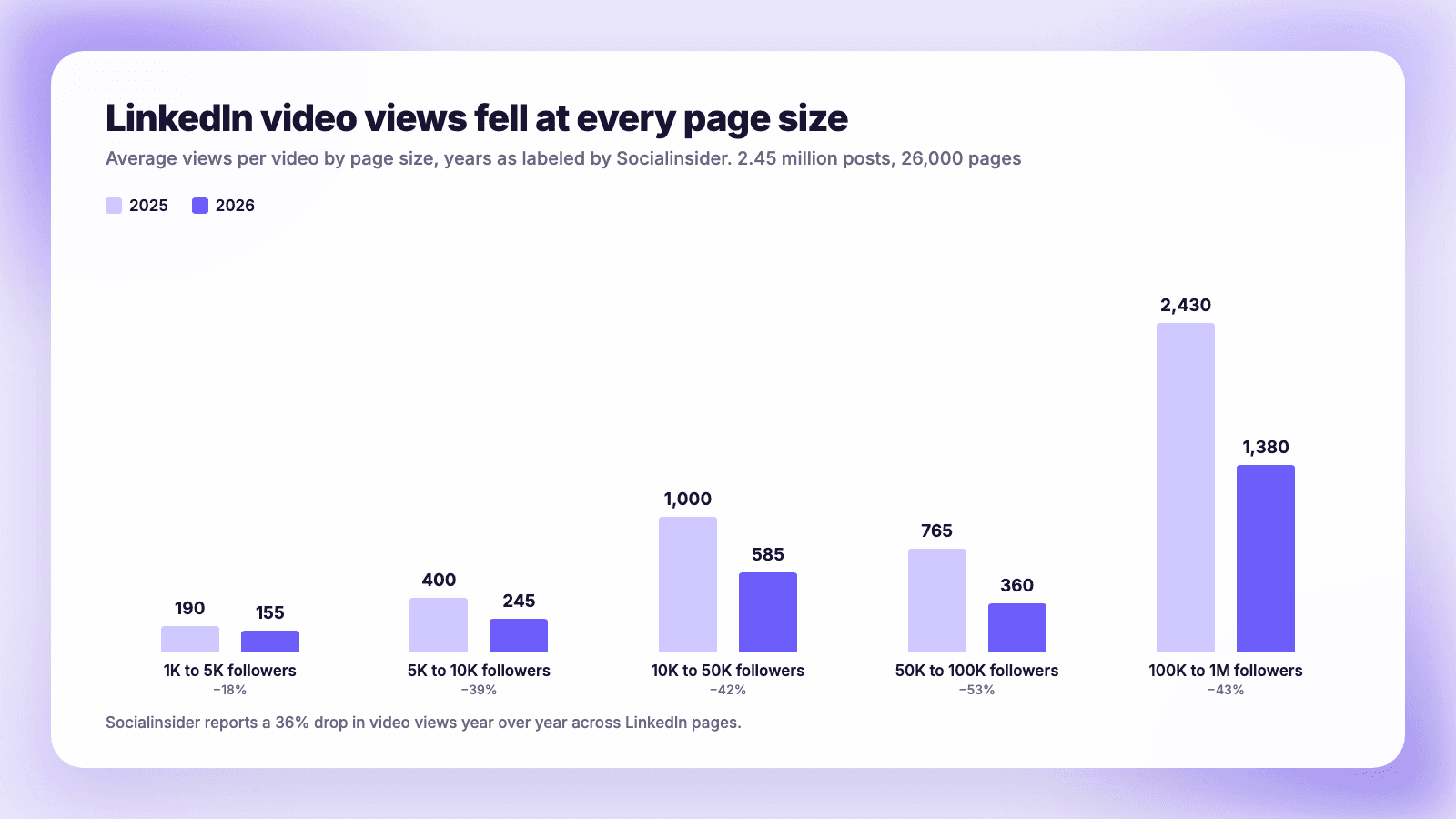
Socialinsider, which tracks 2.45 million posts from 26,000 company pages, found the same squeeze on brand pages: average video views fell 36% year over year at every page size, and follower growth slowed for every page size in 2025, from 21.6% to 6.4% for pages with 100K to 1M followers.
On Reddit the drops look like cliffs. u/rae0801, who manages a CEO's account, wrote in June that the account "got over 300k impressions" in three weeks, then "we're not even at 100K" for June. The best advice we found was u/charlesnobleseo's in a September r/AskMarketing thread: "A drop that is entirely non-follower reach means distribution changed. A drop across both usually means posting cadence or format changed and nobody logged it." Our guide to why your reach dropped walks through the rest.
Why it dropped: interest beats connections
LinkedIn now decides who sees your post largely by topic. Van der Blom's April post put it starkly: connections' share of a post's initial distribution fell from 70% in 2024 to 54% in 2025 to 10% in 2026, while the "interest graph" rose from 5% to 21% to 50%.
Treat those exact figures with care. LinkedIn has not published anything like them, and its own retrieval paper still describes content from members' connections as "the bulk of impressed items in the LinkedIn feed." The direction is not in dispute, though: a growing share of reach depends on whether a post's topic matches the reader, judged by AI reading the post and the profiles on both sides. Add the slop filter, which cuts generic posts beyond your network first, and ranked comments competing with posts for attention. LinkedIn's September Network tab test, a feed of only "the people you have explicitly connected or followed," suggests it knows the swing went far.
Which formats still work
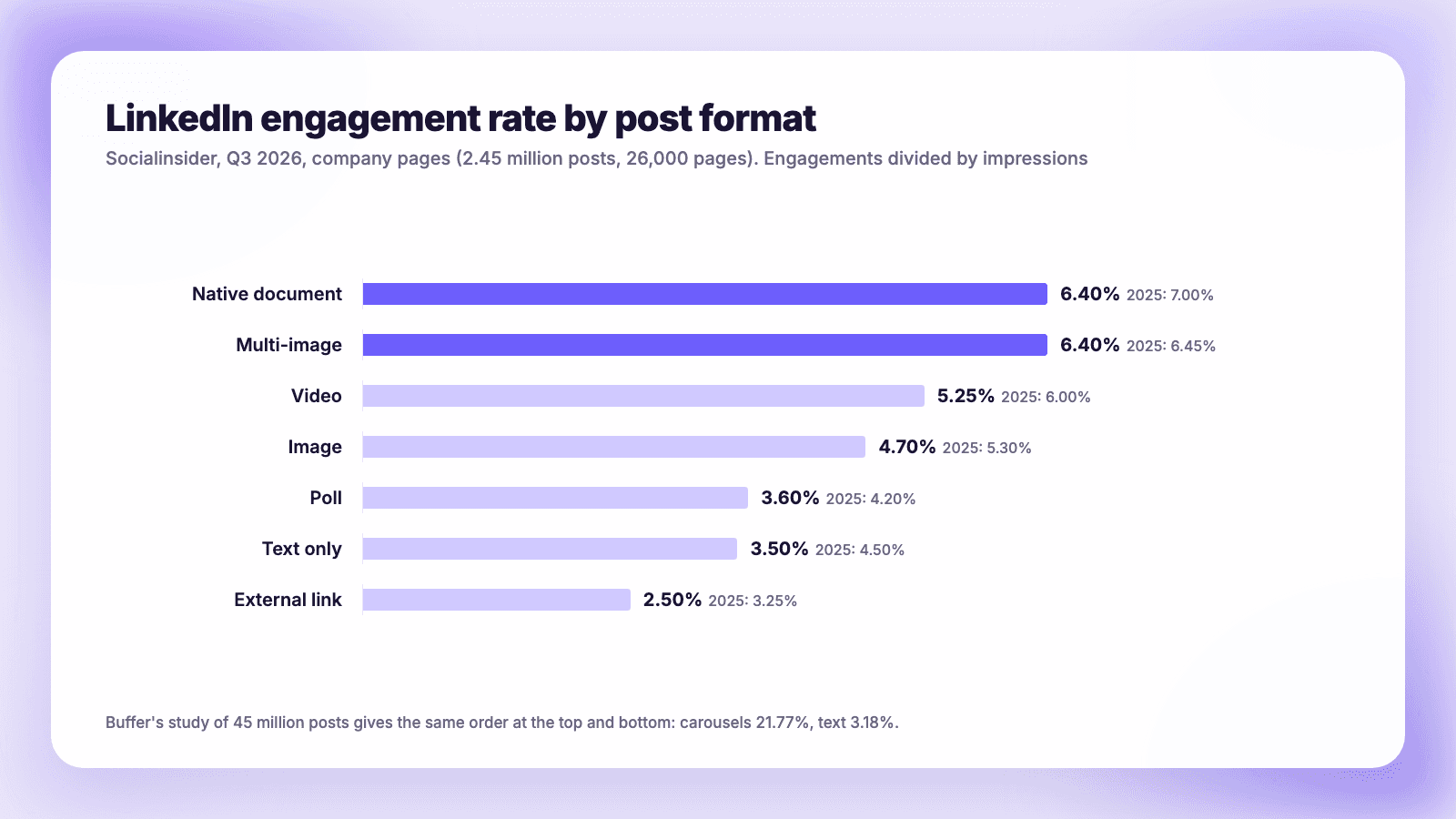
The two biggest format studies disagree on the numbers but agree on the order: document posts (PDF carousels) on top, text and links at the bottom. Socialinsider's data for company pages:
| Format | Engagement rate, Q3 2026 | Full-year 2025 |
|---|---|---|
| Native document | 6.40% | 7.00% |
| Multi-image | 6.40% | 6.45% |
| Video | 5.25% | 6.00% |
| Image | 4.70% | 5.30% |
| Poll | 3.60% | 4.20% |
| Text | 3.50% | 4.50% |
| Link | 2.50% | 3.25% |
Buffer's study of 45 million posts across platforms, using 2025 data from accounts that post through Buffer, measured a much higher median engagement rate for LinkedIn carousels, 21.77%, followed by video at 7.35%, images at 6.52%, links at 3.81% and text at 3.18%. Buffer counts clicks as engagement, which is one reason its numbers run higher. Our guide to engagement rates across platforms explains why these definitions vary.
- Documents are the safest bet for teaching. Swiping through slides is exactly the "long dwell" the ranking model lists.
- Video is the format LinkedIn talks up and the data is cooling on. LinkedIn's Callie Schweitzer told Buffer "Video, Video, Video, Video," yet Socialinsider measured views down 36%.
- Polls buy reach, not much else. Van der Blom's March 2026 preview rated polls up for reach and engagement but 1 out of 5 for saves. Chris Donnelly told Forbes they are "top for reach but very low for follower growth or conversion."
The myths with no LinkedIn source
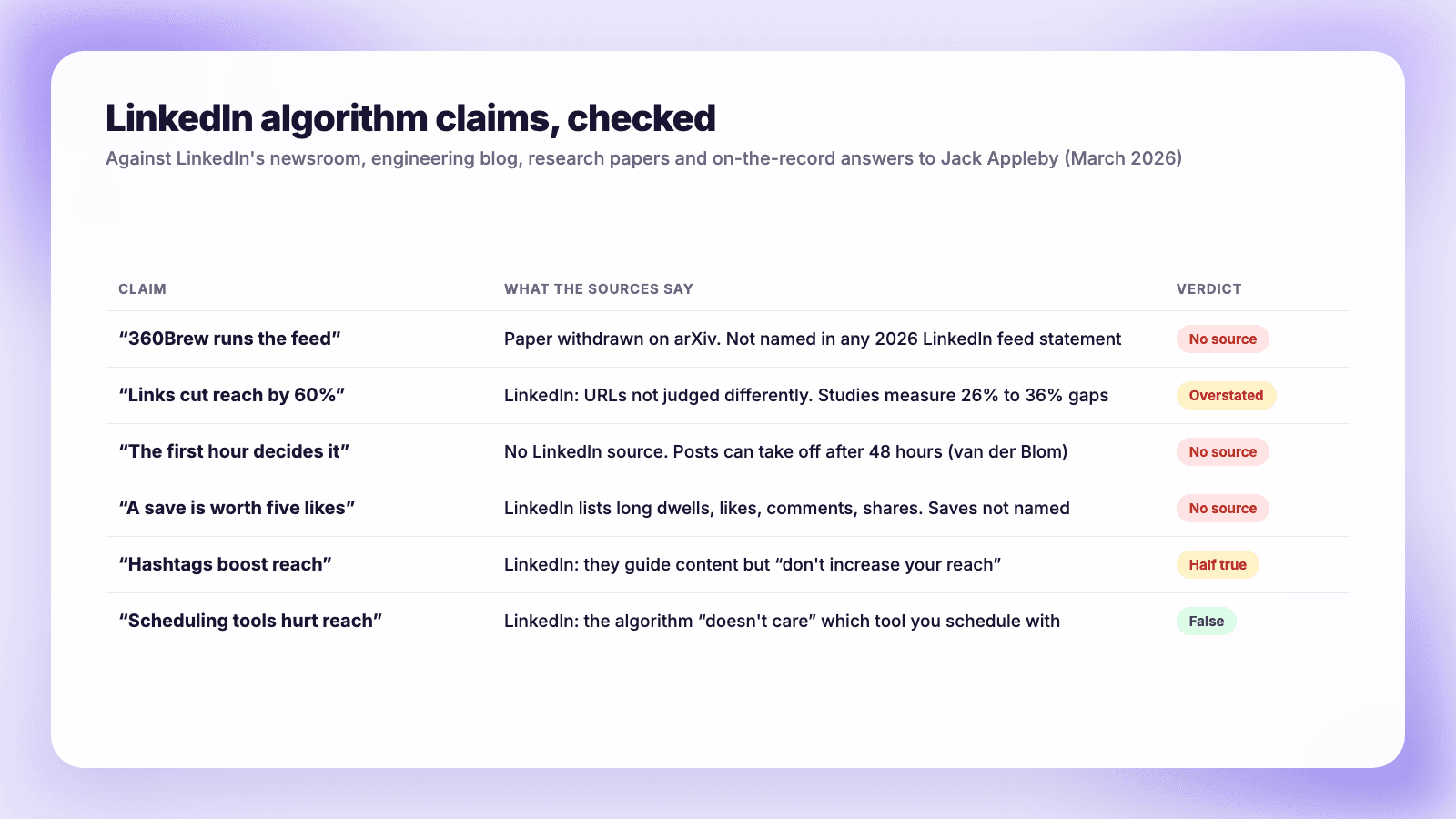
"360Brew runs your feed." 360Brew was a January 2025 LinkedIn research paper. All three versions are marked withdrawn on arXiv, and no 2026 LinkedIn statement about the live feed names it. The idea people attach to it (your profile and posts should match) is real, as Profile Relevance shows. The name is not.
"Links cut your reach by 60%." Forbes ran that figure in a July headline without a published method. In March, LinkedIn's communications and engineering teams told newsletter writer Jack Appleby on the record that the algorithm "does not judge content differently if your post does or does not have an outside URL." Measured gaps are smaller: Ordinal reports 26.5% and cites a LinkPost study of 358,000 posts with a median of 448 impressions for linked posts against 705. Readers who click away do not stay to react. Make the post work without the link.
"The first hour decides everything." LinkedIn has published no such window. Van der Blom's October list of rules that flipped says "Quality posts live 3.2x longer and can take off after 48 hours."
"A save is worth five likes." No LinkedIn source. LinkedIn's engineering blog lists long dwells, likes, comments and shares. Saves are not named.
"Hashtags are dead" or "hashtags boost reach." Neither. LinkedIn told Appleby hashtags guide content to the right audience but "don't increase your reach." LinkedIn's own list of things to avoid counts "adding irrelevant hashtags" as engagement bait.
"Scheduling tools hurt reach." LinkedIn also told Appleby the algorithm "doesn't care what tools you use to schedule your content." Automated commenting is what it bans.
What still works on LinkedIn in 2026
- Make your profile say what you post about. Profile Relevance reads headline, summary, skills and experience. If your headline says "Founder" and your posts are about B2B pricing, put pricing in the headline. After talking to LinkedIn's VP of trust, Jodie Cook summed it up as "LinkedIn is now matching the messenger to the message."
- Pick one or two subjects and stay there. Van der Blom's October list says "Stick to 2 topics max, or the algorithm has no idea where to send you."
- Write something only you could write. A number from your own work, a decision you made, a view someone could disagree with. That is the opposite of slop.
- Earn the first stranger's reaction. Profile Relevance waits for one like, comment or share from someone outside your network. A specific first line does more than "comment YES," which LinkedIn calls engagement bait.
- Teach with document posts, keep video short. Both large studies put documents first. Keep carousels tight: Forbes's January piece, drawing on Chris Donnelly's report on 300,000 posts, said abandoned carousels now count against you and advised eight to ten slides at most.
- Reply to every comment, and comment well on other people's posts. Buffer's 2026 engagement report found LinkedIn posts where the author replied got about 30% more engagement. Van der Blom goes further: "Over half of your impressions (!) now come from your comments."
- Post two to five times a week. Buffer's analysis of 2 million posts from 94,000 accounts compared each account with its own quieter weeks and found reach per post rose with frequency.
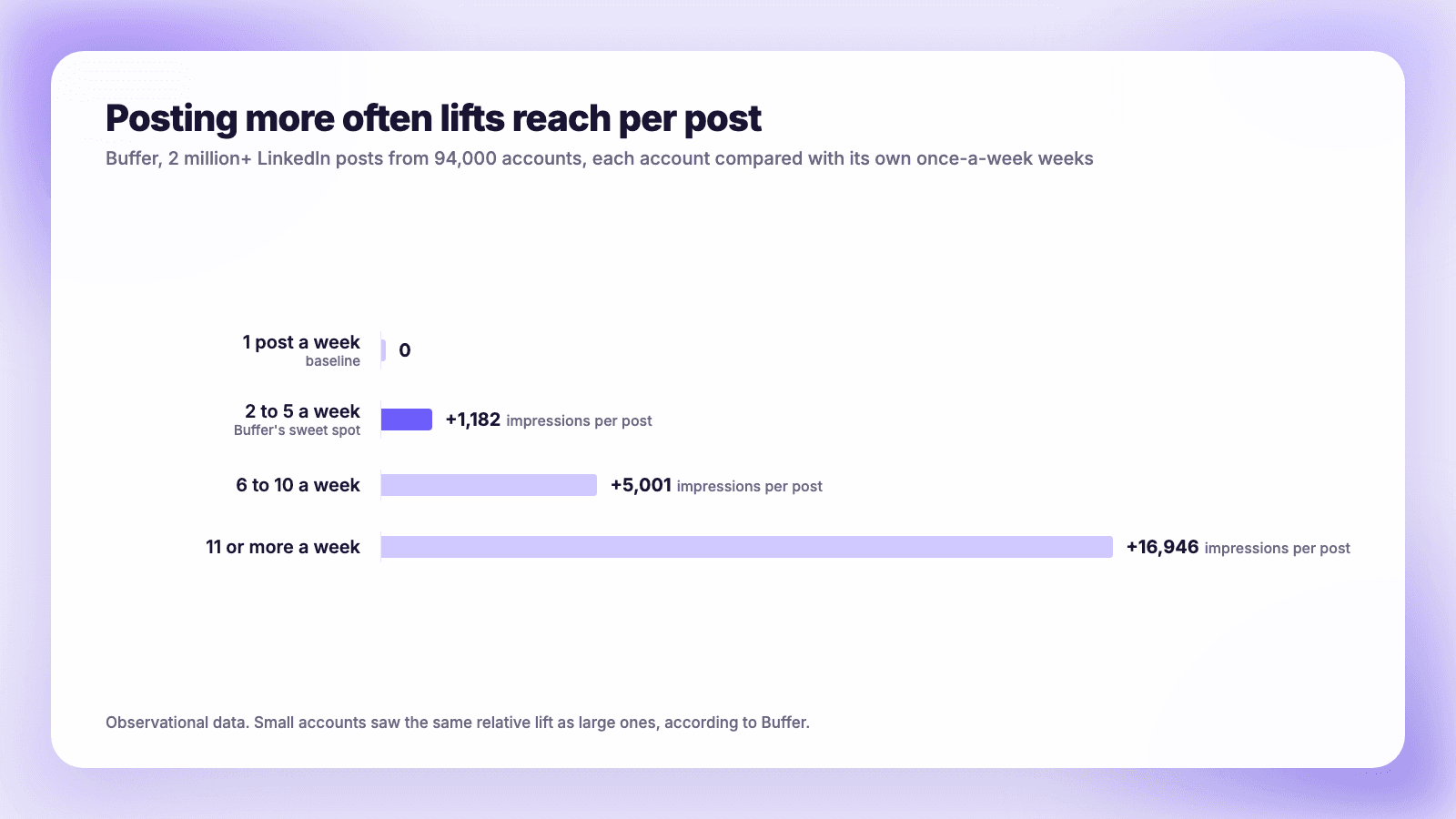
Buffer calls two to five a week the sweet spot: higher cadences are hard to sustain without quality slipping, and a weak post is exactly what the slop filter keeps from strangers.
That cadence is easier to hold when posts are prepared in one batch. Plumefy publishes to LinkedIn and ten other networks from one upload with a caption written for each, so the LinkedIn version can be longer and more specific than the Instagram one. Posting is free on the Free plan, scheduling is on paid plans, and LinkedIn has said scheduling tools do not affect reach. For a full plan built around these rules, see our LinkedIn content strategy for founders.
FAQ
Did the LinkedIn algorithm change in 2026?
Yes. LinkedIn rebuilt the feed in March 2026 around AI retrieval and a model that reads each member's history, added rules against generic AI content in May, ranked comments from July, and explained in November how it matches profiles to posts from outside your network.
Why did my LinkedIn reach drop?
Most likely because more of your reach is now decided by topic match with strangers rather than by your connections, and because generic posts lose out-of-network distribution. Check your post analytics for follower versus non-follower impressions before changing anything.
Does LinkedIn penalize posts with links?
LinkedIn says no: its teams told Jack Appleby the algorithm does not judge posts differently for containing a URL. Independent studies still measure a 26% to 36% reach gap for linked posts, probably because readers leave instead of reacting. The widely quoted 60% figure has no published method.
What is the best post format on LinkedIn in 2026?
Document posts (PDF carousels). They led on engagement in both Socialinsider's and Buffer's 2026 data. Links and plain text ranked lowest in both.
Do more followers still mean more reach on LinkedIn?
Less than they used to. In van der Blom's November data, followers grew 38.7% while reach fell. If your follower count is moving the wrong way, our guide on how to see who unfollowed you on LinkedIn shows how to track it.
Post everywhere, once.
Start on the free plan. No card needed; upgrade when you need scheduling.
Start free