TikTok vs Reels vs Shorts: Where Should You Post?
TikTok, Reels, or Shorts? Compare the three short-video surfaces side by side and see why the smart answer is usually to post to all three at once.
You made a great 40-second video. Now the question every creator asks: TikTok, Instagram Reels, or YouTube Shorts?
Here is the spoiler, because you deserve it up front: for most creators, the answer is all three. The same vertical video works on every surface, cross-posting costs minutes, and each platform reaches people the others do not. Picking one is usually just leaving reach on the table.
But "post everywhere" is not the whole answer. The three surfaces have different audiences, different discovery mechanics, and different long-term payoffs, and knowing the differences tells you where to focus your native effort, which platform to treat as home base, and how to adapt the edges. Let's compare them properly.
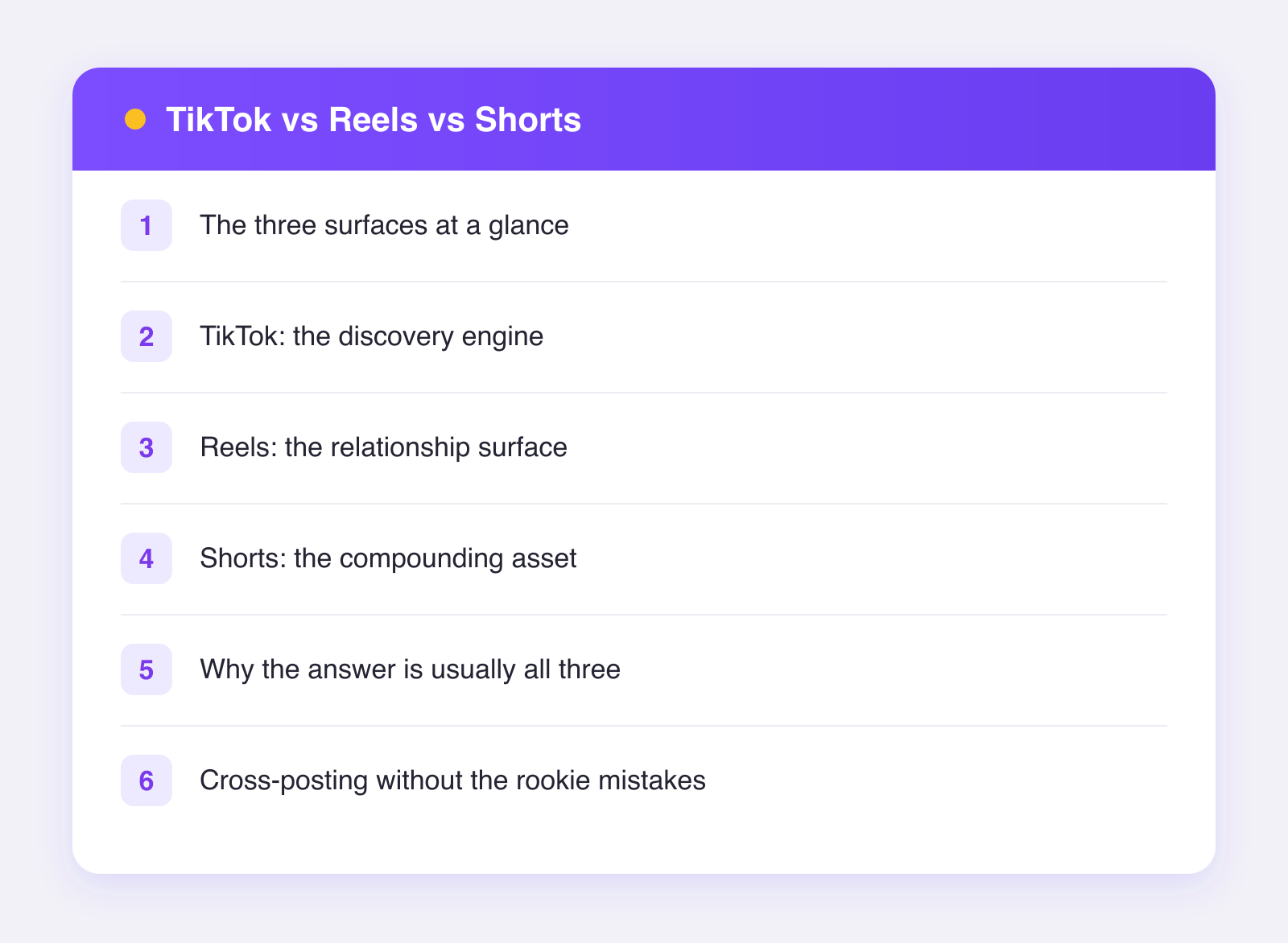
The three surfaces at a glance
Everything below is a rough sketch as of 2026; all three platforms tune their systems constantly.
| TikTok | Instagram Reels | YouTube Shorts | |
|---|---|---|---|
| Discovery | Strongest cold-start; the For You page gives new accounts real chances | Blends followers and discovery; warmer for existing IG audiences | Feed-driven, plus a unique bonus: YouTube search and channel subscribers |
| Audience skew | Younger overall, trend-driven, native and raw wins | Broad, slightly older than TikTok, polish tolerated | Broadest age range, watches longer, tolerates depth |
| Culture | Trends, sounds, fast cuts, in-jokes | Aesthetic, lifestyle, brand-friendly | Value-first: tutorials, explainers, highlights |
| Best for | Reaching strangers fast | Converting your existing followers and DMs | Building a durable channel with search traffic |
| Long-term asset | Weakest; content ages fast | Medium; feeds your IG profile | Strongest; Shorts feed a channel that compounds |
TikTok: the discovery engine
TikTok remains the best place for an unknown account to reach strangers. The For You page tests content on small audiences and scales what holds attention, so a brand-new creator with a genuinely engaging video can reach six figures of views with zero followers. No other surface matches that cold-start generosity, roughly speaking.
The trade-offs: content ages fastest here, trends move weekly, and the culture punishes anything that feels like an ad. If TikTok is your discovery engine, study the craft; our guide on how to go viral on TikTok covers hooks, pacing, and retention in detail.
Treat TikTok as home base if: you are new, your audience skews under 35, or raw and personality-driven is your natural register.
Reels: the relationship surface
Reels lives inside Instagram, which means it connects to everything else you do there: your grid, Stories, DMs, and the followers you already have. Reels discovery is real, but Instagram's superpower is the follow-up: someone finds you in Reels, checks your profile, watches your Stories, and DMs you. That path converts browsers into customers better than any other short-video surface.
The culture tolerates more polish than TikTok, and business accounts feel less out of place.
Treat Reels as home base if: Instagram is already where your customers are, you sell visually, or DMs are how your business actually closes.
Shorts: the compounding asset
Shorts are the sleeper pick. Individual Shorts often get less explosive reach than TikTok, but they feed a YouTube channel, and a channel is the most durable asset in the creator economy: subscribers, search traffic, and a natural bridge to long-form video that pays better in every way. A Short can keep collecting views for months through search and suggestions, long after the same video died on TikTok.
As of 2026, Shorts can run up to roughly three minutes, which suits tutorial and explainer content especially well.
Treat Shorts as home base if: your content teaches something, you want search traffic, or long-form YouTube is in your future.
Why the answer is usually all three
The math is hard to argue with. You already paid the expensive cost: making the video. Posting it to two more surfaces costs minutes and buys you:
- Non-overlapping audiences. Plenty of people live on one of these apps and rarely open the others.
- Three chances per video. The same clip regularly flops on one surface and takes off on another, for reasons nobody can fully predict. More surfaces, more lottery tickets.
- Platform insurance. Reach on any single app can change overnight. Three surfaces mean no single algorithm owns you.
Cross-posting without the rookie mistakes
Three rules keep cross-posted video from underperforming:
- Export clean, never watermarked. A TikTok logo on a Reel signals recycled content to viewers and, it is widely believed, to the algorithms. Always save the original file from your editor.
- Rewrite the caption per platform. TikTok captions are casual and short; Reels captions can carry hashtags and context; Shorts want a clear, searchable title. Our guide to tailoring posts per platform covers the details.
- Mind trend boundaries. A TikTok-specific sound or in-joke may land flat, or hit licensing walls, elsewhere. Videos built on your own voice and value travel best.
The workflow is where this either sticks or dies. Uploading one video into three apps, rewriting three captions on your phone, every posting day, is how creators quietly give up on two of the three surfaces. With Plumefy you upload the clean file once, adjust each caption side by side (or let AI captions on the Pro plan draft platform-tuned versions), and schedule all three, plus anywhere else you post, from one calendar with combined analytics to compare surfaces honestly. The free plan covers 2 accounts and 10 posts; try Plumefy free and run the experiment for a couple of weeks.

FAQ
Will platforms penalize me for posting the same video everywhere?
No, cross-posting itself is fine and extremely common. What appears to hurt is uploading files with another platform's watermark. Post clean exports and you are fine.
Which platform pays creators best for short video?
Monetization programs change frequently, so check current terms. Structurally, YouTube has the most established payout system, and Shorts can funnel viewers to long-form content where earnings are stronger.
Should the video be identical on all three?
The video, usually yes. The caption, title, and tags should be adapted per platform; that ten-minute difference is most of the performance gap between lazy and smart cross-posting.
Where should a total beginner start?
Make the video with TikTok-level energy (strong hook, fast pacing), then post it to all three from day one. You will learn in a month which surface likes you, and that one becomes home base.
Post everywhere, once.
Start on the free plan — no card needed, upgrade when you need scheduling.
Start free