Social Media SEO: How People Actually Search in 2026
People search social apps like search engines now. Learn how keywords in captions, on-screen text, and alt text help your posts get found for months, not hours.

Here is a quiet shift that changes how you should write every post: people now search social apps the way they used to search Google. "Best ramen near me" goes into TikTok. "How to negotiate salary" goes into YouTube. "Small apartment ideas" goes into Pinterest and Instagram.
That means your posts have two possible lives. The short life: a day or two in the feed, then silence. The long life: months of steady discovery every time someone searches your topic. Feed reach is a lottery ticket. Search reach is a savings account.
The good news is that social SEO is not a dark art. It mostly means saying what your content is about, in the words a searcher would use, in the places the platform reads. Let me show you exactly where those places are.
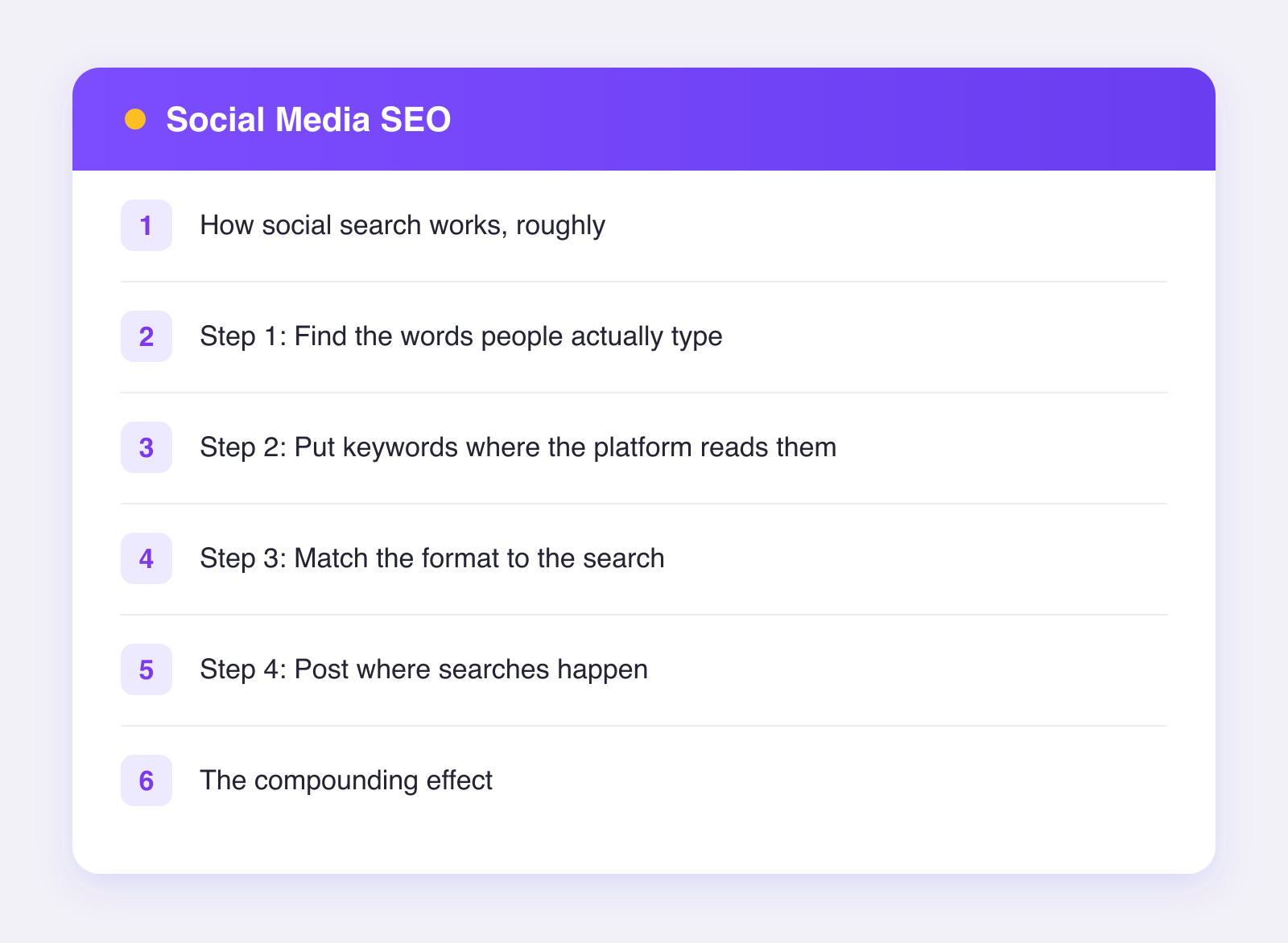
How social search works, roughly
As of 2026, the platforms do not publish their ranking recipes, but the observable pattern is consistent: they read the text attached to your post to understand its topic, then match it against searches. That text includes more than the caption:
- The caption or description
- On-screen text in your video
- What you actually say out loud (platforms transcribe speech)
- Hashtags and keywords fields
- Your username and bio
- Alt text on images
Engagement still decides how high you rank; a post nobody watches will not top a search. But relevance decides whether you are in the running at all. That part is fully in your control.
Step 1: Find the words people actually type
Before writing, spend two minutes finding the real phrasing. Type your topic into the search bar of TikTok, YouTube, or Pinterest and look at the autocomplete suggestions. Those are actual searches, ranked roughly by popularity. "Protein breakfast ideas" might autocomplete while your clever phrase "morning fuel hacks" returns nothing.
Use the boring phrase. Searchers use boring phrases. Save your creativity for the content itself.
Step 2: Put keywords where the platform reads them
Captions and descriptions
Work your phrase into the first sentence, naturally: "Three protein breakfast ideas you can make in five minutes." Do not keyword-stuff; one clear statement of topic beats the same phrase repeated four times, and stuffing reads as spam to humans and machines alike. Caption norms differ per platform, so pair this with our caption length guide thinking: same keyword, different dressing per app.
Say it out loud
Video platforms transcribe your audio. Saying "here are three protein breakfast ideas" in your first line does double duty: it hooks the viewer and tells the platform the topic. This is one more reason talking videos outperform silent trends in search.
On-screen text
Platforms read the text you overlay on video. A title card in your first seconds, "5-minute protein breakfasts," helps both the sound-off viewer and the search index.
Alt text
Instagram and Pinterest let you write alt text for images. It exists for accessibility first, so write a real description of the image for people using screen readers. Done honestly, it naturally contains your keywords: "overnight oats in a glass jar topped with peanut butter." Accessibility and SEO point the same direction here.
Hashtags, demoted but not dead
Hashtags matter less than they used to now that platforms understand plain language. Treat them as a light topical garnish: a few specific ones, not thirty. #proteinbreakfast helps; #foodie #yum #love does nothing.
Step 3: Match the format to the search
Search traffic rewards content that answers a question or serves an intent. Formats that get found:
- How-tos and tutorials for "how to" searches
- Lists and roundups for "ideas" and "best" searches
- Comparisons for "X vs Y" searches
- Local content for "near me" style searches, which also makes Google Business posts worth your time if you have a physical location
A vague vlog is hard to find. "How to clean white sneakers" is findable forever. You do not have to abandon personality content; just make sure a slice of your output is deliberately searchable.
Step 4: Post where searches happen
Different search intents live on different platforms. Recipes and aesthetics live on Pinterest. Tutorials live on YouTube. Local and product discovery live on TikTok and Instagram. Professional questions live on LinkedIn. This is a strong argument for publishing the same core content across platforms: you are not chasing feeds, you are placing an answer everywhere the question gets asked.
That is exactly the workflow Plumefy is built for. Write the post once, adjust the keyword phrasing per platform in one screen, and schedule it to all 11 networks, Pinterest and Google Business included. Then watch which platforms keep sending views weeks later in Plumefy's combined analytics, because search-driven posts show a telltale long tail instead of a one-day spike. If you want help deciding which numbers to watch, see social media metrics that matter.
The compounding effect
Here is why this is worth the small extra effort. Feed posts decay in days. Search posts compound: each findable post is another door into your account, permanently. Creators who write searchable titles for a year often find that old posts quietly outperform new ones. That back catalog becomes an audience machine that runs while you sleep.
FAQ
Does social SEO replace regular Google SEO?
No, it complements it. Google also surfaces social posts and videos in its results, so a well-labeled TikTok or YouTube video can rank in Google too. Same practice, extra reach.
How long until search traffic shows up?
Slower than feed reach, steadier after. Give a searchable post a few weeks, then check whether views keep trickling in. That trickle is the signal it is ranking somewhere.
Should every post be keyword-optimized?
No. Personality posts, replies, and experiments keep an account human. Aim for a healthy slice of deliberately searchable content, not a feed that reads like a phone book.
Do keywords in comments help?
There is no solid evidence for stuffing comments as of 2026, and it looks odd. Put your effort into captions, speech, and on-screen text, where the platforms clearly look.
Say what your content is about, in the searcher's words, everywhere the platform reads. Then put it on every platform where the question gets asked. Try Plumefy free and make one answer findable in eleven places.
Post everywhere, once.
Start on the free plan — no card needed, upgrade when you need scheduling.
Start free