Do Social Platforms Penalize AI Content? An Honest Look
Do social platforms penalize AI-generated content? An honest look at labeling rules, quality signals, and why what you publish matters more than the tool.
It is one of the most common worries we hear: "If I use AI to help write my posts, will the algorithm bury me?" It is a fair question. Nobody wants to invest in content that gets quietly punished.
Here is the short, honest answer: platforms reward and punish outcomes, not tools. What gets buried is content people scroll past. What gets boosted is content people watch, save, share, and reply to. The algorithm measures behavior, and it has no reliable way to know whether a human or a model typed your caption.
That said, there are real rules around AI content worth understanding, especially labeling. Let us walk through what is actually going on.
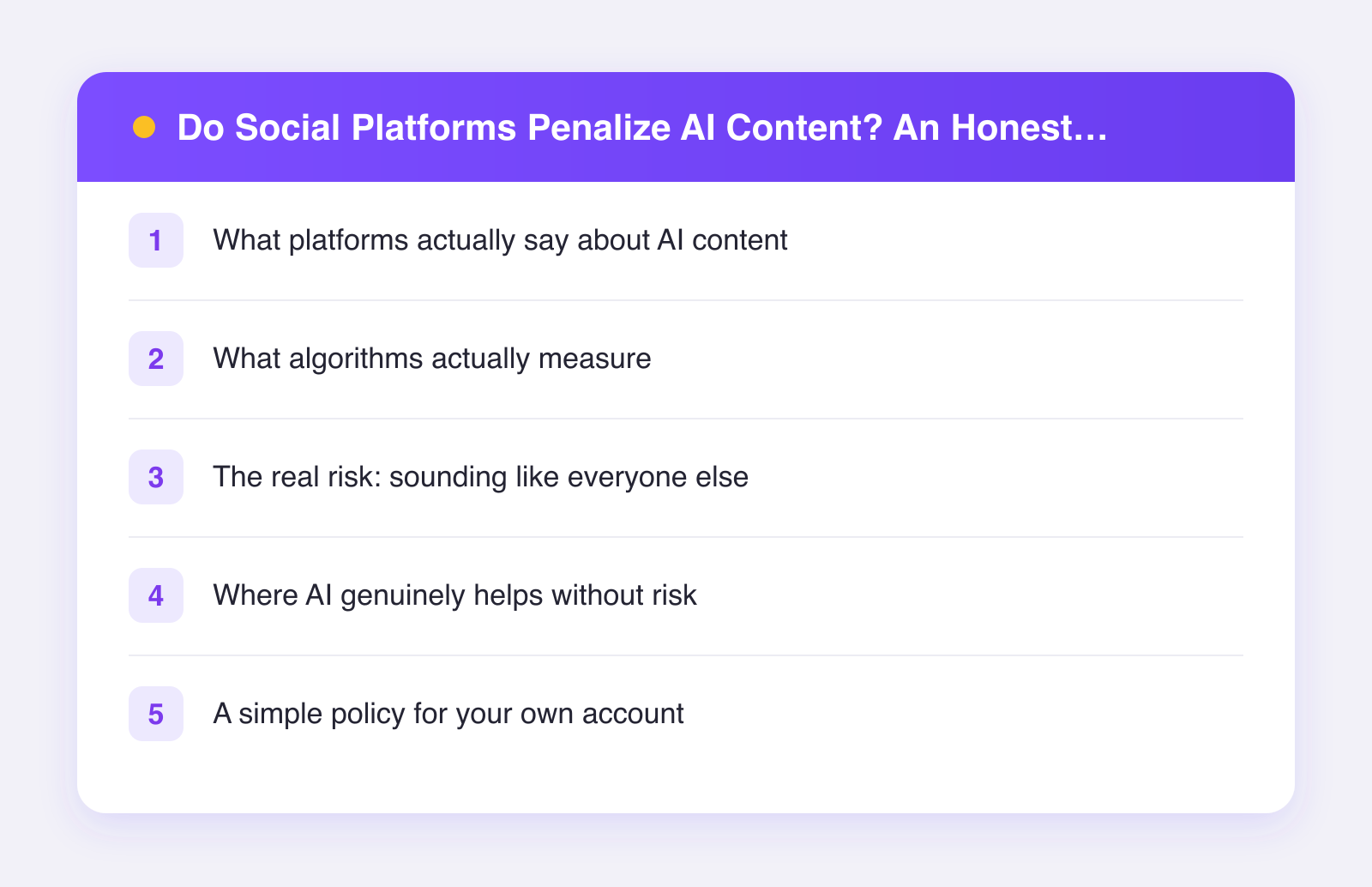
What platforms actually say about AI content
As of 2026, platform policies generally focus on two things: disclosure and deception, not on the mere use of AI.
- Disclosure: several major platforms ask creators to label realistic AI-generated or heavily AI-altered media, especially video and images that could be mistaken for real events or real people. Some apply labels automatically when they detect synthetic media.
- Deception: every platform prohibits using AI to mislead: fake endorsements, impersonation, manipulated footage of real people, coordinated fake engagement.
Notice what is missing from that list: "captions written with AI assistance." We are not aware of any major platform that penalizes ordinary text content simply because a model helped draft it. Policies change and wording varies by platform, so check the current rules for your networks rather than trusting any blog post, including this one. But the broad pattern has been consistent: platforms care about realistic synthetic media and deception, not about writing assistance.
When in doubt, label
If you post a realistic AI-generated video or image, use the platform's disclosure toggle where one exists. Labeling honest content costs you almost nothing. Failing to label content that later gets flagged can cost you reach or worse.
What algorithms actually measure
Recommendation systems do not grade your process. They grade your results, using signals like:
- Watch time and completion on video
- Saves and shares, which signal lasting value
- Comments and replies, especially early ones
- Click-throughs and profile visits
- Negative signals like "not interested" taps, hides, and instant scroll-aways
Here is the uncomfortable part: lazy AI content performs badly on every one of those signals. Not because a detector flagged it, but because it is boring. Generic captions get scrolled past. Scrolled-past posts get shown to fewer people. The "AI penalty" people describe is usually a quality penalty wearing a costume.
The real risk: sounding like everyone else
AI models trained on the same internet produce similar output. When thousands of accounts prompt "write an engaging post about productivity," the results converge. Audiences develop pattern blindness fast. They may not consciously think "this is AI," but they feel the sameness and keep scrolling.
So the practical question is not "will platforms penalize my AI content?" It is "will my audience ignore it?" The fixes are the same either way:
- Start from a specific idea, not a topic. "Productivity tips" is a topic. "The 20 minutes I waste every morning and how I got them back" is an idea.
- Feed the AI your voice. Examples, banned phrases, real details. Our guide on keeping your brand voice with AI walks through the setup.
- Edit every draft. Add one detail only you know. Cut every sentence you would not say out loud.
- Fit the post to the platform. A caption that ignores platform norms reads as spam regardless of who wrote it. See how to tailor posts per platform.
Where AI genuinely helps without risk
Used as an assistant rather than a replacement, AI touches none of the danger zones:
- Drafting captions you then edit. This is standard practice now, and it is invisible in the final product when done well.
- Adapting one message to many networks. Reformatting is transformation, not generation from nothing, and it is where AI is most reliable. In Plumefy, for example, you describe your post and the AI drafts a caption fitted to each network's tone and length, and you edit before anything publishes. The human review step is built into the flow. You can try Plumefy free to see how that feels in practice.
- Ideation and outlining. Nothing the audience sees comes straight from the model.
A simple policy for your own account
If you want a rule you can actually follow, try this three-line policy:
- AI may draft; a human always approves.
- Realistic synthetic media always gets labeled with the platform's tools.
- Nothing goes out that we would be embarrassed to admit was AI-assisted.
That covers the platform rules, protects your audience's trust, and keeps quality as the deciding factor, which is exactly where the algorithms have placed it.
FAQ
Can platforms detect AI-written captions?
Text detection is unreliable, and platforms have not built their ranking around it as far as public information shows. Behavior signals like watch time and saves are far more reliable, so that is what ranking systems lean on.
Do I have to label a caption that AI helped me write?
As of 2026, disclosure requirements generally target realistic synthetic media such as AI-generated video, audio, and images, not text assistance. Check your platform's current policy, since rules evolve, but ordinary AI-assisted writing has not required labels on the major networks.
Why did my reach drop after I started using AI captions?
Correlation is worth investigating, but the likely cause is quality or consistency, not detection. Compare your AI-assisted posts honestly against your best manual ones. If they are more generic, edit harder or change your prompts. Also check whether your posting time, format mix, or frequency changed at the same moment.
Is AI-generated video treated differently from text?
Generally yes. Realistic synthetic video and audio face the strictest disclosure expectations because the potential for deception is highest. Use platform labels for that content every time.
Post everywhere, once.
Start on the free plan — no card needed, upgrade when you need scheduling.
Start free