Why Your Reach Dropped (and How to Get It Back)
Reach dropped and you don't know why? Walk through a diagnosis checklist — format shifts, cadence breaks, topic drift, platform dips — then test your way back.
You open your analytics and the line points the wrong way. Last month your posts reached thousands of people. This month, a fraction of that. Nothing obvious changed, and the silence feels personal.
First: reach dips happen to every account, on every platform, at every size. They are not proof the algorithm hates you, and they are almost never permanent. But they do have causes, and most of those causes are findable.
This is a diagnosis checklist. Work through it in order, rule things out one at a time, and you will usually land on a fixable answer instead of a vague dread.
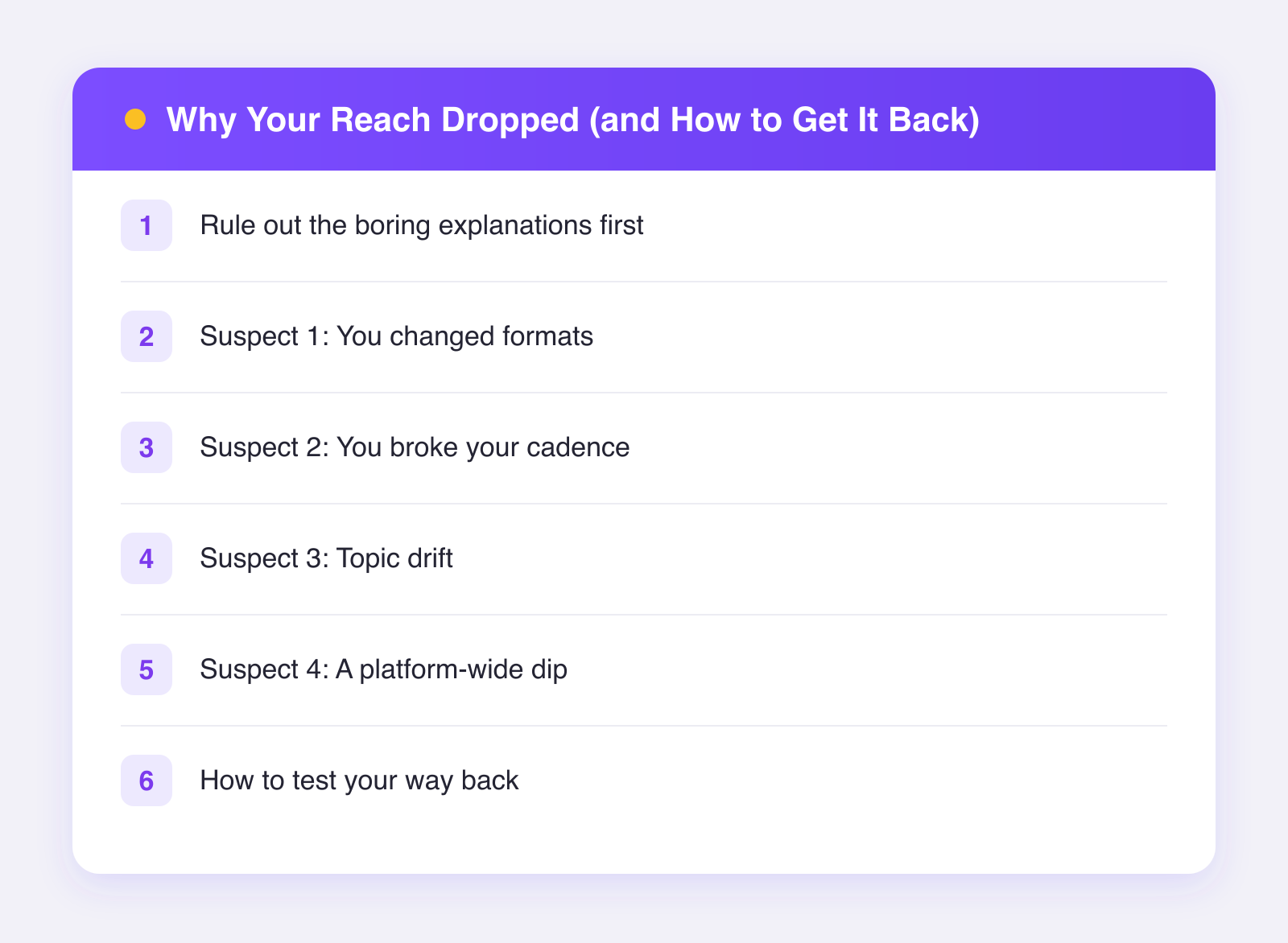
Rule out the boring explanations first
Before you rethink your whole strategy, check the mundane stuff:
- Did you post less? Fewer posts means fewer chances to be seen. Count your posts this month versus last month before you blame anything else.
- Are you comparing against a spike? If one post went semi-viral last month, this month's "drop" may just be a return to your real baseline. Compare against your median month, not your best one.
- Did the calendar shift? Holidays, summer weekends, and big news events all pull attention away. A dip that lines up with one of these usually fixes itself.
If none of those explain it, move on to the four real suspects.
Suspect 1: You changed formats
Platforms push whatever format they are currently invested in, and they reward accounts that use it. If you quietly drifted from video to static images, or from carousels to single photos, your reach can sag even though your ideas are as good as ever.
Look at your last 20 posts and sort them by format. If the high-reach posts cluster around one format and you have been posting less of it, you found your answer. This is also why it pays to tailor posts per platform instead of pushing one identical format everywhere.
Suspect 2: You broke your cadence
Consistency is not magic, but gaps are costly. When you disappear for two weeks, two things happen: platforms have fewer fresh signals about who wants your content, and your audience gets out of the habit of engaging with you. Both suppress early engagement on your comeback posts, and early engagement is what earns wider distribution.
The fix is not to panic-post daily. It is to pick a sustainable rhythm and hold it. Our guide on how often to post on social media covers how to find a cadence you can keep through a busy month, which is the only cadence that counts.
Suspect 3: Topic drift
Your audience followed you for something specific. If your content slid toward adjacent topics — cooking to lifestyle, coding to career advice — the people who see your posts first stop engaging, and platforms read that as "this content is not landing" and show it to fewer people.
Check for this by listing the topic of each of your last 20 posts next to its reach. Drift shows up fast when you see it written down. You do not have to abandon the new topic, but you may need to reintroduce it more deliberately, or accept a slower rebuild while your audience composition shifts.
Suspect 4: A platform-wide dip
Sometimes it genuinely is not you. Platforms adjust distribution constantly, and entire categories of accounts feel it at once. Signs point this way when:
- Creators in your niche are reporting the same slump at the same time
- Your engagement rate per viewer is steady even though total reach fell
- The dip hit all your content types equally, all at once
This is where posting on more than one network saves you. A single-platform account eats the whole dip; a multi-platform one barely notices. If everything you make lives on one app, that dip is an argument to grow on multiple platforms. Plumefy makes the mechanics painless — write once, then cross-post and schedule to up to 11 networks — so a rough month on one platform stops being a rough month everywhere. The free plan covers two accounts if you want to test the water — try Plumefy free.
How to test your way back
Once you have a prime suspect, do not change five things at once. You will never know what worked. Instead:
- Pick one hypothesis. "My reach fell because I stopped posting video."
- Change only that. Return to the old format for ten posts, keep topics and timing steady.
- Give it two to three weeks. Recovery is rarely instant. Platforms need a run of well-received posts before they widen distribution again.
- Compare medians, not peaks. Judge the test on the middle post, not the best one.
- Then test the next suspect if the first change did nothing.
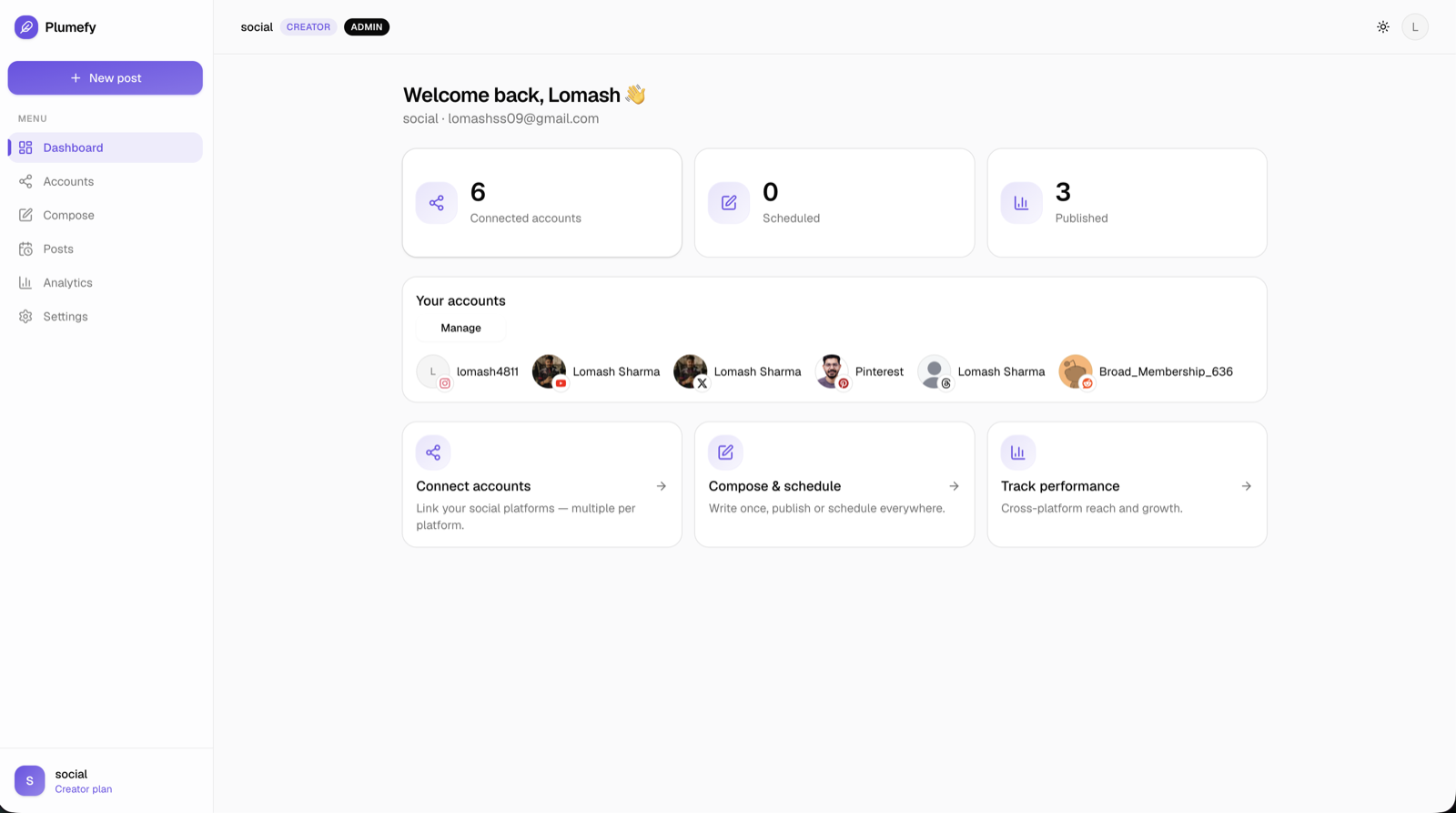
A side-by-side view helps here. Plumefy's combined analytics shows reach and engagement per account across every platform in one dashboard, which makes "is it just Instagram or is it everything?" a ten-second question instead of a tab-hopping chore.
What not to do
- Do not delete the low-reach posts. They are data, and deleting them does not reset anything.
- Do not spam-post to compensate. Volume without quality teaches the platform your posts are skippable.
- Do not buy engagement. Fake engagement produces exactly the wrong signal and can get you penalized.
- Do not rebrand in a panic. A reach dip is a maintenance problem, not an identity crisis.
FAQ
How long do reach dips usually last?
If the cause is on your side — cadence, format, topic — reach usually starts recovering within a few weeks of fixing it. Platform-wide dips resolve on their own timeline, which is another reason not to build on one platform alone.
Could I have been shadowbanned?
True penalties are rarer than the internet suggests, and they usually follow clear rule-breaking like banned hashtags or spammy automation. Before assuming a penalty, work through the checklist above. Boring causes explain most dips.
Should I just post at better times?
Timing is a real but secondary factor. It can sharpen a healthy account's results, and our best time to post guide shows how to find your windows. But timing rarely explains a large sustained drop on its own.
My reach is down but engagement rate is up. Is that bad?
Honestly, it is often fine. It usually means fewer, more interested people saw your posts. Keep engagement quality high and reach tends to follow it back up.
Post everywhere, once.
Start on the free plan — no card needed, upgrade when you need scheduling.
Start free