Hootsuite Pricing in 2026, Explained: What You Actually Pay and When to Leave
Hootsuite pricing in 2026: about $199 per user per month on Standard, $399 on Advanced, no free plan. The per-seat math, who should stay, and where to go.

Hootsuite's pricing page has changed more in the last two years than in the previous ten, and most of the articles ranking for "Hootsuite pricing" still quote numbers from before the change. If you searched because your renewal email looked wrong, or because a teammate asked why the social tool costs more than the CRM, this is the current picture, with the per-seat math written out and an honest answer to the question people actually have: is it time to leave?
The short version for 2026: At the time of writing, Hootsuite's Standard plan is about $199 per user per month on annual billing, Advanced is about $399 per user per month, and Enterprise is quoted. There is no free plan, only a 30-day trial. The number that catches teams out is "per user": a three-person team on Standard pays about $597 a month before add-ons. Older guides still list $99 or $149, which were real prices once and are not any more. Hootsuite remains a strong choice for large teams that use its approval workflows, social listening and enterprise reporting. For everyone else, the same scheduling costs a fraction elsewhere, and this guide shows the alternatives by the reason you are leaving.
Hootsuite's plans in 2026
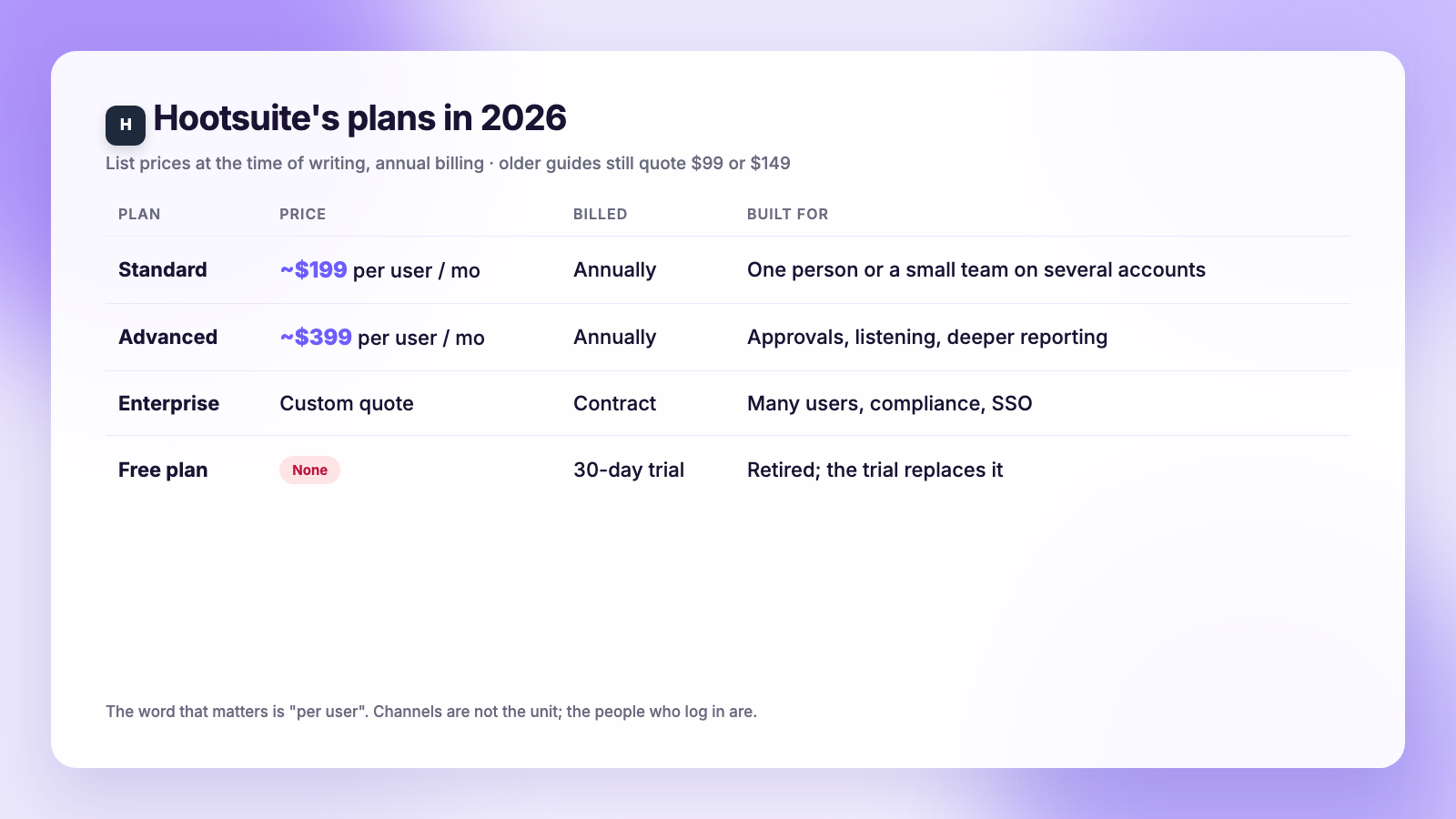
Here is the lineup as of November 2026. Check Hootsuite's pricing page before you buy, because the company has repriced more than once since 2024 and regional prices differ.
| Plan | Price at the time of writing | Who it is built for |
|---|---|---|
| Standard | about $199 per user per month, billed annually | One person or a small team running several accounts |
| Advanced | about $399 per user per month, billed annually | Teams that need approvals, listening and deeper reports |
| Enterprise | custom quote | Large organisations with many users and compliance needs |
| Free plan | none | A 30-day trial replaces it |
The plans used to be called Professional, Team, Business and Enterprise, and some comparison sites still list those names with their old prices. If a page tells you Hootsuite starts at $99 a month, it is describing the old Professional plan, which no longer exists at that price.
Why "per user" is the number that matters
Most scheduling tools charge for channels, which are the social accounts you connect. Hootsuite charges for users, which are the people who log in. The two models feel similar on a one-person account and diverge fast after that.
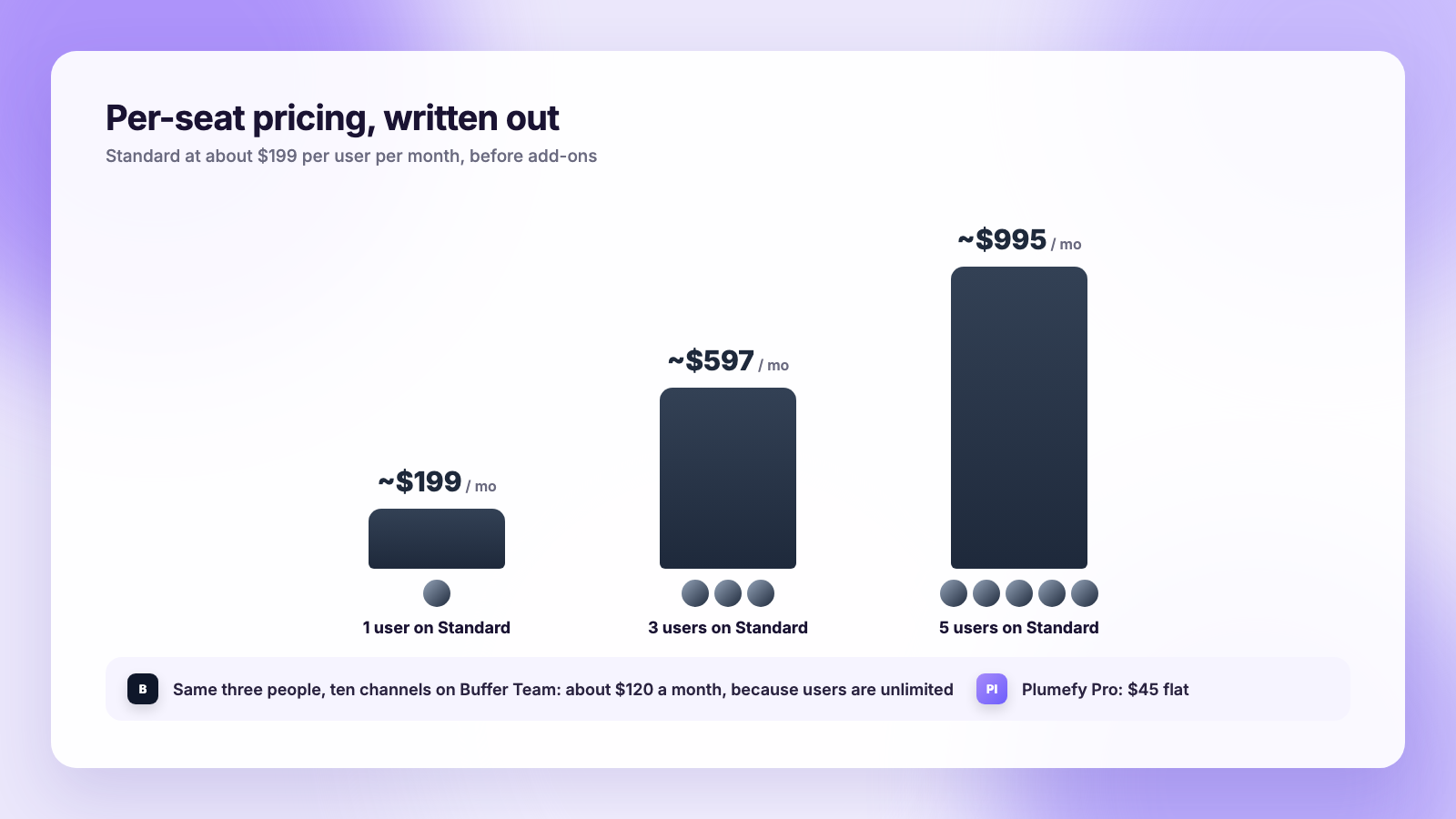
Take a small agency with three people who all need to post:
- One user on Standard: about $199 a month
- Three users on Standard: about $597 a month
- Three users on Advanced: about $1,197 a month
That is before any add-on, and it is annual billing, so the commitment is about $7,164 a year for the three-person Standard setup. A tool priced per channel would charge the same whether one person or three people log in. Buffer's Team plan, for example, includes unlimited users and charges about $12 per channel per month at the time of writing, so ten channels run by three people cost about $120 a month. The difference over a year is close to $5,700.
None of this makes Hootsuite a bad product. It makes it a product priced for a specific customer, and the first job is to decide whether that customer is you.
Why people say they are leaving
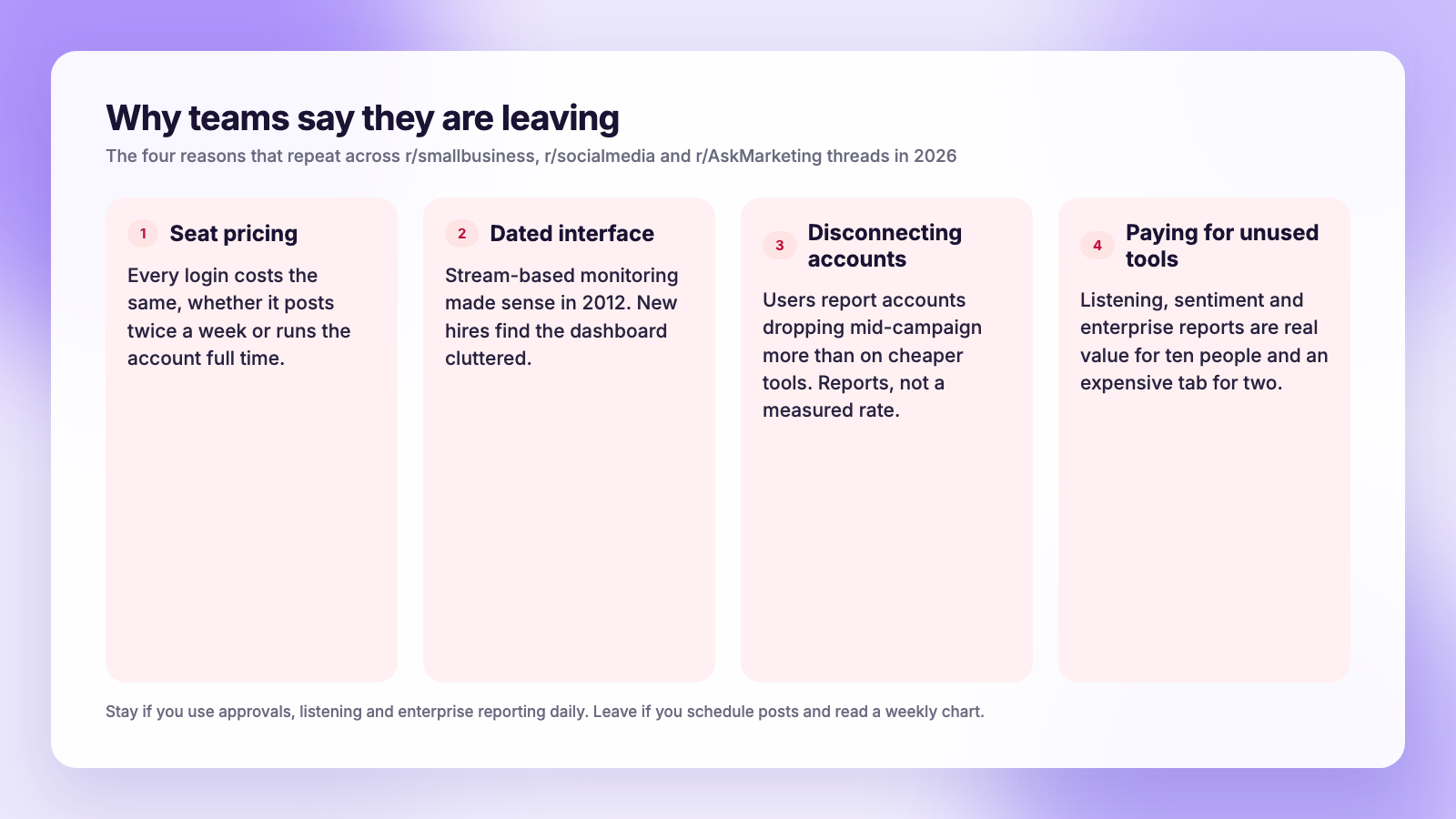
Reddit threads in r/smallbusiness, r/socialmedia and r/AskMarketing in April 2026 filled up with the same question in different words: what are you using instead of Hootsuite? The reasons repeat.
- Seat pricing. The common line was that you pay for seats, approvals and reporting whether you use them heavily or not. Adding a part-time contractor who posts twice a week costs the same as adding a full-time manager.
- A dated interface. Stream-based monitoring was a clever idea in 2012. In 2026 several people described the dashboard as cluttered and slow to learn for new hires.
- Accounts that disconnect. Social networks expire tokens, and every tool has to reconnect them. The complaint was that Hootsuite seemed to drop accounts mid-campaign more than the cheaper tools did. Treat that as user reports, not a measured failure rate.
- Paying for features that sit unused. Listening, sentiment analysis and enterprise reporting are real value for a brand team of ten. For a two-person marketing team they are an expensive tab nobody opens.
There was also a non-price reason in spring 2026. An r/socialmedia thread in April reported that Hootsuite was working with U.S. Immigration and Customs Enforcement and that the company's leadership had said the contract would stand. Several agency owners in that thread said they were switching for that reason alone. We are noting it because it came up repeatedly in the research for this article, not to tell you what to think about it; if it matters to you, verify the current status directly rather than relying on a months-old thread.
Who should stay on Hootsuite
Leaving is not always the right call. Hootsuite earns its price when you use the parts that competitors do not have.
- Approval workflows across departments. If legal or compliance has to sign off on posts, Hootsuite's approval chains are mature and auditable.
- Social listening. Monitoring brand mentions, competitor campaigns and sentiment across networks is a different product from scheduling, and Hootsuite bundles a credible one on Advanced.
- Enterprise reporting. Custom reports, role-based access and SSO matter at a certain size, and procurement teams know Hootsuite.
- A big team on one contract. If ten or more people need to log in and the budget already exists, the per-seat model is at least predictable.
If you recognise your organisation in that list, the better question is whether you are on the right tier, not whether to leave. Many teams sit on Advanced for one feature they could live without.
Who should go, and where
If you are a creator, a freelancer, a small business or an agency with a handful of clients, you are paying enterprise rates for scheduling and a calendar. Here is where people go, matched to the reason they left.
| Your reason | Try | What changes |
|---|---|---|
| Seat pricing | Buffer Team (about $12 per channel per month, unlimited users) | You pay for accounts, never for people |
| Budget, solo operator | Publer (free for 3 accounts, Professional from about $5 per account per month) | Lowest entry price, widest network list |
| You mostly wanted the reports | Metricool (free tier with analytics, Advanced from about $53 per month annual) | Reporting and competitor tracking come first |
| You want one flat bill | Plumefy (Free; Creator $26 per month; Pro $45 per month) | Fixed price for up to 15 or unlimited accounts, captions written per network |
We compared the three mid-market tools head to head in Buffer vs Publer vs Metricool, and our Hootsuite alternative for small teams page covers the feature-level trade-offs. If you are choosing between the full suites rather than leaving them, Plumefy vs Hootsuite lays the two out side by side.
A worked cost comparison
Here is the monthly bill for three common setups, using list prices at the time of writing. Hootsuite figures are annual billing. Buffer figures use the Team plan so that multiple people can log in. Plumefy figures use the plan that fits the seats and accounts.
| Setup | Hootsuite Standard | Buffer Team | Plumefy |
|---|---|---|---|
| Solo, 8 accounts | about $199 | about $96 | $26 (Creator, up to 15 accounts) |
| 3 people, 10 accounts | about $597 | about $120 | $45 (Pro, up to 20 seats) |
| Agency, 5 people, 25 accounts | about $995 | about $300 | $45 (Pro) |
Hootsuite's Standard plan also limits how many social accounts each user can connect, so the agency row may need Advanced in practice, which doubles the first column. Publer and Metricool are left out of the table because their totals depend on which add-ons you pick; their entry points are in the table above.
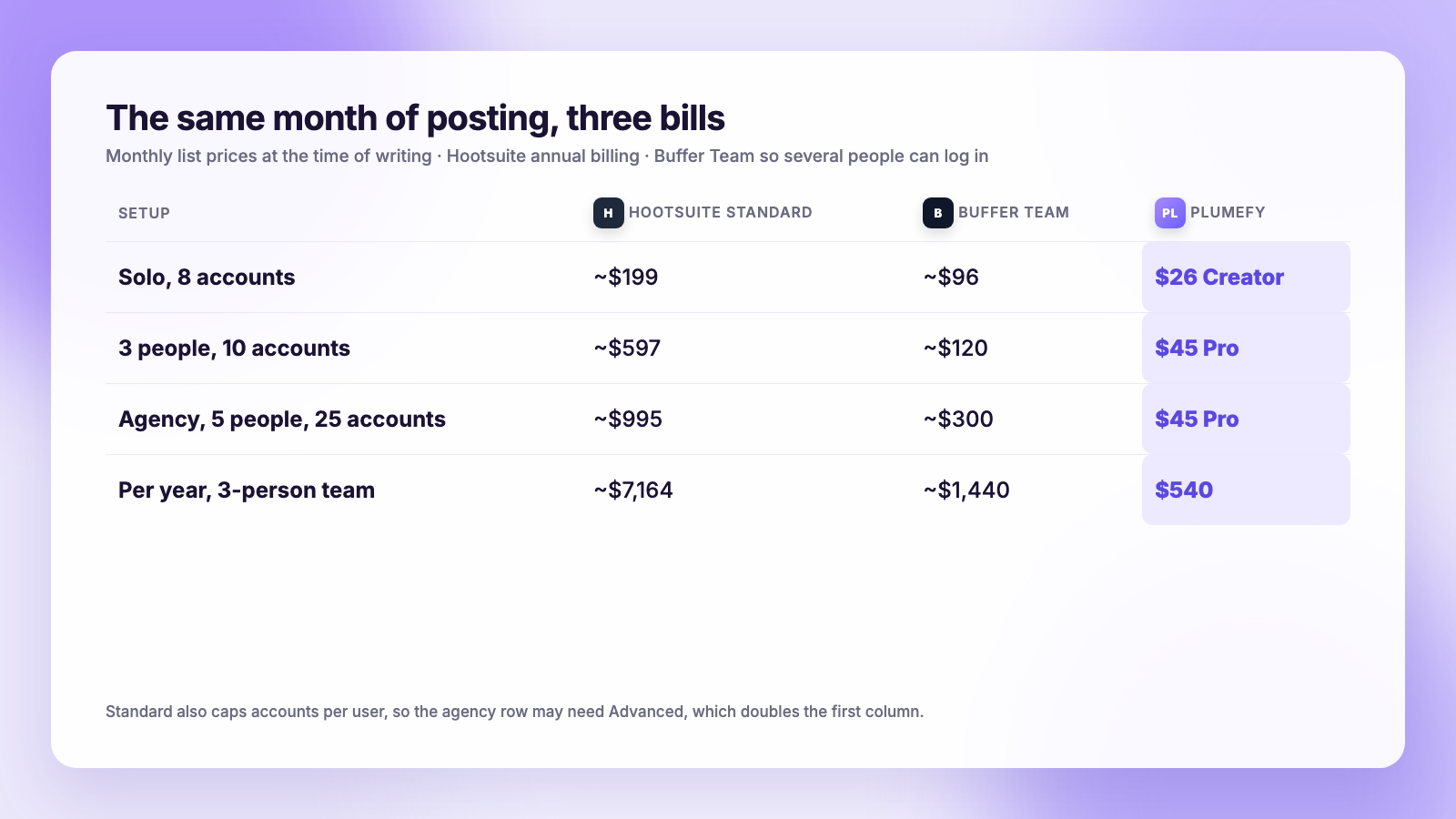
For a solo operator the annual difference between Hootsuite Standard and Plumefy Creator is about $2,076. For the three-person team it is about $6,624. Those are not rounding errors; they are a freelancer's month of work.
What you give up when you leave
Honesty cuts both ways. Switching from Hootsuite to any of the tools above means:
- No social listening. You will need a separate tool, or you will do it by hand with searches and saved feeds.
- Lighter approvals. Buffer has draft approval on Team; Plumefy has team seats on Pro but not a formal multi-step approval chain. If a client must sign off every post, build that step into your process. Our guide to approval workflows for teams shows how small teams do it without enterprise software.
- Simpler reports. Metricool is the exception. Buffer and Plumefy give you the metrics most people act on; they do not give you a 40-page branded PDF.
If you charge clients for management, re-read how to price social media management before you switch, because a lower tool cost changes your margin and your pitch.
How to switch without a gap
- Export or screenshot your scheduled calendar for the next 30 days.
- Sign up for the new tool and connect every account. Reconnecting is the only step that needs admin access, so do it when the account owner is available.
- Rebuild the next two weeks of posts in the new tool. Captions copy across; media has to be re-uploaded.
- Let both tools run in parallel for one week. Confirm nothing double-posts.
- Cancel Hootsuite before the renewal date. Annual plans do not refund unused months, so time the switch to the end of a term.
FAQ
Does Hootsuite still have a free plan?
No. The free plan was retired, and in 2026 there is a 30-day trial instead. If you need free scheduling for a few accounts, Buffer, Publer and Metricool have free tiers that include scheduling at the time of writing, each with different limits, and Plumefy's free tier posts immediately with scheduling starting on the Creator plan; see free vs paid schedulers.
Is Hootsuite worth $199 a month?
For one person who only schedules posts, no; the same job costs $5 to $30 elsewhere. For a team that uses approvals, listening and enterprise reporting daily, the price buys things the cheaper tools do not sell, and whether that is worth it depends on how much those features are used.
Can I pay for Hootsuite monthly?
Hootsuite has offered monthly billing at a higher rate in the past, but the headline prices on its site are annual. Check the current page, and read the terms on refunds for annual plans before you commit.
What is the cheapest Hootsuite alternative?
For a single account, every tool on this page has a free tier, though Plumefy's free tier posts immediately and scheduling starts on Creator. For more accounts, Publer has the lowest entry price per account and Plumefy has the lowest flat price for up to 15 accounts, at the time of writing. The cheapest tool on paper is the one whose pricing model matches how you grow.
The bottom line
Hootsuite in 2026 is an enterprise suite priced per seat, and it is honest about that. If you use what it bundles, stay and make sure you are on the right tier. If you use it to schedule posts and read a weekly chart, the bill is paying for someone else's features. Compare it against Buffer, Publer, or try Plumefy free and see what the same month of posting costs on a flat plan.
Post everywhere, once.
Start on the free plan — no card needed, upgrade when you need scheduling.
Start free