A Lightweight Social Media Approval Workflow for Teams
A simple draft-review-schedule workflow for social teams: who approves what, how to kill bottlenecks, and how shared workspaces with roles keep access clean.

Every team eventually posts something it regrets. A typo in a product name. A joke that did not land. A promo that went out before the feature shipped. So the team adds an approval step. Then another. Six months later, a tweet takes nine days and four people to publish.
Both failure modes are real: no review means avoidable mistakes, and heavy review means your content is always late and slightly dead on arrival.
The fix is a lightweight workflow with exactly one review step, clear ownership, and a default toward shipping. Here is one that works for teams from two people to twenty.
The three-stage flow: draft, review, schedule
Keep the pipeline to three stages. Every post is in exactly one of them.
Stage 1: Draft
The writer creates the post: copy, media, links, and a note on which platforms and when. Drafts are cheap. Nobody reviews half-written ideas, and nobody polishes a draft for days. The writer's job is to get it to "I would ship this" before asking anyone else to look.
Stage 2: Review
One reviewer, one pass, one deadline. The reviewer checks four things:
- Accuracy. Names, numbers, dates, links, claims.
- Brand fit. Voice, tone, and visual consistency.
- Risk. Anything legally or reputationally spicy.
- Timing. Does it collide with a launch, an outage, or the news?
What the reviewer does not do is rewrite for taste. "I would have phrased it differently" is not a blocker. If the post is accurate, on-brand, safe, and well-timed, it passes, even when it is not how the reviewer would have written it. This single norm removes most approval pain.
Stage 3: Schedule
Approved posts get scheduled immediately, not left in a doc to be posted "sometime." Scheduling is the finish line. If your team plans against a fixed posting schedule, approved posts drop into pre-agreed slots and nobody debates timing twice.
Who approves what
Not every post deserves the same scrutiny. Sort your content into risk tiers and match the review to the tier:
| Tier | Examples | Review needed |
|---|---|---|
| Low risk | Evergreen tips, reposts, curated content | Self-review with a checklist |
| Medium risk | Product posts, promos, campaign content | One reviewer |
| High risk | Pricing, legal, crisis response, sensitive topics | Reviewer + owner sign-off |
Most teams discover that 70% of their content is low risk and never needed a second pair of eyes. Reserving human review for the posts that can actually hurt you is what makes the workflow light.
Killing the bottleneck
Approval workflows die in the review stage, almost always for one of three reasons. Each has a direct fix.
- The reviewer is too senior. If the CEO approves every post, every post waits on the CEO's calendar. Delegate medium-risk review to a marketing lead and reserve the boss for high-risk items only.
- No deadline on review. Add a service-level agreement: reviews happen within one business day, and a post submitted on time that gets no response escalates once, then ships if it is low or medium risk. Silence should not mean "no" forever.
- Review happens post by post. Batch it. Review a week of content in one 30-minute session instead of interrupting the reviewer eight times. Batched review pairs perfectly with batched writing.
Where the tooling fits
You do not need heavyweight software for this; a shared calendar and a clear owner go a long way. What you do need is shared access without shared passwords.
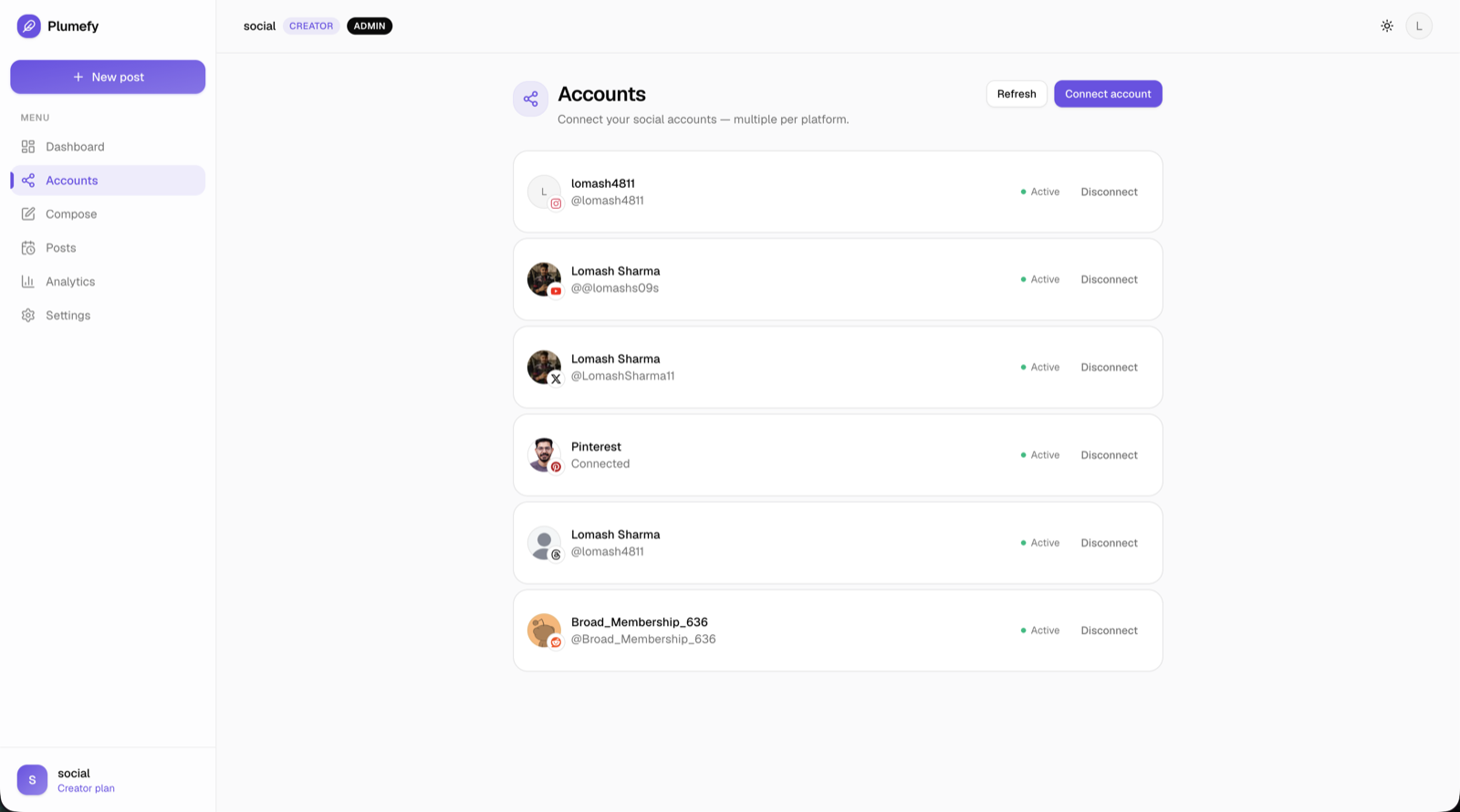
This is where roles matter. In Plumefy, a team works in one shared workspace: editors draft and schedule, admins manage accounts and settings, and viewers, like a client or an exec, can see the calendar and analytics without being able to touch anything. Owner, admin, editor, and viewer roles cover the access side of an approval workflow cleanly, and nobody ever pastes a password into Slack. Agencies can go further and give each client their own workspace, which our guide to managing client social accounts walks through in detail.
Run the review itself wherever your team already talks: a weekly content review meeting, a shared doc with comments, or a simple checklist message. The workflow is the agreement, not the app.
A worked example
Here is the whole system for a three-person team:
- Monday: Writer batches next week's eight posts and drafts them in the shared workspace.
- Tuesday morning: Marketing lead reviews all eight in one sitting, flags two, approves six.
- Tuesday afternoon: Writer fixes the two flagged posts; lead approves on second look.
- Tuesday, end of day: All eight posts scheduled across platforms for the coming week.
Total review overhead: about 40 minutes a week. Nothing ships unseen, and nothing waits more than a day.
FAQ
How many approval steps should we have?
One, for almost everything. Add a second sign-off only for genuinely high-risk posts. Every extra mandatory step roughly doubles your time-to-publish and halves the odds anyone follows the process.
What if the reviewer and writer disagree?
The tier decides. On accuracy, risk, or brand violations, the reviewer wins. On style and taste, the writer wins. Writing that rule down once prevents a hundred future debates.
How do clients fit into an approval workflow?
Give clients visibility, not edit access, and a fixed weekly window to raise objections. A viewer role in a shared workspace shows them exactly what is planned. If you want to see how that feels in practice, you can try Plumefy free and set up a workspace with roles in a few minutes.
Does this work for a team of one?
Yes, with a twist: replace the reviewer with a checklist and a time gap. Draft today, review your own work tomorrow with fresh eyes against the same four checks, then schedule. Future-you is a surprisingly good editor.
Post everywhere, once.
Start on the free plan — no card needed, upgrade when you need scheduling.
Start free