How to Price Social Media Management (Models That Work)
Retainers, per-platform pricing, and project fees compared: how to scope deliverables, pick a pricing model for social media management, and raise your rates.

"What should I charge?" is the wrong first question. The right one is: "What am I actually selling, and how should the price be structured?" Get the model and the scope right, and the number becomes a business decision you can adjust. Get them wrong, and no number saves you.
This guide skips the fake "industry average" figures you see elsewhere. Averages mislead because the market ranges from a student running one Instagram account to an agency running full-funnel content for a national brand. Instead, here is how the pricing models work, how to scope so you stay profitable, and how to raise prices without losing clients.
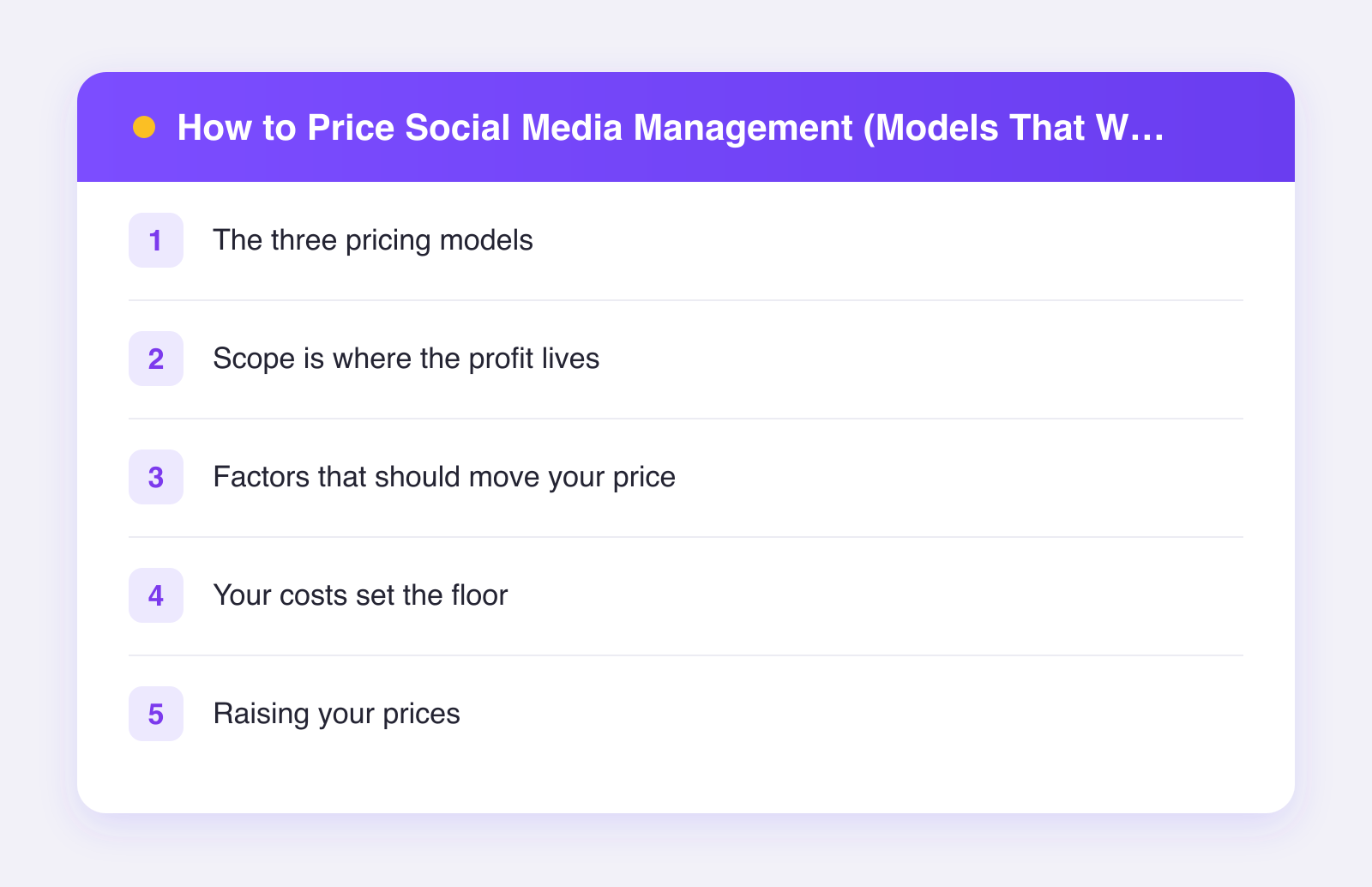
The three pricing models
1. The monthly retainer
A fixed monthly fee for a defined scope. This is the default for ongoing social media management, and for good reason: your work is continuous, so your billing should be too.
- Best for: ongoing management, strategy plus execution.
- Upside: predictable revenue for you, predictable cost for the client, and it rewards you for getting efficient.
- Risk: scope creep. A retainer without a written deliverables list slowly becomes an all-you-can-eat buffet.
2. Per-platform (or per-account) pricing
A base fee plus an add-on price for each additional platform or account. It maps price to workload in a way clients instantly understand.
- Best for: productized services and smaller clients comparing options.
- Upside: upsells are natural. "Want TikTok too? That is one line item."
- Risk: it quietly assumes each platform is equal work. Native video platforms cost far more effort than cross-posted text, so weight your add-on prices accordingly.
3. Project pricing
A one-time fee for a bounded outcome: a launch campaign, a channel audit, a 90-day content system setup.
- Best for: launches, audits, strategy sprints, and trial engagements that can grow into retainers.
- Upside: easy yes for new clients; no long commitment on either side.
- Risk: underestimating hours. Fixed price plus fuzzy scope equals unpaid overtime.
Many healthy agencies blend these: a setup project first, then a retainer, with per-platform add-ons as the client grows.
Scope is where the profit lives
Whatever model you choose, the deliverables list is the real contract. Specify:
- Volume: posts per week, per platform, and what counts as a post (an edited video is not a repost).
- Creative depth: who supplies photos and video footage, and how many original designs per month.
- Community management: are replies and DMs included, at what hours, and with what response window?
- Reporting: what report, how often, and how deep.
- Meetings: how many calls per month are included.
- Revisions: how many rounds per post or per batch.
Then add the sentence that protects every service business: "Anything not listed above is quoted separately." Scope creep rarely arrives as a big ask. It arrives as fifteen small ones.
Factors that should move your price
Two clients with identical deliverables can justify very different fees. Adjust for:
| Factor | Pushes price up when... |
|---|---|
| Market | The client's revenue per customer is high (B2B, legal, medical) |
| Risk | The account is high-visibility and mistakes are costly |
| Speed | They need same-day turnaround or weekend coverage |
| Inputs | They provide no raw material and you create everything |
| Strategy | You set direction rather than execute someone else's plan |
| Access | They want senior people in the room, not just output |
Price the relationship, not just the deliverables. Strategy and accountability are worth more than production, and your pricing should say so.
Your costs set the floor
Before quoting, know your own numbers: your hours per client per month, your tool costs, and your target effective hourly rate. Tools are usually the smallest line. A scheduler like Plumefy runs $26/mo on Creator or $45/mo on Pro with 20 seats and per-client workspaces, which spreads to a trivial per-client cost once you run several accounts through it. Time is the real expense, which is why efficiency work like batching content directly raises your margin at any price point.
Raising your prices
You will underprice your first clients. Everyone does. Here is how to correct it without drama:
- Raise quotes for new clients first. New prospects have no anchor. Test higher pricing where there is nothing to renegotiate.
- Give existing clients notice and a reason. Sixty days' warning, framed around scope and results, with the new deliverables list attached.
- Offer a path, not an ultimatum. "Keep the current price with reduced scope, or move to the new price with everything you get today plus X."
- Expect some churn and price for it. Losing your lowest-margin client at a 25% higher rate across the rest is usually a raise, not a loss.
Efficiency gains are your other lever. If workspaces, roles, and combined analytics cut your per-client admin hours, you can hold prices and expand margin, or add capacity. Our guide to managing client accounts efficiently covers that side, and you can try Plumefy free to see how much of your admin time it removes.
FAQ
Should I publish my prices?
Publish for productized, per-platform packages; quote custom for strategy-heavy retainers. Public pricing filters out mismatched leads, which is a feature, not a risk.
Hourly billing: ever a good idea?
Rarely, for social media. Hourly punishes you for being fast and makes clients audit your minutes instead of your results. Keep hourly only for out-of-scope extras.
What about performance-based pricing?
Be careful. Organic social outcomes depend on the client's product, budget, and approval speed, none of which you control. If you take performance incentives, layer a bonus on top of a base fee rather than putting the base at risk.
How do I quote a client much bigger than my usual?
Scope first, then anchor to their alternative: an in-house hire plus tools, or a larger agency. Your quote can be a multiple of your usual rate and still be the economical option for them. Never quote a big client from your cost floor.
Post everywhere, once.
Start on the free plan — no card needed, upgrade when you need scheduling.
Start free