The One-Hour Social Media Audit
Run a full social media self-audit in 60 minutes: check your profiles, review your last 30 posts, pull five key metrics, and make three clear decisions.

A social media audit sounds like something that requires a consultant, a slide deck, and a week of your life. It does not. The useful version takes one hour, a timer, and a willingness to look at your own accounts the way a stranger would.
The goal is not a report. The goal is three decisions you can act on this week. Everything in this audit funnels toward that ending.
Set a timer for each block and move on when it rings, even if you are not done. An imperfect audit you finish beats a thorough one you abandon. Here is the hour.
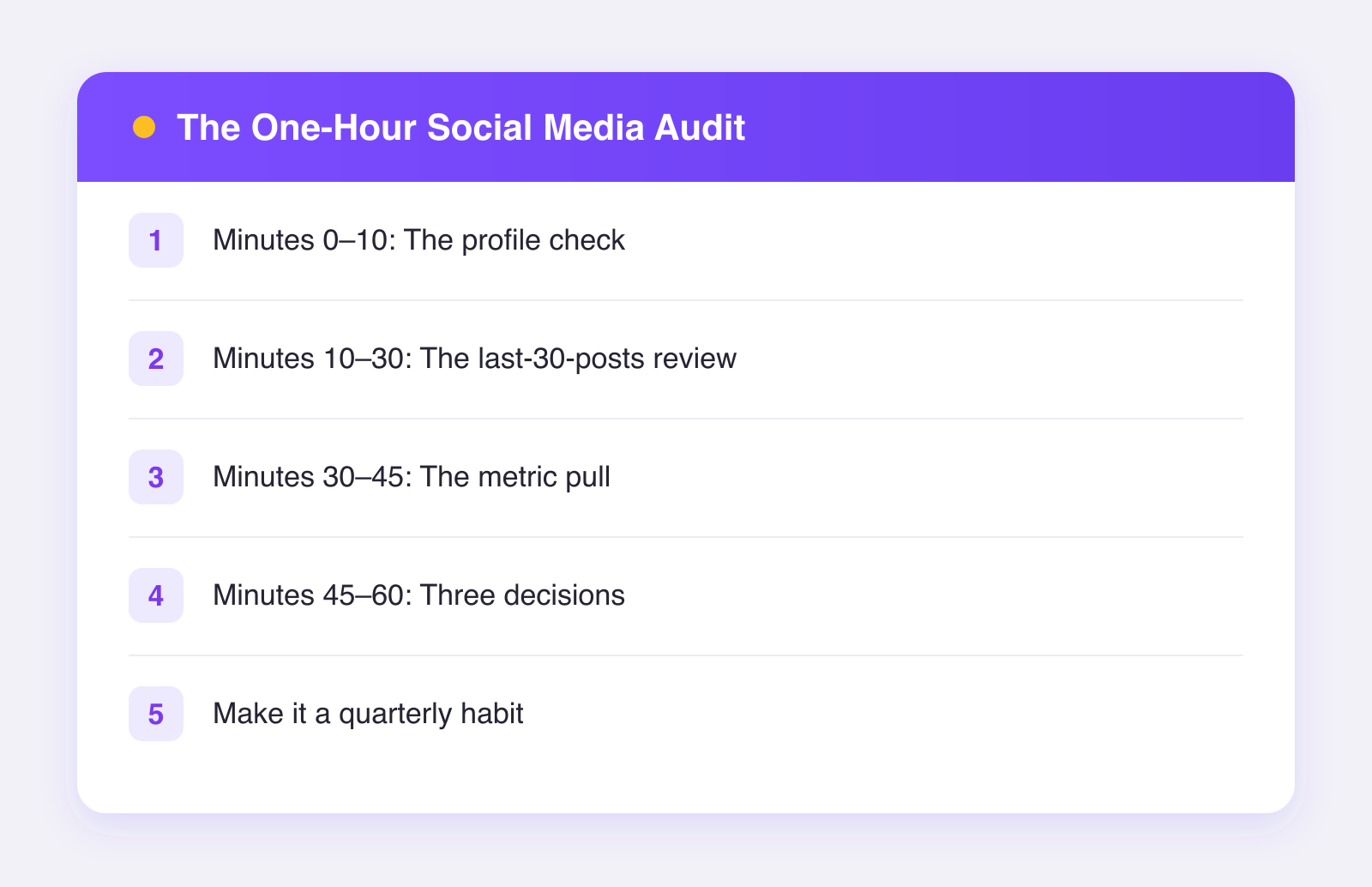
Minutes 0–10: The profile check
Open each of your profiles in an incognito window, so you see what a stranger sees. For each one, run this checklist:
- Can a stranger tell what you do in three seconds? Your name field, bio line, and pinned content should answer "what is this account and why would I follow it." If your bio requires inside knowledge, rewrite it.
- Is the profile photo legible at thumbnail size? Check it small, not full-screen — small is how everyone sees it.
- Does the bio link work, and does it go somewhere current? Dead links and last season's promo are the most common audit finds.
- Is your naming consistent across platforms? Same handle or close to it, same photo, same one-line promise. People who find you on one network should recognize you on another.
- Is the pinned content your best, or just your most recent? Pin the post you would want a first-time visitor to judge you by.
Fix anything that takes under two minutes right now. Note the rest.
Minutes 10–30: The last-30-posts review
Scroll your own feed on your main platform and look at your last 30 posts — or fewer if that is what you have. You are not reading metrics yet. You are reading the content like an outsider. Ask:
- Would I know what this account is about from these posts alone? If a stranger would guess three different topics, you have drift.
- Which three posts would I stop scrolling for? Be brutal. Note what those three share: format, hook style, topic, mood.
- Which posts feel like filler? The ones you posted to stay consistent rather than because they deserved to exist. Count them.
- Do the first lines earn the click? Read only the first line or first frame of each post. That is all most viewers ever see.
- Is there a call to action anywhere? Not on every post — but if none of 30 posts invites a save, share, reply, or click, you are leaving compounding to chance.
Write down the pattern in one sentence: "My best posts are X; a third of my posts are filler; my hooks are weakest when Y."
Minutes 30–45: The metric pull
Now the numbers. Pull five metrics for the last 30 days, per account:
- Reach — total people seeing your content
- Engagement — likes, comments, saves, shares combined
- Net follower change — gains minus losses
- Your top post and worst post by engagement, plus a one-line guess at why each landed where it did
- Link clicks or profile visits — the intent signal
Compare each against the previous 30 days if the platform lets you. You are looking for direction, not precision. Not sure these are the right five for your goals? Our guide to social media metrics that matter explains what each metric can and cannot tell you.
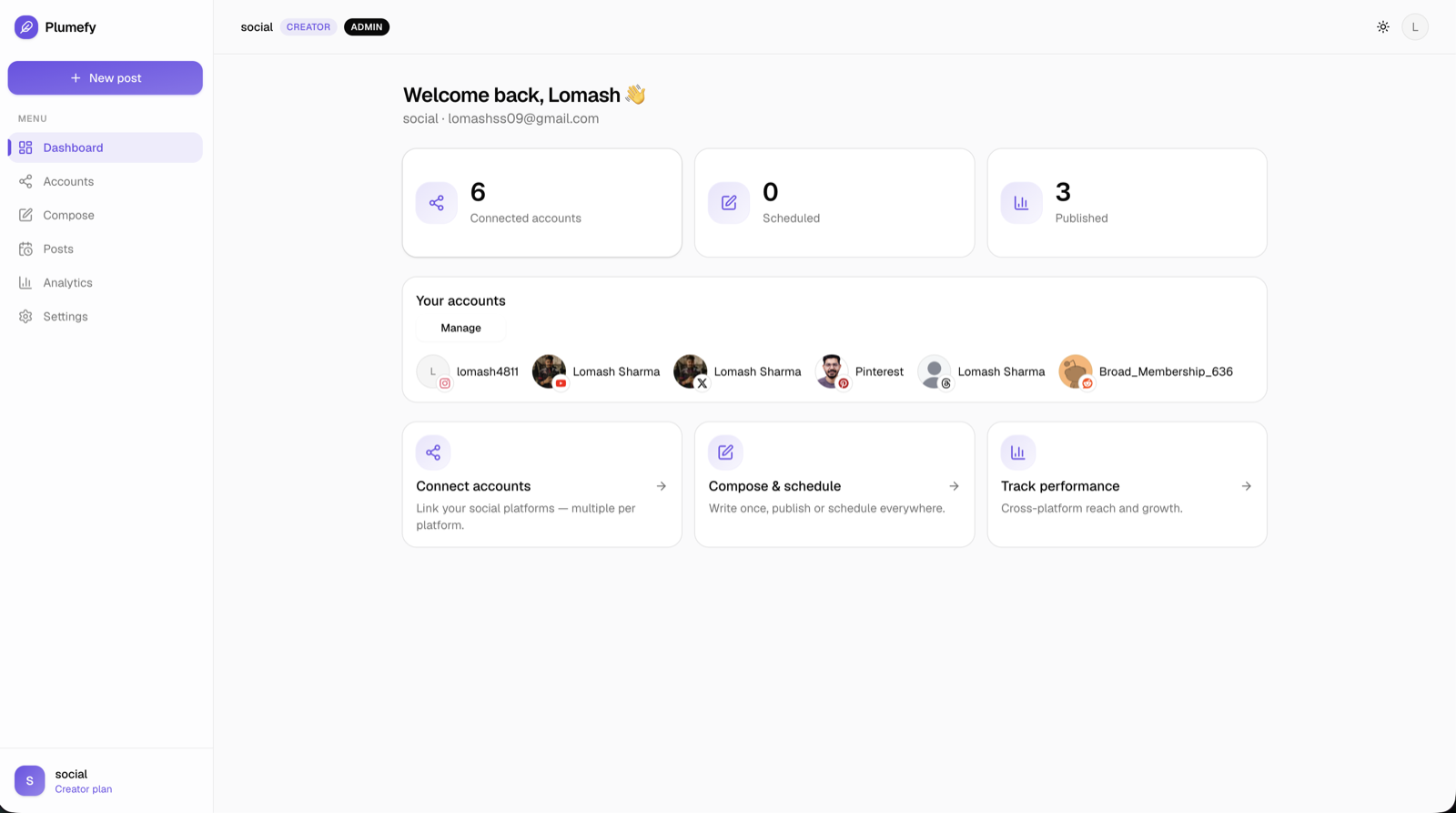
This block is where the hour usually dies — logging into every native analytics tab eats the clock. If your accounts are connected in Plumefy, the combined dashboard shows reach, engagement, and follower growth for every account across platforms in one view, and this fifteen-minute block shrinks to about three.
Minutes 45–60: Three decisions
Everything above was input. Now convert it. Write exactly three decisions:
- One thing to double down on. Your review and your top posts almost certainly agree on something. Make more of it, deliberately, starting this week.
- One thing to stop. The filler posts, the format that never lands, the platform you post to out of guilt. Cutting it frees real time.
- One thing to fix or test. A dead bio link is a fix. A weak hook pattern is a test. Pick the single highest-leverage item from your notes.
Date the page and keep it. Next quarter's audit starts by checking whether you actually did these three things — that follow-through check is half the value.
If one of your decisions touches cadence — most audits surface either "post more consistently" or "post less filler" — turn it into a concrete calendar with our posting schedule guide, and use a scheduler so the decision survives your busiest week. Plumefy covers that side too: schedule and cross-post to up to 11 networks from one place, free plan included — try Plumefy free.
Make it a quarterly habit
An audit is a snapshot; the value compounds when you take one every quarter. Same hour, same blocks, same three-decision ending. Over a year you get four honest snapshots, twelve deliberate decisions, and a record of which ones you kept. That is more strategy than most accounts ever apply.
FAQ
How often should I audit my accounts?
Quarterly is the sweet spot. Monthly turns auditing into busywork; yearly lets problems calcify. If something feels suddenly wrong between audits, run just the metric-pull block as a check-in.
Should I audit every platform I am on?
Do the full hour on your most important one or two. For the rest, do the ten-minute profile check and the metric pull. If a minor platform keeps failing both, that is a stop-decision candidate.
What if the audit just makes me feel bad?
That usually means you skipped the last block. Findings without decisions are just criticism. Force the three decisions — they convert every ugly finding into a next step, which is the whole point.
Can I have someone else audit my account?
Fresh eyes help, especially for the profile and content blocks, where you are blind to your own context. But do the decisions block yourself. You know what you can sustain; a reviewer does not.
Post everywhere, once.
Start on the free plan — no card needed, upgrade when you need scheduling.
Start free