How to Handle Negative Comments on Social Media
A calm triage framework for negative comments: tell critics from trolls from unhappy customers, use ready response templates, and know when to delete or block.
The first truly nasty comment on your post has a special sting. Your stomach drops. You draft four replies and delete them all. You consider deleting the whole post, or the whole account.
Here is the reframe that helps: negative comments are a routing problem, not an emotional one. Different kinds of negativity need completely different responses, and once you can sort them quickly, most of the dread disappears. You stop reacting and start triaging.
This guide gives you the triage framework, response templates you can adapt, and clear lines for when deleting and blocking is the right call.
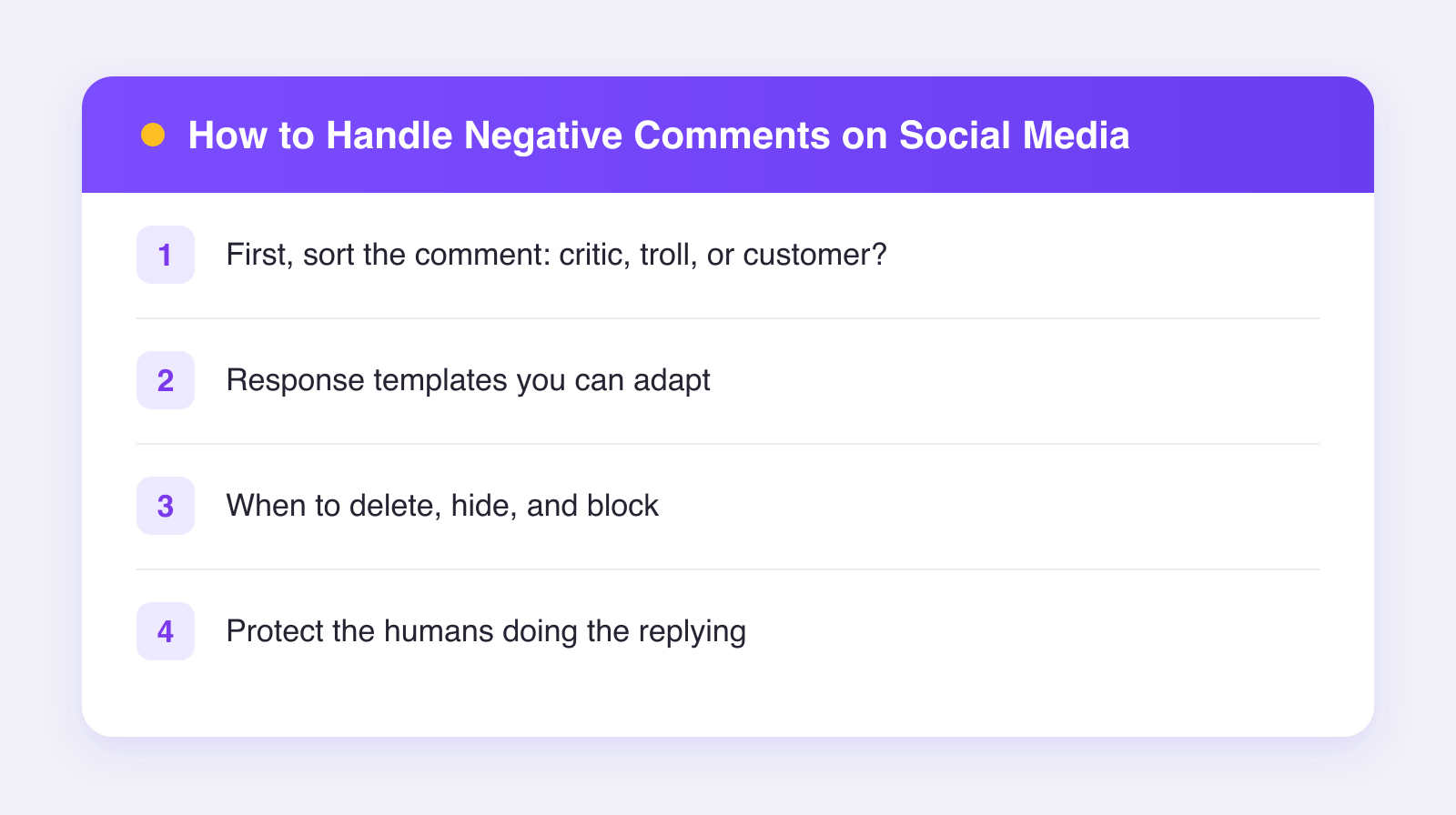
First, sort the comment: critic, troll, or customer?
Almost every negative comment falls into one of three buckets, and the bucket decides everything.
1. The critic
A real person with a real disagreement. "This advice does not work for service businesses." "You are overstating this." Critics can be blunt, even rude, but there is substance underneath.
How to respond: engage with the substance, skip the tone. A good-faith reply to a critic is some of the best content you will ever produce, because everyone else is watching. Concede what is fair, clarify what is not, and thank them when they actually improved the discussion. You are not replying to change the critic's mind. You are replying for the hundred silent readers.
2. The troll
Someone performing for an audience, hunting for a reaction. The tells: no specific claim you could respond to, personal insults, instant escalation, a comment history full of the same behavior.
How to respond: you do not. Trolls feed on engagement; a reply is a meal. Hide or delete if the comment breaks your rules, block if they persist, and move on. The winning move genuinely is not playing.
3. The unhappy customer
The most important bucket, and the one where silence hurts most. This person paid you, something went wrong, and they are telling you in public.
How to respond: fast, human, and toward a private channel. Acknowledge publicly so onlookers see you respond, then move the details to DM or email. Never argue the facts of a support case in a comment thread, even when you are right. Prospects reading the exchange do not remember who was right; they remember how you behaved.
Response templates you can adapt
Write these down before you need them. In the moment, you will not be at your calmest, and a template protects you from your own first draft.
- For critics: "Fair pushback. You're right that [valid point]. Where we'd disagree is [clarification]. Appreciate you laying it out."
- For unhappy customers: "That's not the experience we want anyone to have. I'm sorry. Just sent you a DM so we can fix this properly."
- For misinformation: "Quick correction for anyone reading: [fact, stated plainly, no snark]." Correct the record once, politely, and do not get dragged into rounds two through five.
- For heated-but-fair complaints: "You've clearly had a frustrating time and I get why. Here's what happened on our end: [brief honest context]. Can we take this to DMs and sort it out?"
Two rules across all templates: reply once or twice, never five times, and never reply within the first ten minutes of feeling angry. The thread will still be there after a walk.
When to delete, hide, and block
Deleting real criticism backfires; screenshots outlive comments. But moderation is not censorship, and your comment section is your storefront. Clear lines:
| Action | When it is right |
|---|---|
| Leave it up and reply | Criticism, complaints, awkward questions |
| Leave it, don't reply | Vague negativity, drive-by snark |
| Hide or delete | Slurs, spam, harassment of other commenters, doxxing |
| Block | Repeat offenders, coordinated pile-ons, anything threatening |
A useful practice for any business account: publish a short comment policy in your bio link or a pinned post. "We welcome criticism; we remove abuse, spam, and harassment." Ten words of policy make every moderation decision defensible.
Protect the humans doing the replying
If a team manages your comments, negativity is an operational issue, not just a personal one.
- Decide who answers what. Routine complaints go to whoever is on comment duty; legal threats and press-sensitive issues escalate to the owner. Write the escalation line down.
- Share the load. Nobody should absorb an angry inbox alone, every day. Rotating comment duty across a shared workspace, with roles so the right people have the right access, keeps one person from becoming the shock absorber. Plumefy's workspaces with owner, admin, editor, and viewer roles cover that access side for teams.
- Do not let one bad thread derail the calendar. Keep publishing on schedule while you handle the issue; going silent reads as guilt. This is easier when your posts are batched and scheduled in advance, and it is one more reason small businesses benefit from a steady system rather than day-by-day posting. Scheduling through a tool like Plumefy means the machine keeps running while you deal with the humans; you can try Plumefy free if you do not have that layer yet.
FAQ
Should I respond to every negative comment?
No. Respond to critics and customers, ignore trolls, remove abuse. Aim to respond to anything substantive within a business day, and let pure snark age quietly.
What if the negative comment is factually right?
Agree with it, fast and plainly. "You're right, we got this wrong, here's what we're doing about it" is the single most trust-building reply that exists on social media. It feels terrible to write and lands brilliantly.
Does negativity hurt my reach?
Comments are engagement, and platforms mostly count them as such. A spicy comment section often extends reach. That is one more reason to moderate abuse but not disagreement.
When should I turn off comments entirely?
Almost never for routine negativity. Reserve it for active harassment campaigns or sensitive announcements where a pile-on is guaranteed. Closing comments on ordinary criticism signals fragility and invites screenshots.
Post everywhere, once.
Start on the free plan — no card needed, upgrade when you need scheduling.
Start free