The First Three Seconds: Video Hooks That Actually Work
The first three seconds decide if your video lives or dies. Learn cold opens, text hooks, pattern interrupts, and loops that keep viewers watching to the end.
Here is an uncomfortable truth about short video: most people never see your video. They see the first second of it, decide, and swipe. The thumb moves faster than thought.
That means the first three seconds are not part of your video. They are the whole ballgame. Everything after them only exists for the people who stayed. The good news is that hooks are a craft, not a gift. There are a handful of patterns that work over and over, and you can learn all of them this week.
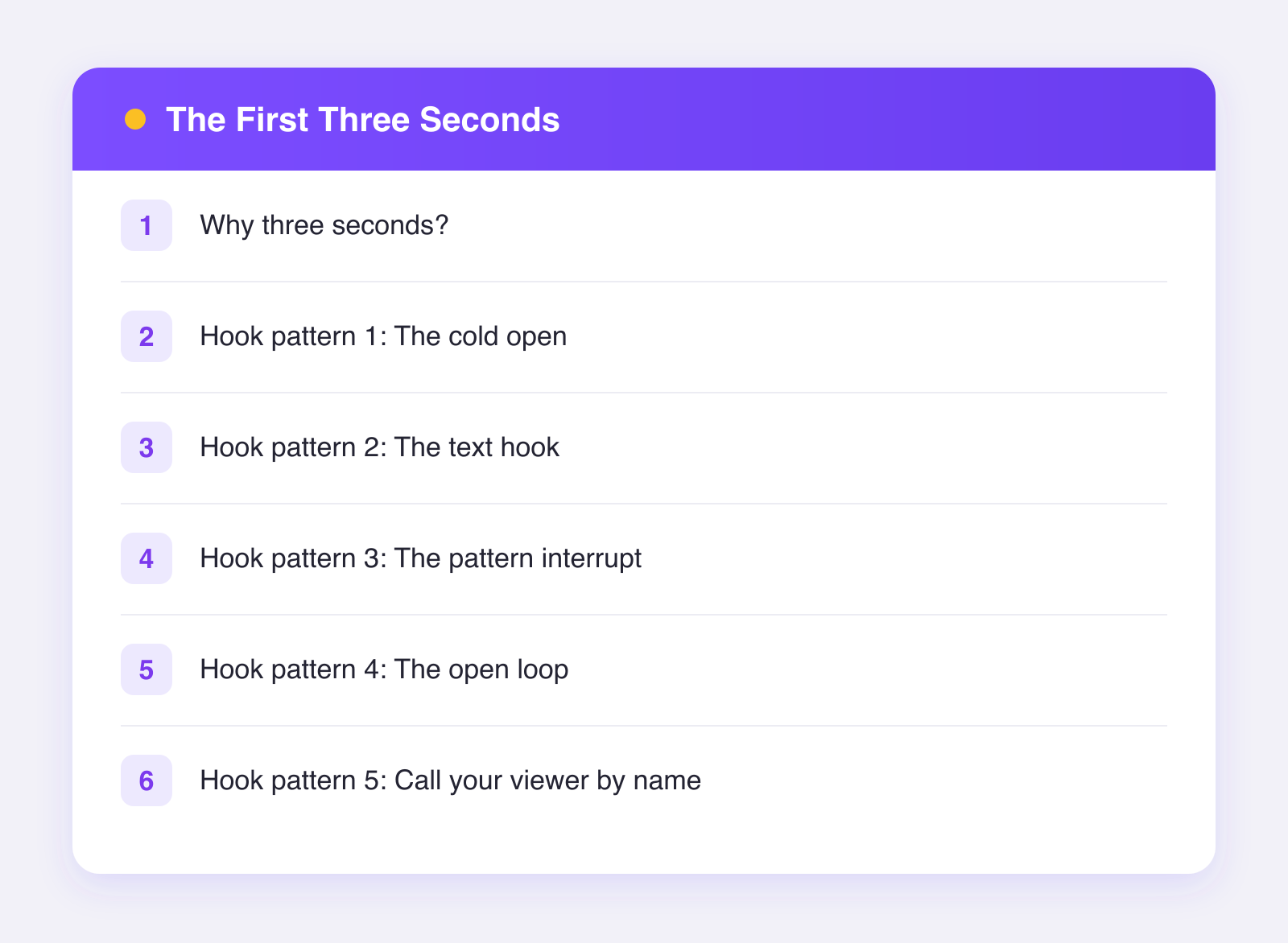
Why three seconds?
Short-video feeds measure whether people keep watching. When viewers swipe away instantly, the platform reads your video as a miss and shows it to fewer people. When they stay, it shows it to more. As of 2026, the exact mechanics are a black box, but every platform says some version of the same thing: early retention matters most.
So the job of second one is not to introduce yourself. It is not to show your logo. It is to make swiping feel like a mistake.
Hook pattern 1: The cold open
Start in the middle of the action. No greeting, no context, no "hey guys, welcome back." The pan is already sizzling. The before photo is already on screen. You are mid-sentence in the most interesting part of the story.
A cold open works because it creates a small gap in the viewer's head: what is happening here? Their brain wants the gap closed, so they stay.
Try this: edit your video normally, then delete the first five seconds. Nine times out of ten, the video gets better.
Hook pattern 2: The text hook
Many people scroll with sound off, so your first frame needs a written hook too. A short line of on-screen text, readable at a glance, that makes a promise or picks a fight:
- "I was doing this wrong for 3 years"
- "The cheapest way to do X"
- "Nobody talks about this part"
- "Watch the left side of the screen"
Keep it under about eight words. Put it in the middle of the frame where no app buttons cover it. And make sure the video actually pays the promise off, because a hook the video cannot cash is just clickbait, and viewers punish it in the comments.
We collected a bigger swipe file of these in hooks that stop the scroll.
Hook pattern 3: The pattern interrupt
Feeds are rivers of similar-looking content. Anything that breaks the visual rhythm earns a pause. Some reliable interrupts:
- Unusual framing. Extreme close-up, overhead shot, or the camera lying on the floor.
- Movement toward the lens. Walking at the camera, tossing something toward it.
- An odd prop or setting. Explaining marketing while standing in a supermarket freezer aisle.
- Silence. When every video has loud music, a quiet one stands out.
You do not need all of these. You need one thing in frame that does not match what the viewer just scrolled past.
Hook pattern 4: The open loop
Tease the payoff, then delay it. "The third one saved me $400 a month" makes people sit through the first two. "Wait for the end" is the crude version; the elegant version bakes the loop into the structure: a countdown, a transformation, a reveal you keep visibly building toward.
Loops also power replays. If your last frame flows seamlessly back into your first frame, some viewers watch twice before they notice. Replays are pure gold for retention numbers.
Hook pattern 5: Call your viewer by name
Not literally. But "if you edit videos on your phone, stop scrolling" filters for exactly the right audience, and the right audience watches longer. Naming the viewer beats naming yourself. Nobody swipes because they know who you are; they stay because the video is for them.
Stack, do not pile
The strongest openers combine two or three patterns in the same beat: a cold open with a text hook over it, plus an open loop in the first spoken line. That is not overkill; it is one moment doing three jobs. What you should not do is pile on effects, five captions, three zooms, and an airhorn. Confusion is not a hook.
Test hooks like a scientist
Here is a habit that will improve your hooks faster than any list: make one video, film three different first-three-seconds for it. Post the variations over a few weeks, or across platforms, and watch which opener holds people. Because the rest of the video is identical, you are running a clean experiment on the only part that varies.
This is much easier when posting is not a chore. With Plumefy you can schedule the variations across TikTok, Reels, Shorts, and the rest of your 11 networks from one screen, then compare how each held up in the combined analytics view instead of hopping between four different apps. Speaking of TikTok specifically, our guide on how to go viral on TikTok digs into what happens after the hook does its job.
FAQ
Do hooks matter for longer videos too?
Yes, just with a longer fuse. A YouTube video gets maybe thirty seconds to prove itself instead of three. The principle is identical: open with the most interesting true thing, not with throat-clearing.
Are these patterns overused by now?
The cheesy phrasings get stale; the patterns underneath do not. "Wait for the end" sounds tired, but open loops are as old as storytelling. Refresh the words, keep the mechanism.
What if my content is calm and slow by nature?
Calm is a pattern interrupt now. A quiet, steady opening can stop a scroll full of screaming edits. The rule is not "be loud," it is "be immediately interesting," and stillness can be exactly that.
Should I say my name at the start?
Almost never in the first three seconds. Earn the viewer first, introduce yourself once they care. Your handle is on the screen the whole time anyway.
Hooks feel like a dark art until you practice them, and then they feel like carpentry. Pick one pattern, use it all week, then pick another. And when you have a hook that works, get it in front of every audience you have. Try Plumefy free and post it everywhere in one go.
Post everywhere, once.
Start on the free plan — no card needed, upgrade when you need scheduling.
Start free