The 3-Phase Social Media Plan for a Product Launch
Plan a product launch on social in three phases: tease, launch week, and echo. Assign each platform a role and schedule the burst before the chaos starts.
Most product launches on social media are actually announcements: one excited post on launch day, a follow-up nobody sees, then silence. The team wonders why the needle barely moved.
The problem is not the product or even the content. It is the shape of the campaign. A single spike of posting cannot build anticipation before the launch or capture the stragglers after it. Attention needs a ramp in and a ramp out.
Here is a three-phase plan, tease, launch week, and echo, that gives your launch that shape, plus the per-platform roles and the scheduling work that make it survivable.
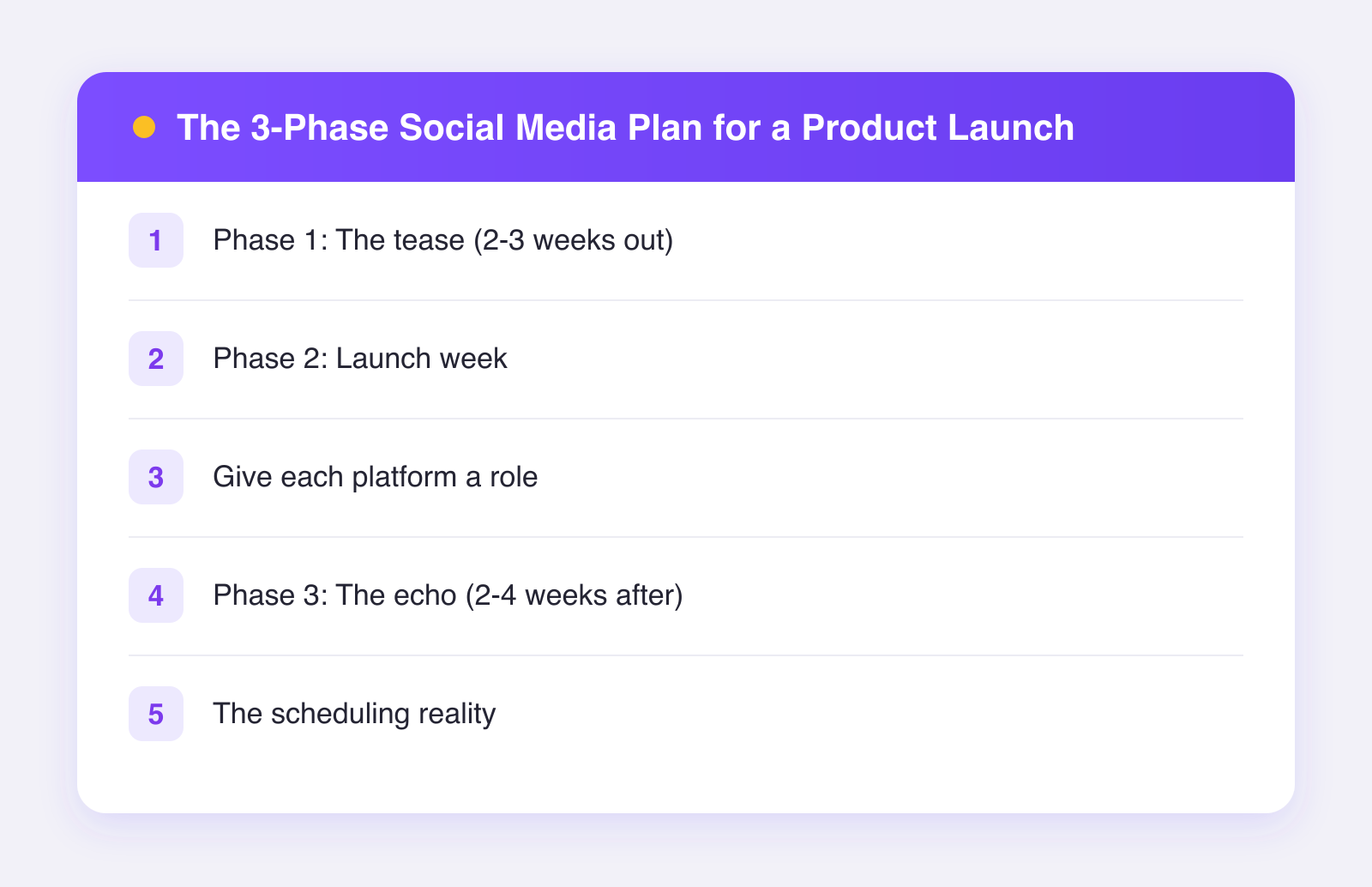
Phase 1: The tease (2-3 weeks out)
The goal of this phase is not sales. It is to make launch day land on a warmed-up audience.
Weeks 3 to 2 before launch: seed the problem. Post about the pain your product solves, without mentioning the product. Stories, hot takes, and how-tos on the problem space. You are building context so the announcement feels like an answer, not an ad.
Week 1 before launch: open the curtain. Now you tease directly:
- Behind-the-scenes of the build. Screenshots, prototypes, packaging, decisions.
- A founder post on why you built it. First-person, honest, specific.
- A date announcement. "Something ships on the 17th" gives people a reason to watch.
- If you can, a waitlist or notify-me link, so anticipation becomes a list you own.
Keep your normal content running underneath the tease. A feed that becomes 100% launch hype two weeks early exhausts people before the day arrives.
Phase 2: Launch week
Launch week is a burst, and bursts have to be prebuilt. Aim to have 80% of the week's content written and scheduled before Monday. Launch day itself will be chaos: replies to answer, bugs to fix, customers to onboard. You do not want to be writing captions in the middle of it.
A proven launch week rhythm:
| Day | Post |
|---|---|
| Day 1 | The announcement: what it is, who it is for, one link |
| Day 2 | The demo: show it working, 60 seconds or less |
| Day 3 | The origin story: why this exists, what it took |
| Day 4 | Use cases: three concrete ways people will use it |
| Day 5 | Early reactions: real feedback and answers to real questions |
| Day 6-7 | The recap plus a nudge for any launch offer ending |
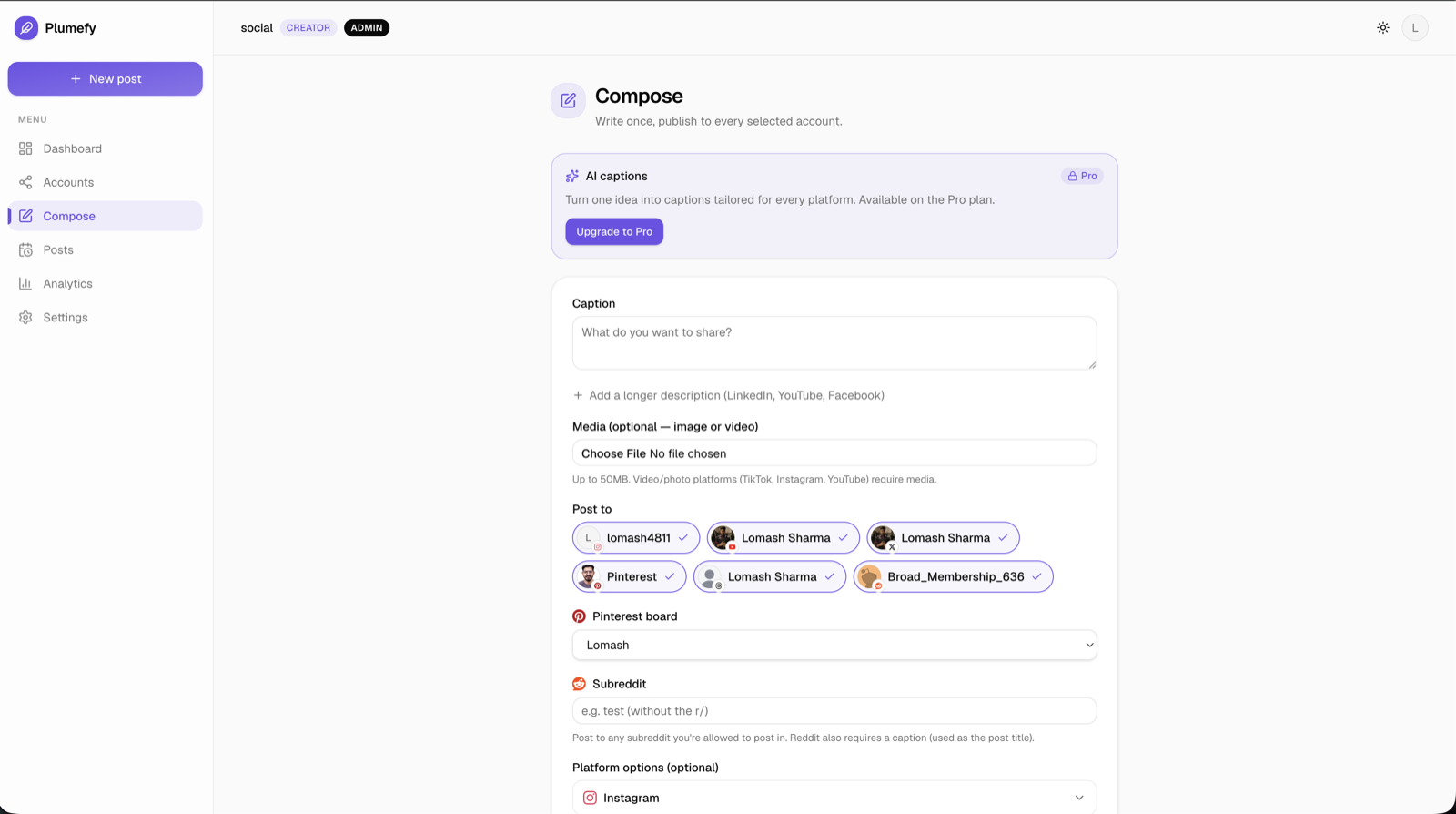
Write the whole set in one or two sittings; a launch is the perfect occasion for batching your content. Then load everything into the scheduler and spend the live week where you cannot be pre-scheduled: in the comments, in the DMs, resharing early customer posts. With Plumefy you can schedule the full launch sequence across up to 11 networks from one calendar and adjust captions per platform, so publishing runs itself while you handle the conversation.
Give each platform a role
Cross-post the launch everywhere, but let each platform do the job it is built for, instead of pasting one caption into eleven boxes.
- LinkedIn: the founder-led narrative. Story of the build, lessons, the business case.
- Instagram: the visual reveal. Product shots, demo Reels, behind-the-scenes Stories, a countdown.
- TikTok and Shorts: the problem-solution hook. Fast, casual, native-feeling demos.
- X: the play-by-play. Build-in-public threads, launch-day live commentary, quick replies.
- Facebook and communities: the discussion. Longer posts where your existing customers already gather.
- Pinterest and YouTube: the long tail. Searchable content that keeps selling months later.
Same launch, same week, different lead post per platform. This is exactly where per-platform caption customization earns its keep.
Phase 3: The echo (2-4 weeks after)
Most teams stop posting about the product within days of launch, right when social proof starts existing. The echo phase converts the people who saw the launch but did not act, which is most of them.
- Week 1-2 after: share real usage. Customer posts, questions you keep getting, a "what surprised us" post.
- Week 2-3: go deeper on one feature or use case per post. The announcement sold the headline; the echo sells the specifics.
- Week 3-4: publish the retrospective. What worked, what flopped, honest numbers if you share them. Retro posts consistently outperform because they are rare.
Then fold the product into your regular content pillars so it keeps appearing naturally. A launch is not an event with an end date; it is the loud start of a permanent topic.
The scheduling reality
Across three phases, five or more platforms, and four-plus weeks, a real launch plan is 40 to 60 posts. That volume is unmanageable ad hoc and completely manageable scheduled. Build the calendar in phase order, tease first, launch week next, echo last, and slot posts against your normal posting schedule so the launch adds to your rhythm instead of replacing it.
FAQ
How long before launch should I start posting?
Two to three weeks of tease is the sweet spot for most products. Shorter and the audience is cold on day one; much longer and anticipation turns into fatigue.
What if I have a tiny audience?
Run the same shape, smaller. The tease matters even more when you are small, because it is also your audience-building phase. And lean harder on communities and DMs, where audience size does not gate you.
How much of launch week should be scheduled vs live?
Schedule the posts, keep the interaction live. Around 80% prebuilt is the practical target: the announcement, demo, story, and use-case posts are all knowable in advance. The 20% you improvise is reactions, replies, and resharing early users.
Do I really need to post on every platform?
No. Prioritize the two or three where your buyers actually are, and cross-post to the rest as cheap bonus reach. The marginal cost of the extra networks is nearly zero when one tool publishes everywhere; try Plumefy free and test that on your next launch.
Post everywhere, once.
Start on the free plan — no card needed, upgrade when you need scheduling.
Start free