Personal Brand vs Business Account: Which Should You Grow?
Personal brand or business account? Compare trust dynamics, founder-led content, and handoff plans, and learn how to run both without doubling your workload.
You have limited hours for social media. Should they go into your personal account, where people follow you, or the business account, where people follow the brand?
It is one of the most common strategy questions founders and freelancers ask, and the honest answer is: it depends on what you are optimizing for. Faces grow faster. Brands last longer. The trick is knowing which dynamic you need right now, and setting up so you are not trapped by the choice later.
Let us walk through the trade-offs, then a practical way to run both without doubling your workload.
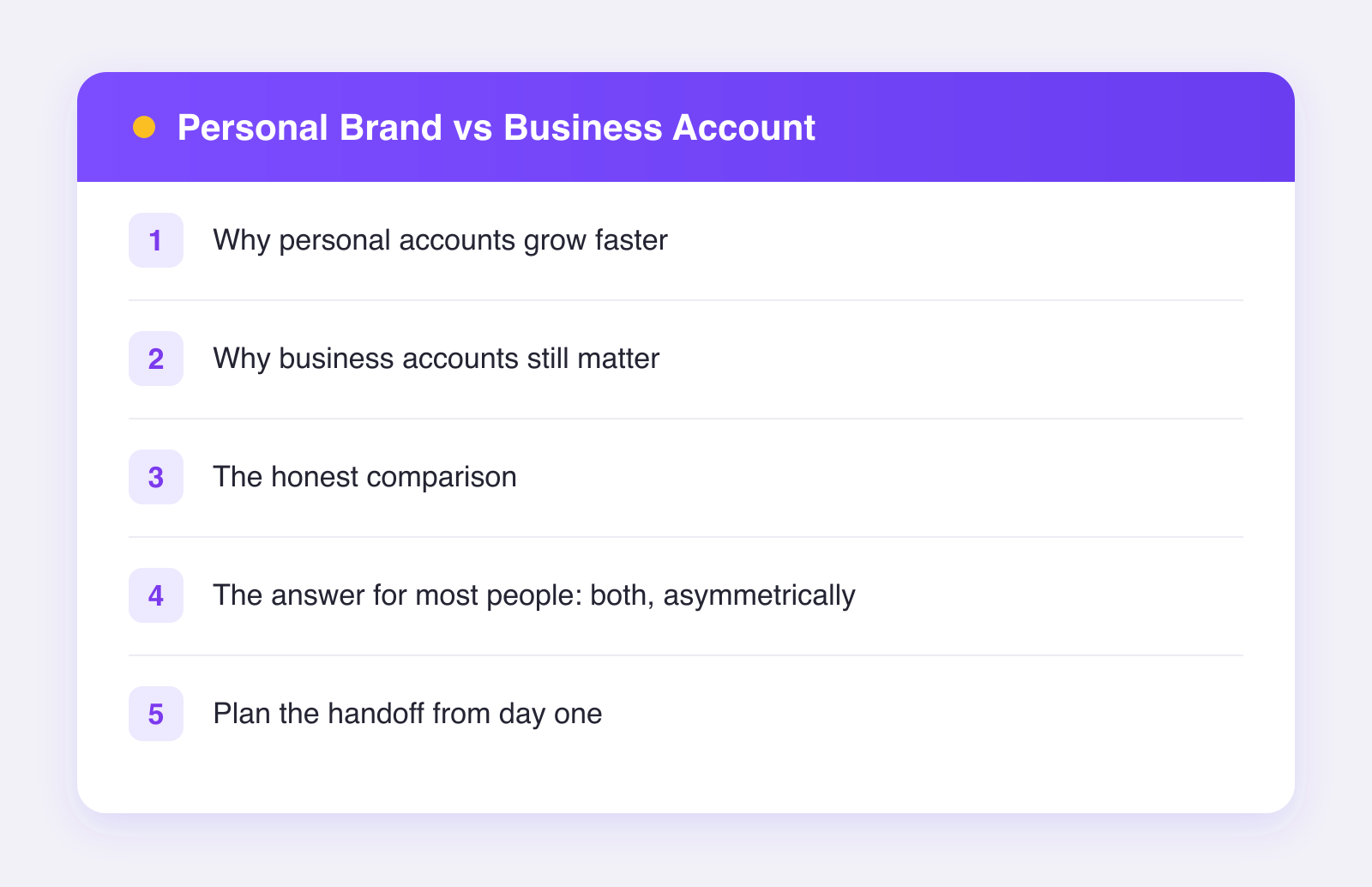
Why personal accounts grow faster
People trust people. It is that simple, and it shows up everywhere in how the platforms and their users behave.
- Faces get engagement. A take from a person invites replies. The same take from a logo reads like a press release.
- Stories only work in first person. "I almost shut the company down in year two" is a post. The brand version of that sentence does not exist.
- Algorithms reward conversation. Personal posts start conversations; brand posts mostly collect impressions.
- People buy from people. Especially in B2B and services, the founder's credibility often is the marketing.
This is why founder-led content has become the default early strategy for so many companies. If you are a founder posting on LinkedIn, our guide to LinkedIn content strategy for founders goes deep on exactly this play.
Why business accounts still matter
So why not go all-in on personal? Because personal accounts have structural weaknesses that show up later.
- They do not transfer. You cannot sell, delegate, or hire someone into your personal account. The audience is attached to you.
- They cap the team. Employees can contribute to a brand account. They cannot post as you.
- They mix contexts. Your personal account carries your hobbies, your opinions, and your next venture. A brand account stays on-message.
- Buyers eventually check the brand. A dead company account next to a lively founder account reads as a one-person shop, which is fine until you are pitching bigger clients.
Think of it this way: the personal account rents attention, and the business account is where you store it.
The honest comparison
| Question | Personal account | Business account |
|---|---|---|
| Speed of growth | Faster | Slower |
| Trust and engagement | High | Lower |
| Can be delegated | No | Yes |
| Survives your exit | No | Yes |
| Runs ads and shop features | Limited | Full |
| Risk if you burn out | Everything stops | Team continues |
The answer for most people: both, asymmetrically
The practical strategy is rarely either-or. It is both, with a deliberate imbalance:
- Lead with the personal account. Opinions, stories, lessons, behind-the-scenes. This is where growth and trust come from, so it gets your best material and most of your voice.
- Keep the business account alive and useful. Product updates, customer wins, helpful evergreen content, and amplification of the founder's best posts. Two to three posts a week is enough for it to look like a real, operating company.
- Cross-pollinate on purpose. The personal account mentions the company naturally; the brand account reshapes the founder's hits into brand-voice content. One idea, two accounts, two audiences.
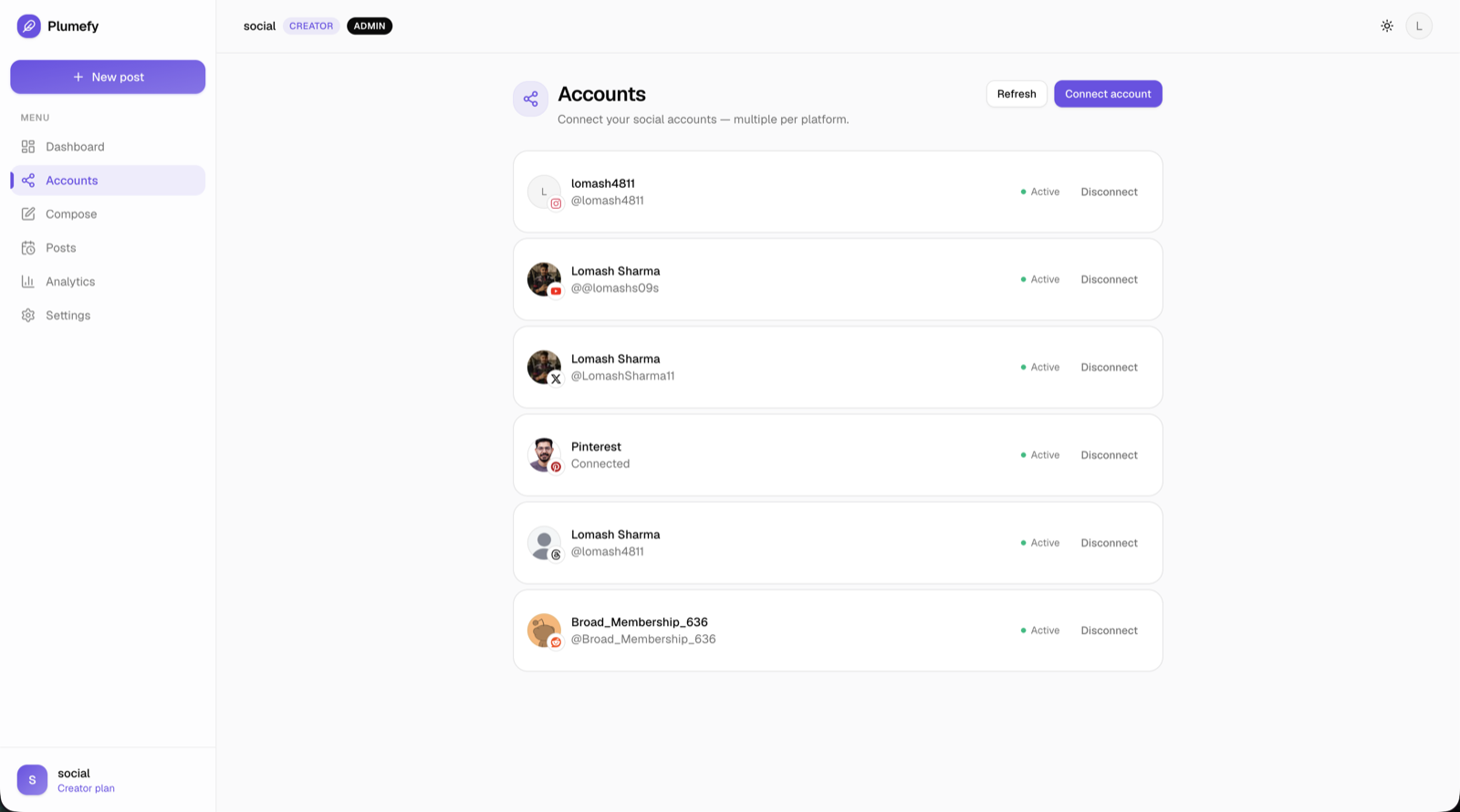
The workload objection is real but solvable. Most of it is logistics, not writing: two accounts, several platforms each, different posting rhythms. This is exactly the problem schedulers exist for. Plumefy lets you connect multiple accounts per platform in one workspace, so your personal and business profiles sit side by side on one calendar, and one batching session covers both. Our guide to managing multiple social media accounts covers the full workflow.
Plan the handoff from day one
If you build on your personal brand, the smart move is to design the exit before you need it.
- Route the audience to owned channels. Consistently point followers to a newsletter or community the business owns. An email list transfers; a follower graph does not.
- Build the brand's own voice early. Give the business account a recognizable style now, so it is not starting from zero when it needs to stand alone.
- Introduce other faces. As the team grows, feature teammates in content. Audiences can transfer trust to people, just not to logos, so give them people.
- Document your voice. If someone will eventually help with your content, a one-page voice guide makes ghost-drafting possible without the audience noticing a seam.
Founders who skip this end up chained to a posting schedule years after they wanted to stop, because the company's demand generation lives in their personal profile.
FAQ
I am a freelancer with no plans to build a company. Do I still need a business account?
Probably not. For solo service providers, the personal account is the business account. Revisit only if you productize or plan to sell the business someday.
Will not a personal account look unprofessional to big clients?
Usually the opposite: a specific human with visible expertise reads as more credible than a small anonymous brand. What looks unprofessional is inconsistency, on either account type.
How do I split content between the two accounts?
A simple rule: if it has an "I" in it, it is personal; if a teammate could have written it, it is brand. Stories and opinions go personal, product and proof go brand, and the best posts get adapted for both.
Is running both accounts twice the work?
Not if you batch. Write once, adapt per account and platform, and schedule everything in one session. With Plumefy you can manage both accounts across up to 11 networks from one calendar, with AI captions per platform on Pro doing the adaptation. Try Plumefy free and see how much of the doubling disappears.
Post everywhere, once.
Start on the free plan — no card needed, upgrade when you need scheduling.
Start free