Facebook Pages in 2026: Still Worth It?
Is a Facebook Page still worth it in 2026? An honest look at organic reach, when a Page still earns its keep, and how cross-posting makes it nearly free.
Let's answer the question honestly, because most articles about Facebook Pages are written by people selling Facebook services.
Organic reach on Facebook Pages is low. It has been declining for over a decade, and as of 2026 a typical Page post reaches only a small fraction of the people who follow the Page, often in the low single digits percentage-wise, roughly speaking. If your plan is to build a Page audience and reach it for free like it is 2012, that plan is dead.
And yet the honest answer to "is a Page still worth it" is usually yes, if it costs you almost nothing. The trick is knowing what a Page is still good for, and getting those benefits without pouring hours into a channel with quiet organic distribution. Let's break it down.
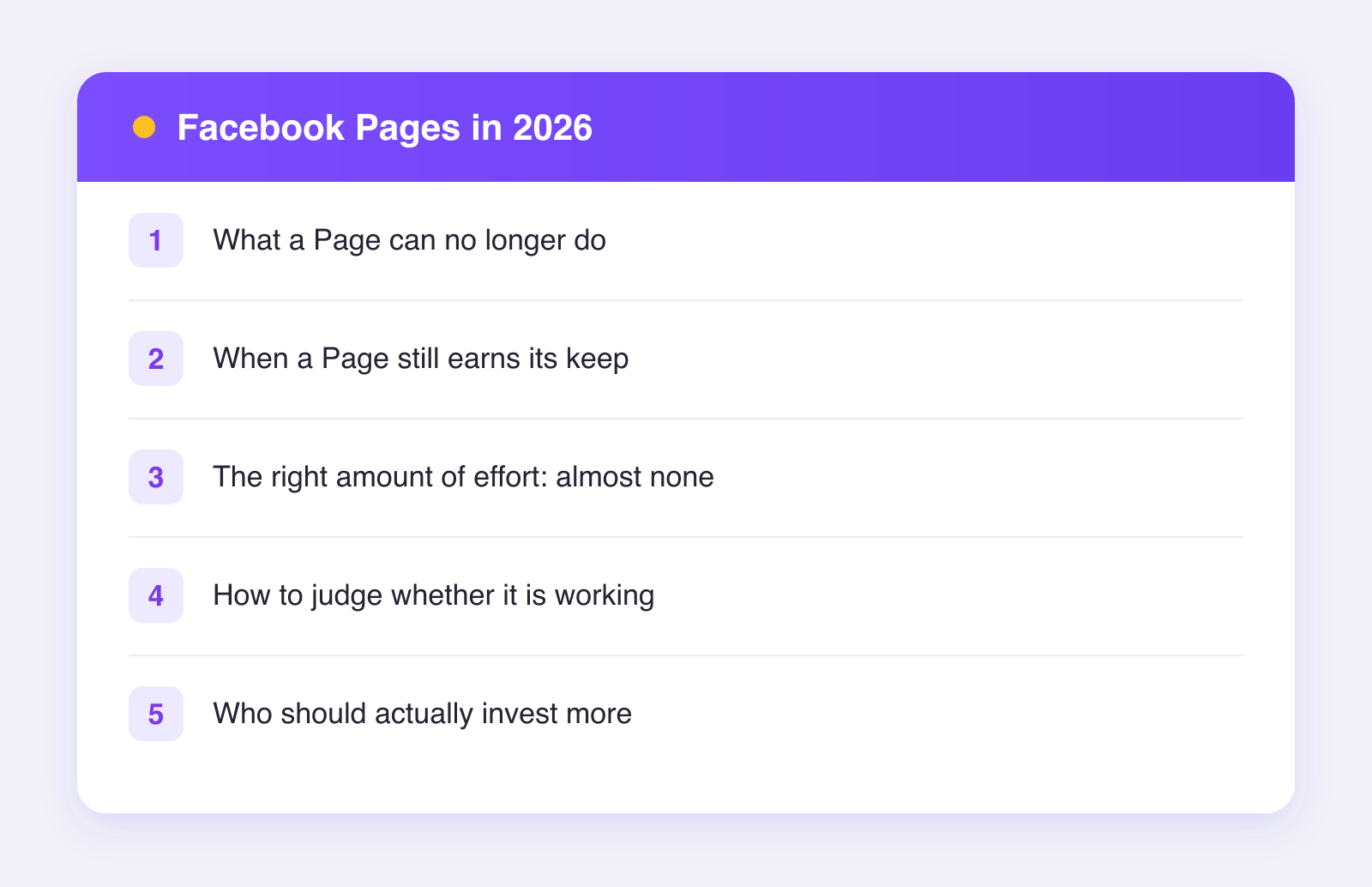
What a Page can no longer do
Clear-eyed first:
- It will not grow your audience organically the way TikTok or Threads can. Facebook's feed heavily favors content from friends, groups, and recommended videos over Page posts.
- Follower count means little. 10,000 Page followers might translate to a few hundred impressions per post. Do not buy, chase, or celebrate the number.
- Posting more will not fix reach. Volume does not beat the distribution model.
If Facebook were a new platform launching today with these numbers, nobody would join. But it is not new; it is enormous and woven into how a huge share of people, especially over 35, check whether a business is real. Which brings us to what a Page still does well.
When a Page still earns its keep
- It is your legitimacy check. A large number of customers will look you up on Facebook before buying, booking, or visiting. A Page with current posts, real photos, and recent activity passes the check. A Page last updated two years ago quietly fails it. This alone justifies keeping a pulse on the Page.
- Local discovery still works. For local businesses, Facebook remains a genuine channel: people check hours, read reviews and recommendations, find events, and message Pages directly. Local reach behaves better than the global averages suggest.
- Ads require a Page. If you might ever run Facebook or Instagram ads, even $50 behind a local promotion, you need a Page in decent shape. The Page is the account your ads come from, and people click through to it.
- Groups and events. Facebook Groups remain some of the highest-engagement communities online, and Pages tie into events, which small venues and organizers still get real attendance from.
- Older and local demographics. If your customers skew 40-plus or small-town, Facebook may quietly be where more of them spend time than any platform you would rather post on.
Notice what is missing from that list: reach for reach's sake. The Page in 2026 is infrastructure, not a growth channel.
The right amount of effort: almost none
Here is the strategy that fits the reality: keep the Page alive at near-zero marginal cost.
You are already making content: Instagram posts, TikToks, updates, photos of your work. The Page's job is to reflect that heartbeat so anyone who checks sees a living business. That means:
- Cross-post everything relevant. Every Instagram post, every update, every offer goes to the Page too. Not as extra work, as a checkbox in the same publish step.
- Never create Facebook-only content unless something above (local, groups, events, ads) is a proven channel for you.
- Check messages and reviews weekly. The people contacting you there have high intent.
This is exactly what cross-posting tools exist for. With Plumefy, the post you write for Instagram goes to your Facebook Page in the same scheduling step, with the caption tweaked if you like, across up to 11 networks. Your Page stays current for roughly zero additional minutes per week. Our guide on repurposing content across platforms covers the one-asset-many-channels workflow in detail, and you can try Plumefy free to wire it up.
How to judge whether it is working
Since reach is not the point, do not measure reach. Watch instead:
- Messages, calls, and clicks coming from Facebook. Check your insights and just ask new customers where they found you.
- Review activity. Reviews and recommendations influence buyers who never see your posts.
- Event responses, if you run events.
If those are zero after six months of near-zero-cost maintenance, you have lost almost nothing. If they are not zero, your Page is quietly paying rent. More on choosing metrics that actually matter in our metrics guide.
Who should actually invest more
A minority of businesses should go beyond maintenance mode: local businesses whose customers demonstrably live on Facebook, community-driven brands that can run a thriving Group, event businesses, and anyone whose paid ads perform well there. If that is you, lean in deliberately. Everyone else: maintain, cross-post, and spend your creative energy where organic distribution still exists.
FAQ
Should I delete my Facebook Page?
Almost never. An abandoned Page looks worse than no Page, but a maintained one costs minutes and serves as social proof, a message channel, and your ads foundation. Cross-post to it and keep it alive.
How often should I post to a Page in 2026?
Whatever rhythm your other platforms already have, mirrored via cross-posting. Two to five posts a week keeps the Page looking alive without any Facebook-specific effort.
Why is my Page reach so low?
Because Facebook's feed prioritizes personal content, groups, and recommended video over Page posts, and has for years. It is the platform's design, not your content failing.
Do Facebook ads make sense for small budgets?
Often, yes, especially locally. Ad targeting is the paid replacement for organic reach, and modest budgets can work for concrete local offers. Just measure results against what you spent.
Post everywhere, once.
Start on the free plan — no card needed, upgrade when you need scheduling.
Start free