An X (Twitter) Content Strategy for Creators
A simple X (Twitter) content strategy for creators: the right mix of threads, one-liners, and media, plus a reply habit that grows your account daily.
Most creators on X are doing one of two things: posting rarely and wondering why nothing happens, or posting constantly with no shape and wondering why nothing compounds.
A content strategy for X does not need to be complicated. It needs three things: a deliberate mix of formats, a daily reply habit, and a cadence you can hold for months. That is genuinely the whole game. Let's build each piece.
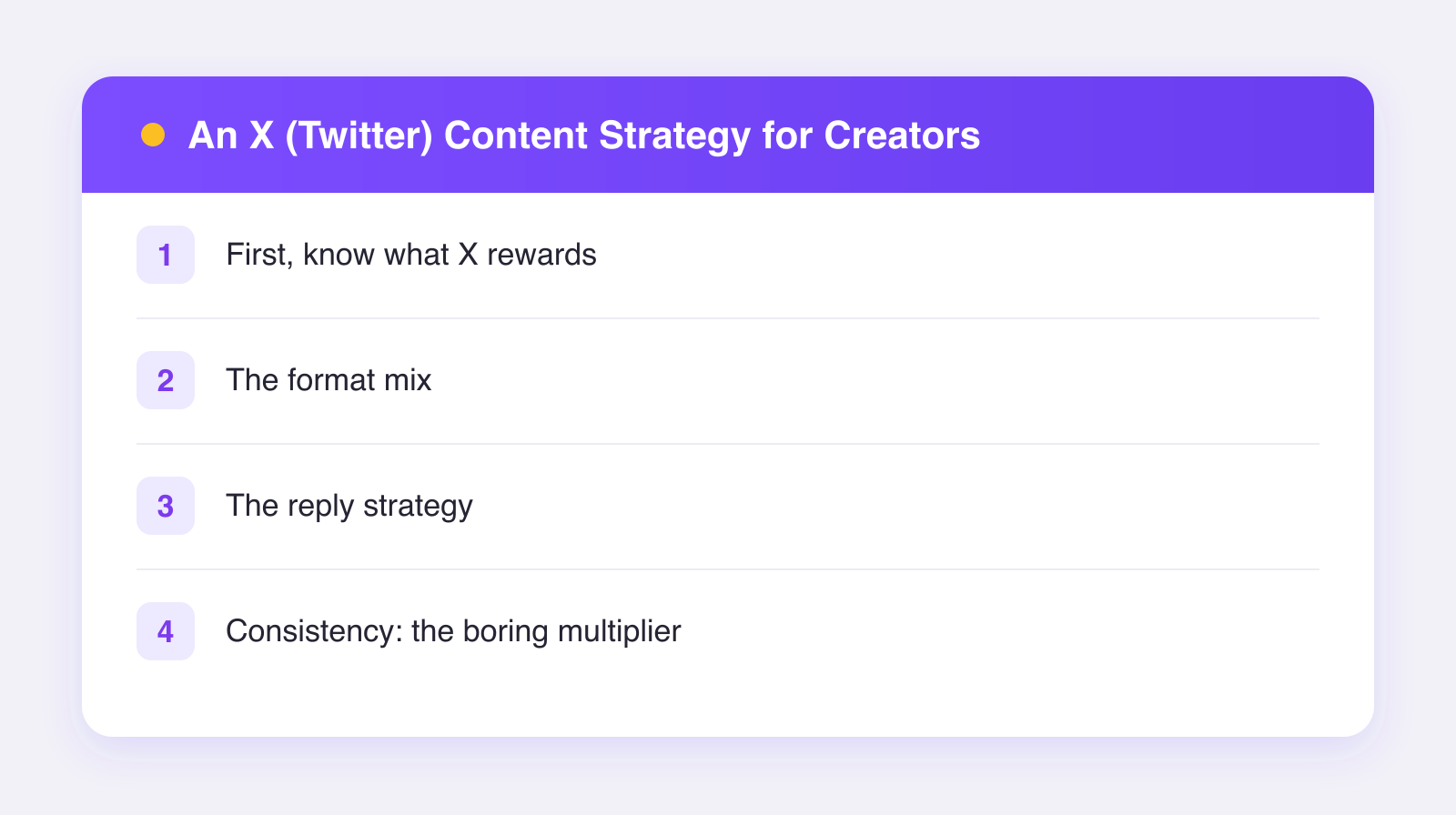
First, know what X rewards
As of 2026, roughly speaking, the X feed favors posts that generate fast engagement, especially replies, and keeps rewarding posts that hold attention. Follower count matters, but the For You feed gives small accounts real chances when a post resonates. Two practical consequences:
- The first line decides everything. People reply to and share what stops their thumb.
- Conversation is fuel. Posts that start discussions travel further than posts that just collect likes.
Everything below is downstream of those two facts.
The format mix
Strong X accounts are not one-format accounts. A mix that works for most creators, as a rough weekly shape:
- One-liners, most days. Single short posts: an observation, a lesson, a hot take, a question. Cheap to make, they keep you present, and every so often one of them massively outperforms and tells you what to expand.
- Threads, once or twice a week. Multi-post breakdowns of one topic: how you did something, what you learned, a step-by-step. Threads are your depth format; they earn follows because they demonstrate you know things.
- Media posts, a few times a week. Images, short video, screenshots of your work, charts. Media stands out in a text feed and often earns disproportionate attention for the effort.
A sane starting split is roughly 60% one-liners, 20% threads, 20% media. Adjust based on what your audience responds to, not what feels fun to make.
Writing one-liners that work
One idea, said plainly, with the strongest words first. Cut the throat-clearing: "Honestly, I think that in many cases..." dies; "Raise your prices" lives. Write ten, post the best two, keep the rest in a notes file. That file becomes your idea bank on empty days.
Building threads that get read
The first post of a thread is a promise: what will I get for reading? Make it specific ("How I got my first 100 customers with no audience"). Then one point per post, concrete details throughout, and a final post that summarizes and invites discussion. A thread is an article with the boring parts deleted.
Media without a production budget
Screenshots are the underrated format: your work in progress, your results, your notes. Authentic beats polished on X. Short vertical video cross-posted from your TikTok or Reels pipeline also does honest work here, one more surface for content you already made.
The reply strategy
Here is the part most creators skip, and it is the actual growth engine for small accounts: replies put you in front of audiences you have not earned yet.
When you leave a genuinely good reply on a large account's post, thousands of people can see it. Some tap your profile. If your recent posts are good, some follow. Repeat daily and this quietly outperforms everything else you do.
The practice:
- Pick 10 to 20 accounts in your niche, a mix of big and mid-sized.
- Spend 15 minutes a day replying where you can add something real: an example, a counterpoint, a sharper phrasing, a useful link to nothing.
- Never reply with flattery or "Great post!" It is invisible at best.
- Answer replies on your own posts quickly, especially in the first hour.
Consistency: the boring multiplier
Nothing above works as a burst. The X accounts that grow are simply present every day for months. The way to make that survivable:
- Batch your plannable content. One-liners and threads can be written in a weekly session and scheduled across the week. Timely posts and replies happen live from your phone.
- Post at times your audience is awake. Test a few slots; our guide to the best time to post covers how to find yours without cargo-culting someone else's chart.
- Track a tiny scorecard. Once a week, note your top three posts and bottom three. Make more of the former. That is the entire analytics practice you need at first.
This batching rhythm is exactly what Plumefy is built for: write your week in one sitting, schedule to X alongside Threads and Bluesky versions of the same ideas, and see the results in one combined analytics view. On the Pro plan, Plumefy's AI captions can draft the per-platform variants for you, and we wrote honestly about when AI captions work and when they do not. You can try Plumefy free with 2 accounts and 10 posts to test the workflow.
FAQ
How often should I post on X?
One to three original posts a day is a strong, sustainable range, plus daily replies. More volume helps only if quality holds. Below roughly one post a day, momentum is hard to build.
Are threads dead on X?
No, but lazy threads are. Listicle threads recycling generic advice stopped working long ago; specific, experience-based threads still earn follows reliably.
Should I schedule posts or post live?
Both. Schedule your baseline so consistency never depends on your mood, and post live when something timely happens. Replies always happen live.
Do links kill reach on X?
Posts built around external links tend to underperform, roughly speaking. Common practice is to deliver value in the post itself and use links sparingly, or place them in a reply. Test it on your own audience.
Post everywhere, once.
Start on the free plan — no card needed, upgrade when you need scheduling.
Start free