How to Turn Followers Into Customers
Followers don't pay the bills until they become customers. Learn the trust ladder, calls to action that don't feel gross, and where the sale actually happens.
A follower count is not revenue. Every creator learns this the day they launch something — a product, a service, a course — and hear silence from an audience that supposedly loves them. The likes were real. The wallet never opened.
The gap is not a mystery, and it is not betrayal. It is a missing ladder. People do not jump from "I enjoy this account" to "here is my credit card." They climb, one small step of trust at a time, and most accounts never build the middle rungs.
Here is how the ladder works, the content that moves people up it, and how to sell without feeling like a walking pop-up ad.
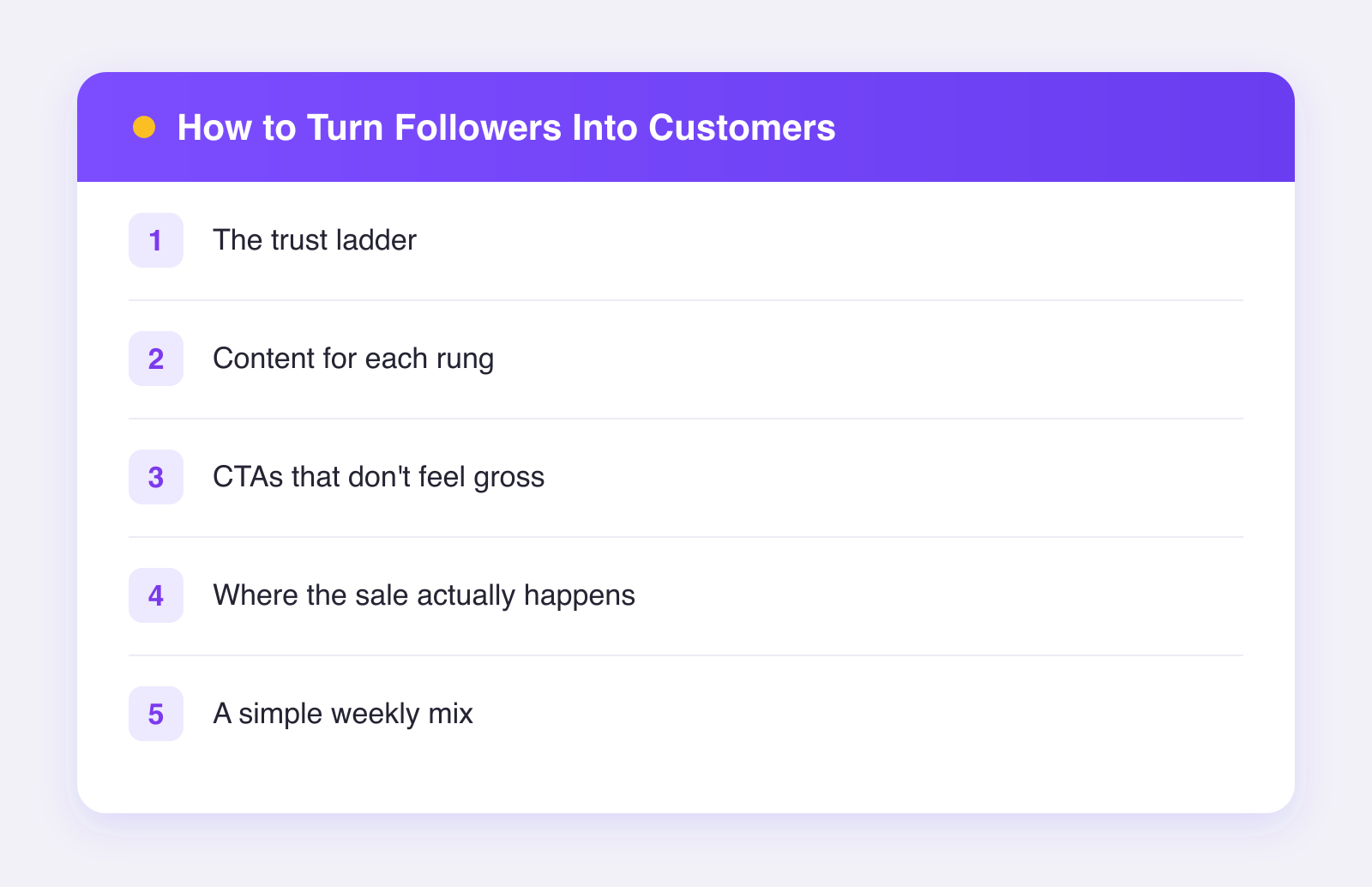
The trust ladder
Every customer you will ever earn from social climbs roughly the same five rungs:
- Stranger — saw one post in a discovery feed. Owes you nothing.
- Follower — liked the vibe enough to want more. Cheap commitment, easily reversed.
- Engager — comments, saves, replies to stories, answers your questions. Now they know you notice them.
- Subscriber or DM contact — joined your email list, downloaded the free thing, sent a real message. First real exchange of value.
- Customer — bought, booked, hired, or subscribed.
Two facts about the ladder change how you should post. First, each rung has a job, and one post cannot do all five jobs — a post built to stop strangers is rarely the post that closes a sale. Second, people fall off between rungs silently. If your content only entertains, everyone stays parked at rung two forever, and you get the loud-audience-quiet-launch problem.
Content for each rung
| Rung | Job | Content that does it |
|---|---|---|
| Stranger → Follower | Prove you are worth a follow | Your best teaching and entertaining posts, clear niche |
| Follower → Engager | Start conversations | Questions, hot takes, polls, replies to every comment |
| Engager → Subscriber | Trade value for contact | Free guide, template, or email series worth an address |
| Subscriber → Customer | Show the paid thing works | Case walk-throughs, behind-the-scenes, honest offers |
Most accounts over-invest in the first row and under-invest in everything below it. A healthy mix keeps most of your content free and genuinely useful — that is what builds the audience — while a steady minority does ladder work. Boosting the follower-to-engager rung is largely an engagement craft problem; our guide on how to increase your engagement rate covers that rung in detail.
CTAs that don't feel gross
A call to action feels gross when it is mismatched to the rung. Asking a stranger to buy is gross. Asking an engaged fan who has followed your work for months whether they want the full version is a service.
Rules that keep CTAs clean:
- Ask for one step, not the whole ladder. "Save this for later" for cold viewers. "Grab the free checklist" for warm ones. "DM me the word AUDIT" for hot ones. One post, one ask.
- Earn the ask in the same post. Deliver the value first, then invite the next step. A CTA after a genuinely useful post reads as a favor; the same CTA after fluff reads as a trap.
- Say what happens next, plainly. "Link sends you to a 2-minute signup" beats vague "check it out." Uncertainty, not selling, is what people actually resist.
- Sell openly a minority of the time. Regular, honest, low-drama offers train your audience that you sell things and that it is fine. The creators who never sell until launch day shock their audience into silence.
Where the sale actually happens
Here is the part that surprises people: the sale almost never closes in the feed. Feeds are for discovery and trust. Sales close in owned or intimate channels:
- Email. You control delivery — no algorithm decides whether your launch reaches the people who asked to hear about it.
- DMs. For services and higher-priced offers, a short real conversation converts better than any landing page. This is where being a genuine, replying human all year pays off.
- Your site or landing page. Where price, proof, and promise live at full length.
So the social strategy for selling is indirect on purpose: use posts to move people into channels you own, then sell there. This is also why building on several platforms matters — each network is a different top-of-ladder, feeding the same email list and the same offers. Plumefy makes running that wider funnel practical: cross-post and schedule to up to 11 networks, keep multiple accounts in one workspace, and watch which platforms actually drive engagement in one combined dashboard, so you know where your buyers come from — try Plumefy free.
A simple weekly mix
A workable pattern, not a law — adjust to your rhythm. Across a given week, aim for mostly rung-one and rung-two content: teaching, entertaining, conversation-starters. Add one piece that pushes toward your list or lead magnet, and roughly one honest offer or proof post. Evergreen how-tos do most of the trust-building work here, which is why we recommend anchoring your calendar in them — see evergreen vs trending content for how to balance the two.
FAQ
How big does my audience need to be before I can sell?
Smaller than you think. A few hundred genuinely engaged followers in a specific niche can sustain a service business. Ladder depth beats audience width — a small warm list outsells a large cold one.
How often is too often to sell?
Watch the response, not a fixed ratio. If offers get engagement and questions, you are fine. If every offer post goes dead quiet, you are asking people who are still on rung two — build the middle rungs harder.
Do discount codes and urgency tactics work on social?
They can, but they borrow from trust rather than building it. Used rarely and honestly, fine. Used weekly, your audience learns to ignore the price and distrust the countdown.
Should I DM people who engage with my posts?
Replying and continuing real conversations, yes — that is the platform working as intended. Cold-pitching everyone who likes a post, no. The line is simple: respond to interest; don't manufacture it.
Post everywhere, once.
Start on the free plan — no card needed, upgrade when you need scheduling.
Start free