User-Generated Content for Small Brands: A Practical Guide
How small brands find user-generated content, ask permission the right way, credit creators properly, and repurpose UGC across every platform they post on.

The most convincing post about your product will not be made by you. It will be made by a happy customer holding the thing, using the thing, or telling a friend about the thing. That is user-generated content, or UGC, and it is the closest thing small brands have to a cheat code.
Why does it work? Because people trust people. A brand saying "our candles are great" is an ad. A customer filming their cozy Sunday with your candle in the frame is a recommendation. Same product, completely different weight.
The problem for small brands is practical: where do you find UGC, how do you get permission to use it, and how do you get real mileage out of each piece? Let me walk through the whole pipeline.
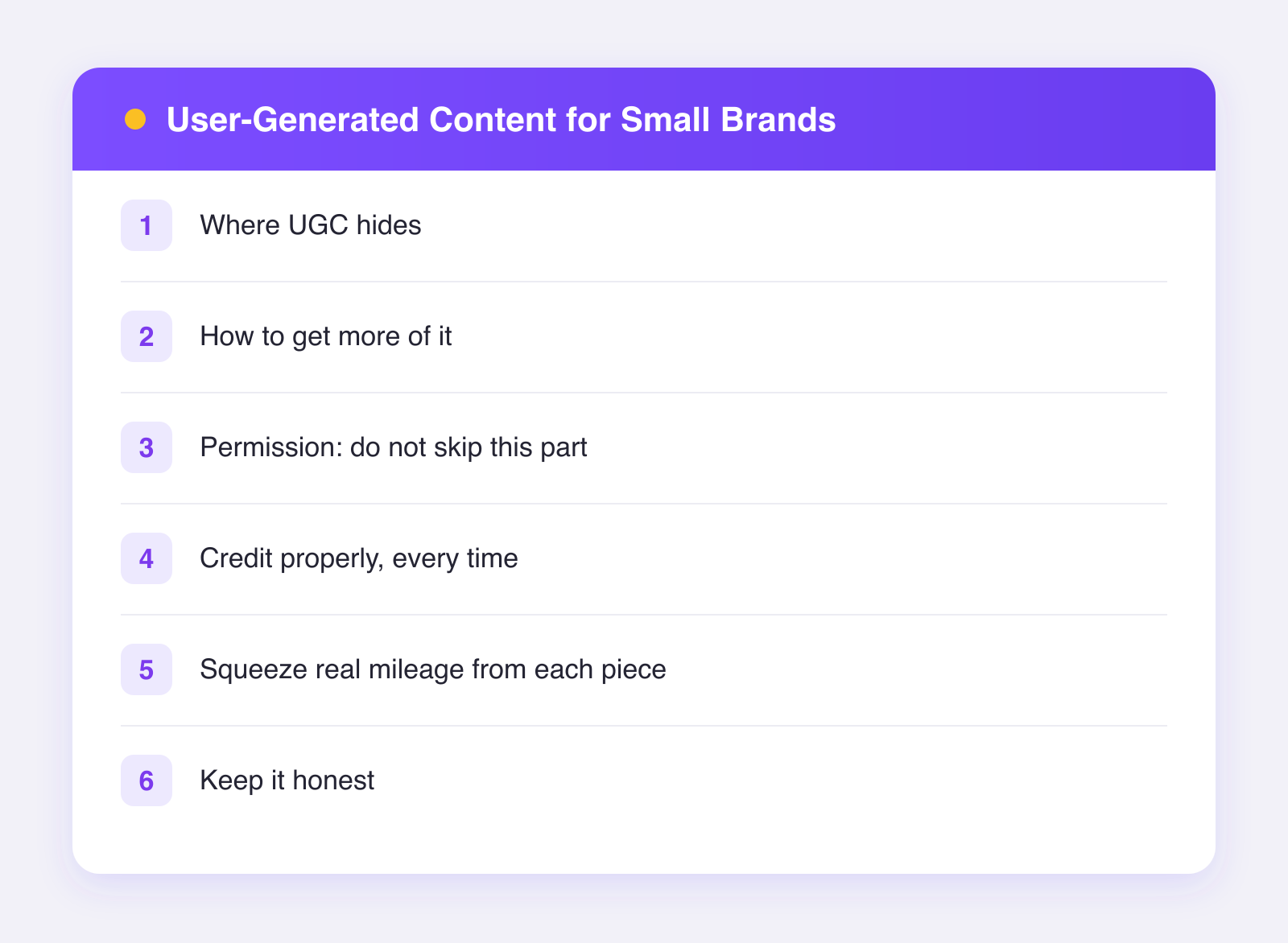
Where UGC hides
You probably have more UGC than you think. Start by looking in these places:
- Tags and mentions. Check your tagged photos and mentions on every platform, not just Instagram. People tag brands more than brands notice.
- Story mentions. These vanish in 24 hours, so check daily or turn on notifications.
- Reviews with photos. Review sections on your shop, Etsy, Amazon, or Google Business often contain great photos nobody asked for.
- Hashtags. If your brand name or product has any hashtag traction, search it. Also search common misspellings.
- DMs and emails. Customers send happy photos directly all the time. Those count too, with permission.
Set a recurring 15-minute slot each week to sweep these spots and save what you find to a folder. That is your UGC inbox.
How to get more of it
If the well is dry, prime it:
- Ask at the happy moment. The package insert, the order confirmation email, the post-delivery follow-up: "Tag us, we feature customers every week." Simple and effective.
- Make your product photogenic at the unboxing. Nice packaging gets photographed. That is the whole reason nice packaging exists.
- Feature people prominently. UGC snowballs. When customers see you resharing real people, more of them tag you hoping for a feature.
- Run a light prompt, not a heavy campaign. "Show us your setup" beats a complicated contest with rules nobody reads.
- Work with micro creators. A small paid collaboration with a creator whose audience matches yours yields content you can often reuse, if the agreement says so in writing.
Permission: do not skip this part
Here is the rule: a public post is not permission to reuse it. The customer owns their photo or video. Reposting it into your feed or, worse, your ads without asking can burn trust and cause real legal problems.
The fix is easy and people almost always say yes. Send a short, warm message:
"Hi! We love this photo. Could we share it on our accounts with credit to you?"
For feed reposts, a clear yes in DMs is generally enough for most small brands. Keep a screenshot of the exchange. For anything bigger, like ads, packaging, or your website, get explicit written permission that names the use, and consider a simple release form. When in doubt about commercial use, a quick chat with a lawyer is cheaper than a dispute.
And if someone says no or asks you to take something down, do it fast and graciously. That is the entire policy.
Credit properly, every time
Credit is not just politeness; it is what keeps the UGC flywheel spinning. The standard:
- Tag the creator's account in the image or video itself where the platform allows it.
- Name them in the caption, not just a buried mention: "Photo by @name."
- Never crop out or cover watermarks or handles they placed themselves.
- Do not edit their content heavily without asking. Light cropping is fine; changing the feel of it is not.
Creators who get credited generously become repeat contributors and genuine fans. Creators who get scraped become public critics.
Squeeze real mileage from each piece
One good customer photo should not live and die as a single repost. With permission that covers it, a single piece of UGC can become:
- An Instagram feed post and a Story with a mention sticker
- A slide in a monthly "customer favorites" carousel
- A frame in a Reel or TikTok compilation of real customers
- A trust-building image on Pinterest
- A quote-plus-photo post for Facebook or LinkedIn if your brand lives there
- A testimonial block on your website
The trick is adapting the framing per platform rather than blasting the identical post everywhere, which starts to feel like wallpaper. Our guide on cross-posting without sounding robotic covers that art. And mechanically, this is where Plumefy earns its keep for small teams: schedule the same UGC to Instagram, Facebook, Pinterest, and the rest of its 11 networks in one sitting, with a caption tuned for each. If you run a brand plus a personal account, or manage a few clients, workspaces keep every account tidy in one place.
For the broader system of stretching content further, see repurposing content across platforms.
Keep it honest
Two lines you should never cross. Do not fabricate UGC by staging fake customer posts; audiences smell it, and in many places undisclosed fake endorsements are illegal. And if you paid for the content or gifted product in exchange, disclosure rules likely apply, so have the creator mark it appropriately. Real enthusiasm, honestly labeled, is the entire value of UGC. Protect it.
FAQ
Is UGC really better than professional content?
Different job. Professional content sets your brand's tone. UGC provides social proof. Strong small-brand feeds mix both, and UGC usually wins on trust per dollar, since the dollar count is roughly zero.
What if my product is boring to photograph?
Shift the frame from the product to the outcome: the finished meal, the organized closet, the completed project. Prompt customers with "show us what you made" instead of "show us the product."
Do I need a contract for every repost?
For an ordinary credited repost on your feed, a clear DM yes is the common practice for small brands. For ads, websites, or packaging, get explicit written permission for that specific use.
How often should I post UGC?
There is no magic ratio. Once a week is a fine starting rhythm for most small brands: frequent enough to keep the flywheel visible, rare enough that features still feel special.
Start this week: sweep your tags, ask two customers for permission, and schedule what you get. Try Plumefy free and give every yes a life on all your platforms.
Post everywhere, once.
Start on the free plan — no card needed, upgrade when you need scheduling.
Start free