How to Never Run Out of Social Media Post Ideas
Idea systems that keep your calendar full: a swipe file, question mining, comment mining, a remix matrix, and an evergreen bank you can pull from anytime.

Running out of post ideas is not a creativity problem. It is a systems problem.
The people who publish daily for years are not more imaginative than you. They have pipes that feed them ideas automatically, so the blank page almost never happens. When they sit down to write, the choosing is already half done.
Here are five systems that do exactly that. You do not need all five. Pick two, run them for a month, and your idea shortage will quietly disappear.
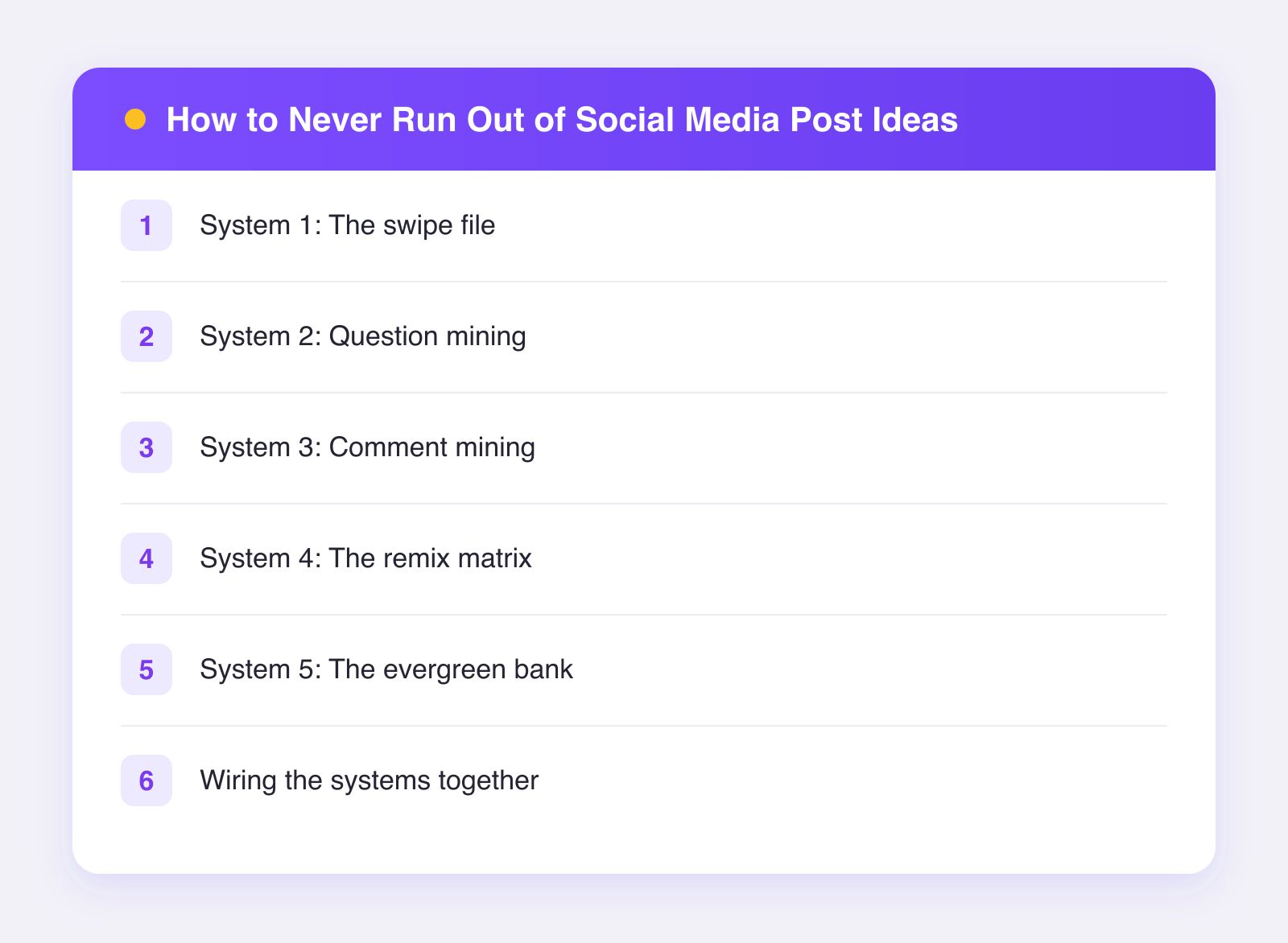
System 1: The swipe file
A swipe file is a running collection of posts, hooks, and formats that made you stop scrolling. Not to copy, but to study and adapt.
Make it frictionless:
- Create one note or folder called "Swipe."
- Every time a post grabs you, save it with one line on why it worked: the hook, the format, the emotion.
- Once a week, skim it and ask: what is my version of this?
The "why it worked" line is the important part. A screenshot graveyard teaches you nothing. A pattern library teaches you hooks, structures, and angles you can reuse forever.
System 2: Question mining
Every question your audience asks is a post they have pre-approved. Mine questions from:
- Sales calls and demos. What do prospects always ask before buying?
- Support tickets and DMs. Confusion is content. If one person asked, fifty wondered.
- Search suggestions. Type your topic into Google or YouTube and read the autocomplete.
- Communities. Reddit threads, Facebook groups, and forums in your niche are question firehoses.
Keep a simple list titled "Questions." One question often yields three posts: a quick answer, a detailed how-to, and a myth-busting take on the wrong answers people usually get.
System 3: Comment mining
Your own comment sections, and your competitors', are an underused idea source.
Look for three signals:
- Follow-up questions on your posts. Each one is a sequel waiting to be written.
- Disagreements. A thoughtful rebuttal to a common objection makes a strong standalone post.
- What people say on competitor posts. What did the post leave out? What confused readers? That gap is your angle.
Comment mining has a bonus effect: because the idea came from a real reaction, the resulting post tends to get reactions too.
System 4: The remix matrix
This is the highest-leverage system on the list. Take your core topics and run them through a list of angles. Topics down the side, angles across the top, and every cell is a post idea.
| Angle | What it looks like |
|---|---|
| Beginner mistake | "The #1 mistake first-timers make with X" |
| Step-by-step | "How to do X in 5 steps" |
| Myth vs reality | "Everyone says X. Here's what actually happens." |
| Before/after | "What changed when we started doing X" |
| Checklist | "Run through this before you X" |
| Hot take | "Unpopular opinion: X is overrated" |
| Story | "The time X went wrong for us" |
Five topics times seven angles is 35 ideas from one brainstorming session. And when a post performs well, remix it again for another platform or format. One strong idea should never live only once. This pairs naturally with batching your content: fill a row of the matrix, then write the whole row in one sitting.
System 5: The evergreen bank
Some posts are timely. The rest should go into an evergreen bank: a stash of finished, undated posts that work any week of the year.
Rules for the bank:
- Only finished posts go in. Ideas live elsewhere; the bank is for ready-to-publish material.
- Aim to keep 10-15 posts in reserve.
- Whenever your calendar has a hole, pull from the bank instead of forcing a rushed post.
The bank turns your worst weeks into normal weeks. Sick days, launches, and vacations stop being calendar emergencies. If you are unsure what belongs in the bank, our guide to evergreen vs trending content draws the line clearly.
Wiring the systems together
Here is the weekly loop that ties it all up:
- Capture all week. Swipe file saves, mined questions, comment finds. Thirty seconds each.
- Choose once a week. Skim your lists, pick the week's posts, and slot them against your content pillars.
- Write in one batch. No idea-hunting during writing time. The pipeline already did that job.
- Schedule everything. Load the batch into a scheduler and walk away.
That last step matters more than it seems. Ideas die in drafts folders. With Plumefy you can schedule the whole batch across up to 11 networks from one calendar, tweak captions per platform, and let the evergreen bank fill any gaps. You can try Plumefy free with 10 scheduled posts, which is a full week or two of this system.
FAQ
How many ideas should I keep on hand?
Enough for two to four weeks of posting, roughly 15-30 ideas plus 10 finished evergreen posts. More than that becomes a museum you never visit.
What if all my ideas feel repetitive?
Repetition is mostly fine; your audience does not read your feed like a book. But if you feel stale, run old topics through new angles in the remix matrix. The topic can repeat when the angle is fresh.
Is it okay to reuse a post that already did well?
Yes. Wait a few months, refresh the hook, and repost or reformat it. Most of your audience never saw it the first time, and the ones who did will not remember.
Where do AI tools fit in?
Use them for angles, hooks, and per-platform rewrites, not for generating your core ideas from nothing. Ideas mined from your real audience will always outperform generic prompts, because the demand behind them is real.
Post everywhere, once.
Start on the free plan — no card needed, upgrade when you need scheduling.
Start free