One Idea, Eleven Posts: The Expansion Workflow
Turn one core idea into a fitted post for all eleven networks. A simple expansion workflow that saves hours without copy-pasting the same caption everywhere.
Here is a belief that quietly burns out creators: every platform deserves its own original content. Eleven networks, eleven separate ideas, eleven separate production efforts. Nobody can sustain that, so most people either shrink to one platform or start copy-pasting identical posts everywhere, which works even worse.
There is a third way, and it is how most successful multi-platform accounts actually operate: one core idea, expanded into a fitted version for each network. The idea is the expensive part. The versions are cheap. You do the hard thinking once and the adaptation many times.
This post walks through the expansion workflow step by step, with a network-by-network map you can reuse for every idea you have.
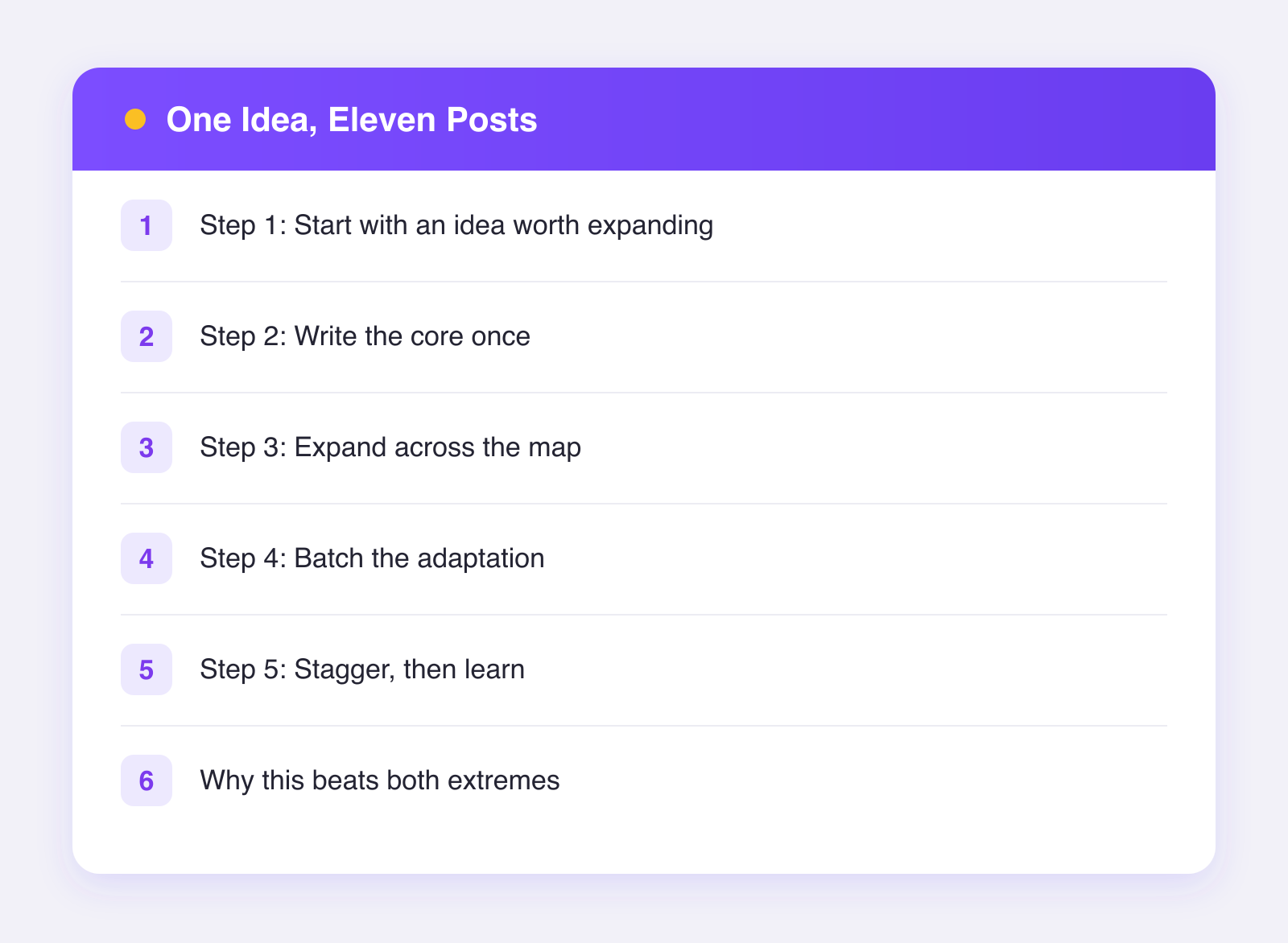
Step 1: Start with an idea worth expanding
Not every idea can carry eleven posts. The ones that can share a few traits:
- They make a claim. "Batching saves time" is a topic. "Batching one hour a week beats posting daily from scratch" is a claim you can argue, demonstrate, and illustrate.
- They contain a story or example. Something happened, something changed, something surprised you.
- They can be compressed and stretched. A good idea survives as one sentence and as five hundred words.
One strong idea per week is enough. Seriously. Depth beats volume, and the expansion gives you the volume anyway.
Step 2: Write the core once
Before touching any platform, write the idea in its fullest natural form: the claim, the story behind it, the takeaway, and any numbers or specifics. Two or three paragraphs. This master version is your source material; every platform post is a cut of it, not a rewrite from scratch.
Step 3: Expand across the map
Here is how one idea translates across all eleven networks Plumefy supports, using our batching claim as the running example:
| Network | The fitted version |
|---|---|
| TikTok | Talking-head video: "I post 20 times a week and work on it one hour. Here's the system." Caption sets up the video, short. |
| Reel or carousel walking through the system; caption tells the mini-story with a save-worthy summary | |
| YouTube | Longer tutorial or a Short cut from the TikTok take |
| The story version, conversational, asks what others do | |
| X | The claim as a sharp one-liner, or a short thread of the steps |
| The professional angle: what batching did for consistency and output, lesson framed for work | |
| The checklist as a graphic; searchable description like "weekly social media batching checklist" | |
| Threads | The casual take, one honest observation, invites replies |
| Bluesky | Conversational one-liner, slightly more offbeat framing works well |
| Value-first: the full system, shared in a relevant community, no self-promotion | |
| Google Business | Only if locally relevant, e.g. a tip tied to your services or an update |
Notice what changes across the rows: length, tone, format, and the call to action. What never changes: the idea. That consistency is a feature. People who follow you in two places see a coherent brand, not a rerun.
Two honest caveats. Reddit punishes anything that smells like marketing, so only post where the full value stands alone. Google Business is for local relevance, not general content, so skip it when the idea does not fit. Ten fitted posts and one deliberate skip beats eleven forced ones.
Step 4: Batch the adaptation
Adaptation is mechanical enough to do in one sitting. With your master version open, most platform cuts take two to five minutes by hand. This is also where AI genuinely earns its place, because reshaping existing material is what it does most reliably.
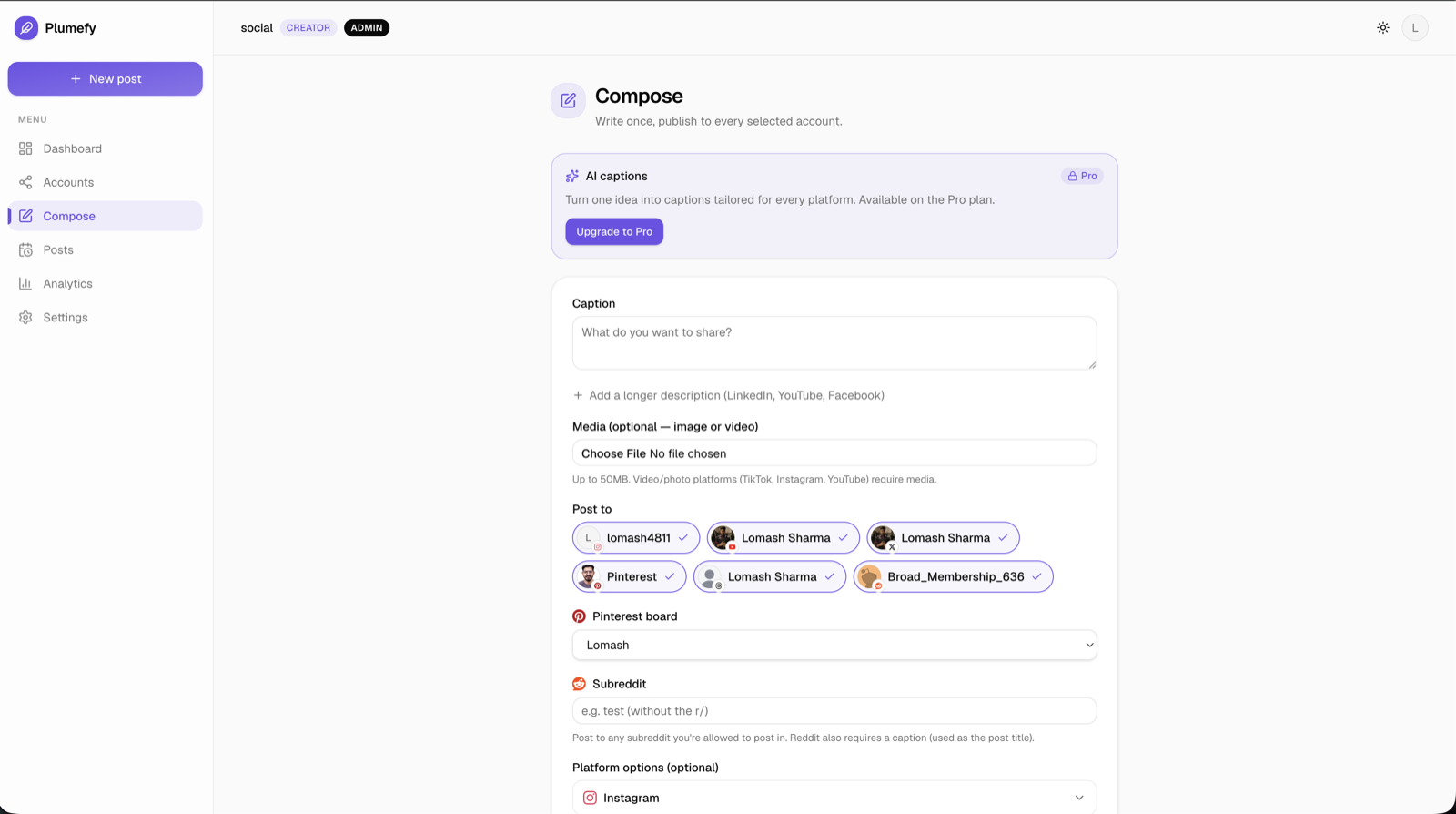
In Plumefy, you describe the post once and the AI drafts a caption fitted to each network's tone and length, which you edit before scheduling. Combined with scheduling to all 11 networks from one screen, the whole expansion, from master version to a scheduled week, fits comfortably inside an hour. You can try Plumefy free and run one idea through the full map to see the time difference yourself.
For the craft side of adaptation, what to change per network and why, see our deeper guide on tailoring posts per platform.
Step 5: Stagger, then learn
Do not fire all eleven posts at the same minute. Spread them across a day or several days; each platform's audience lives on its own clock, and staggering also lets early reactions on one network improve your framing on the next.
Then watch what happens. The same idea will overperform on two or three networks and flop on others. That pattern is gold: it tells you where your audience actually lives and which formats carry your ideas best. Feed it back into next week's expansion.
Why this beats both extremes
Compared to posting on one platform only, you reach people where they already are, at maybe twenty percent extra effort. Compared to copy-paste cross-posting, every post reads native, so none of them get ignored as obvious reruns. The failure mode of lazy syndication is real, and we cover it separately in how to cross-post without sounding robotic.
One idea. One hour. Eleven chances for it to find its audience.
FAQ
Do I have to post to all eleven networks?
No. Expand to the networks where your audience plausibly lives and where the format fits. Many creators run five or six seriously and skip the rest. The workflow is the same at any count.
Won't followers see the same idea twice?
A few might, and it rarely hurts. The versions look and read differently, and repetition of a good idea builds recognition. Marketers have always repeated core messages; you are just doing it across space instead of time.
What order should the platforms go in?
A common pattern: lead with your strongest video platform, since video is the hardest asset to make, then roll text and image versions out over the following days. There is no magic order; consistency matters more.
How is this different from repurposing?
Repurposing usually means converting existing content, like turning an old video into clips. Expansion starts upstream: you design the idea for multi-platform life from the beginning. Both are useful, and they combine well; see our guide on repurposing content across platforms.
Post everywhere, once.
Start on the free plan — no card needed, upgrade when you need scheduling.
Start free