Follower Growth: What's Normal, What's Not
Follower growth is lumpy for everyone. Learn how to compute your own monthly growth rate, when a slow month is fine, and when a drop actually needs attention.
You gained forty followers last week and lost twelve this week, and nothing about your content changed. Is something wrong? Almost certainly not. But the question nags, because nobody tells you what normal growth actually looks like.
Here is the honest answer: normal growth is lumpy. It stalls, spikes, dips, and plateaus, even for accounts doing everything right. The creators who look like they grow in a smooth line are just not showing you the weekly chart.
This post shows you why growth is jagged, how to compute your own growth rate so you have a real baseline instead of vibes, and how to tell a harmless dip from an actual problem.
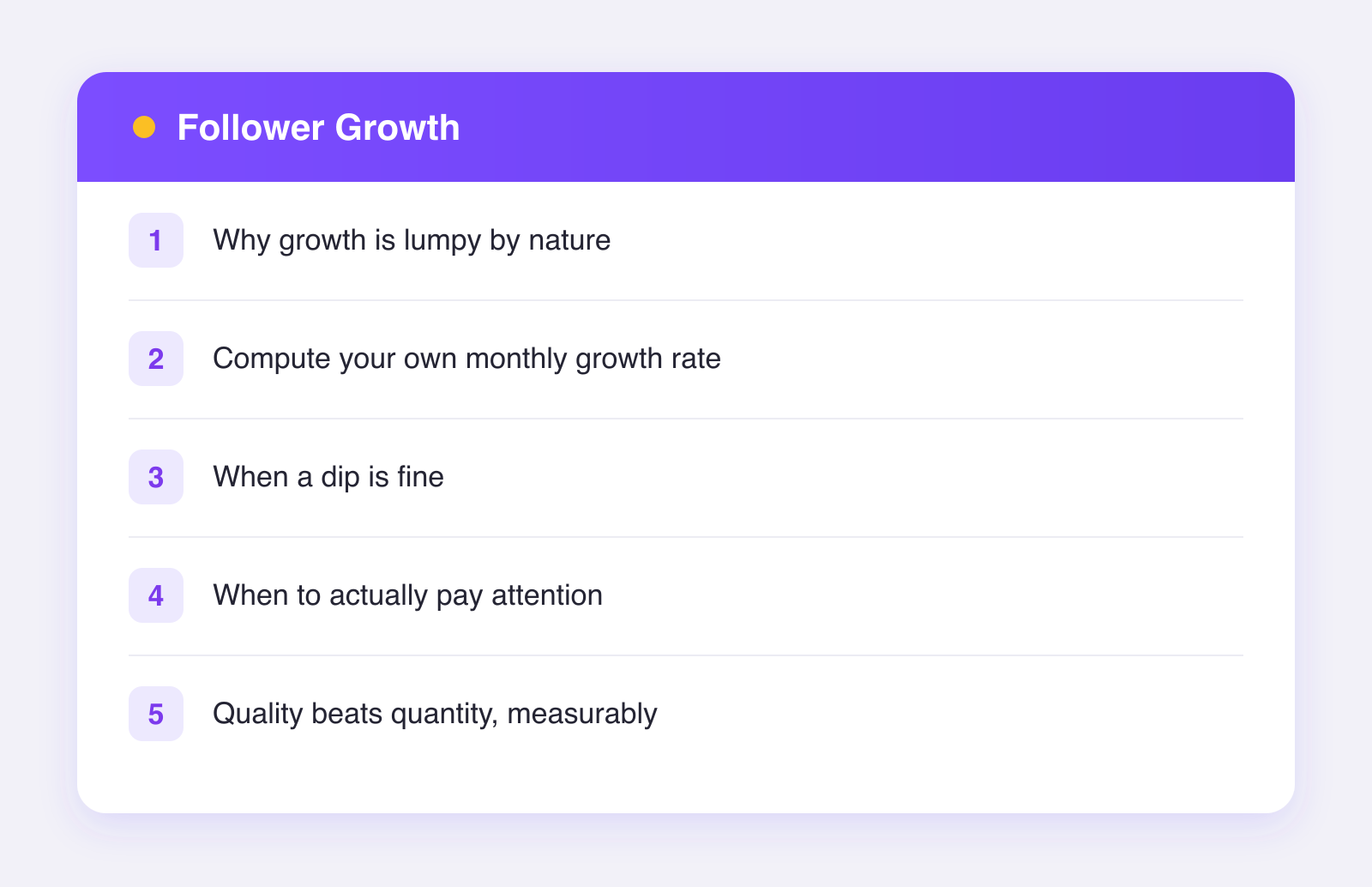
Why growth is lumpy by nature
Follower counts move for reasons that have nothing to do with your latest post:
- Discovery is spiky. Most new followers arrive when a single post travels further than usual. Between those posts, growth idles. That is the normal shape: staircase, not ramp.
- Platforms purge fake accounts. Every network deletes bots and inactive accounts in batches. When a purge lands, counts drop across the board overnight. You lost numbers, not people.
- People tidy their feeds. Mass-unfollow sessions are common. Being cut in a spring cleaning is not a review of your content.
- Seasons matter. Attention shifts with holidays, school calendars, and news cycles. Some months are simply quieter for your niche.
Add these together and a jagged line is what healthy growth looks like up close.
Compute your own monthly growth rate
Generic benchmarks mostly mislead — a food account, a B2B account, and a meme page grow on different physics. The number that matters is your own baseline. Here is how to build it:
- Record your follower count on the first of each month, per account. (Past months are often recoverable from your platform analytics.)
- Compute monthly growth rate: (this month's count minus last month's count) divided by last month's count, times 100.
- Do this for at least three months — six is better — and take the median. That median is your baseline.
Example: you started the month at 2,400 followers and ended at 2,472. That is 72 gained, or 3 percent. If your last few months were 2, 4, and 3 percent, your baseline is about 3 — and a 1.5 percent month is a wobble, not a crisis.
Two details make this more useful. First, track net change and its parts: 100 gained minus 80 lost tells a different story than 25 gained minus 5 lost, even though the net twenty is similar. Second, keep the log per account and per platform — growth rhythms differ wildly across networks, and blending them hides the signal. Plumefy's combined analytics tracks follower growth per account across all your platforms in one dashboard, which turns this whole ritual into a glance.
When a dip is fine
Most of the time. Specifically, do not worry when:
- The dip is small relative to your baseline and lasts under a month
- It coincides with you posting less, or with a quiet season for your niche
- Your engagement per post held steady — the audience that remains still cares
- The drop happened overnight in one chunk (that is a purge, and it made your count more honest)
One unfollow from a real fan hurts more in your head than in your metrics. Zoom out to the monthly line before drawing conclusions from a Tuesday.
When to actually pay attention
A few patterns deserve a closer look:
- Three or more consecutive months below your baseline with no change in your effort. Something shifted — format, topic, platform distribution — and it is worth diagnosing.
- Losses consistently outpacing gains. Steady bleeding usually means your recent content serves a different audience than the one that followed you. Our guide on why you might be losing followers digs into the common causes and the safe way to see who left.
- Growth without engagement. If followers climb but likes, comments, and saves stay flat, you may be attracting the wrong crowd — or bots. That gap tends to hurt reach later.
Notice what is missing from this list: any single bad week.
Quality beats quantity, measurably
A thousand followers who buy, share, and comment are worth more than fifty thousand who scroll past. If you want one habit that improves follower quality, make it this: optimize for the post-level actions that indicate care — saves, shares, replies — rather than raw reach. Our guide on how to increase your engagement rate is the practical playbook for that.
Quality also compounds across platforms. Your most devoted followers will find you everywhere you post, and each network's discovery engine gives you a fresh shot at the right audience. Plumefy lets you cross-post and schedule to up to 11 networks and watch each account's growth side by side, so you can see where your people actually are — try Plumefy free.
FAQ
What is a good monthly growth rate?
There is no universal number worth trusting — niche, account age, and platform change the math completely. As a rough rule of thumb, small accounts see larger percentage swings than big ones simply because the denominator is small. Your own three-to-six-month median is the only benchmark that reflects your reality.
My count dropped overnight for no reason. Was I penalized?
Almost certainly not. Sudden overnight drops across many accounts at once are platform purges of fake and inactive accounts. Your count got more accurate, not smaller in any way that matters.
Should I check my follower count daily?
No. Daily checking maximizes anxiety and minimizes information. Log it monthly, glance weekly at most, and spend the reclaimed attention on making things.
Is buying followers ever worth it as a kickstart?
No. Purchased followers never engage, which drags down the ratios platforms use to decide distribution. You would be paying to look bigger while performing worse.
Post everywhere, once.
Start on the free plan — no card needed, upgrade when you need scheduling.
Start free