How to Automate Social Media Without Looking Automated
Automate the boring parts of social media without looking like a bot. What to schedule, what to keep human, and the etiquette that protects audience trust.

There is a specific kind of account everyone has learned to ignore. Posts appear like clockwork. Every caption ends with the same three hashtags. Comments go unanswered for weeks. The account is technically active and completely lifeless.
That is what bad automation looks like, and it is why some creators swear off scheduling tools entirely. But the tools were never the problem. The problem is automating the wrong things. Automation should buy back your time so you can spend it on the parts that must stay human.
Think of it as etiquette. There are things a machine can do on your behalf without anyone minding, and things that insult people when a machine does them. Here is the line.
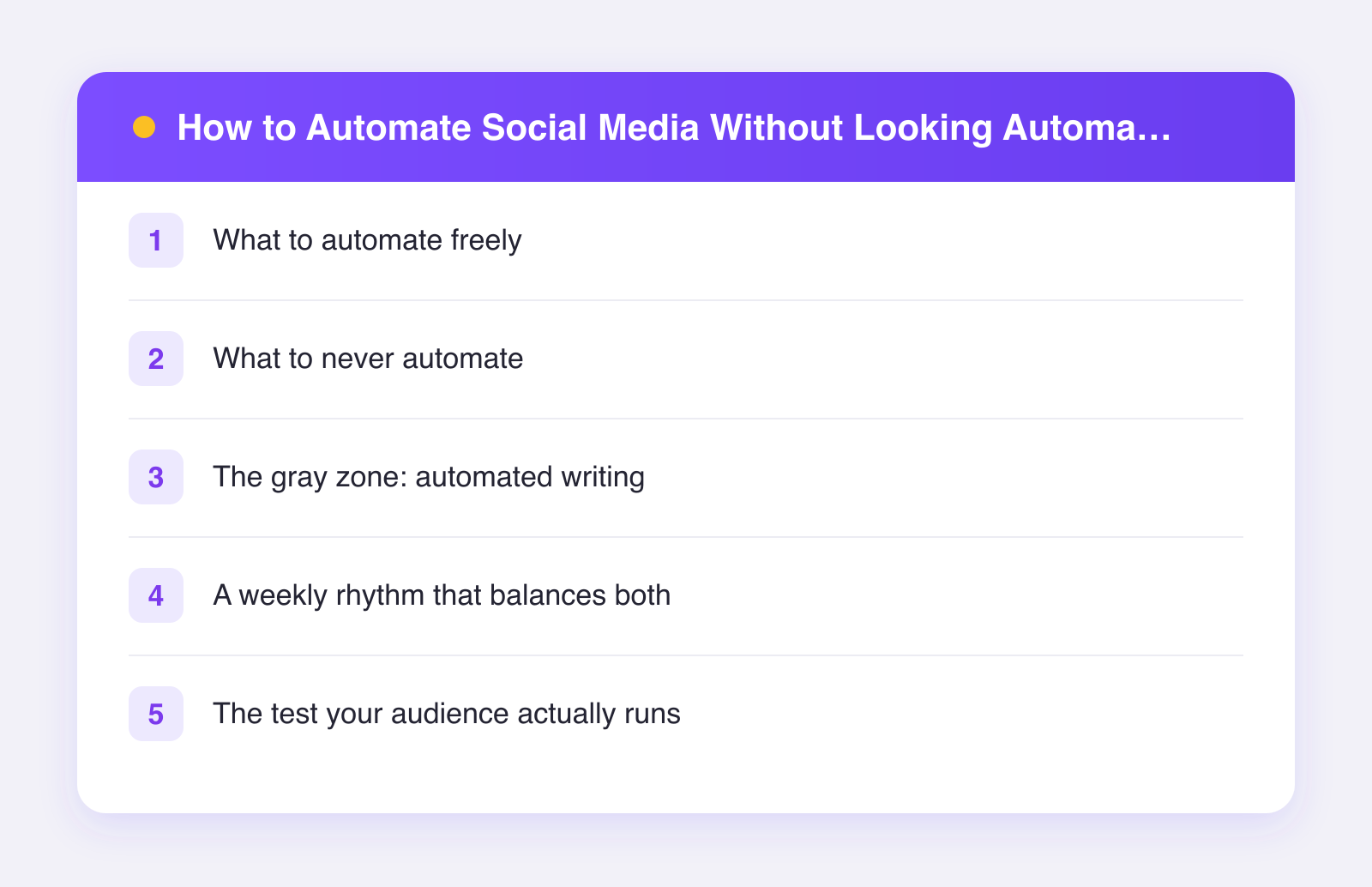
What to automate freely
These tasks are pure logistics. Nobody knows or cares whether a human clicked the final button, and automating them makes your content better, not worse.
- Scheduling and publishing. Writing at 9 p.m. and posting at 9 a.m. is not deception. It is planning. Every publication on earth works this way.
- Cross-posting with adaptation. Sharing one idea to several networks is smart distribution, as long as each version is fitted to its platform. More on that below.
- Formatting. Resizing media, trimming captions to platform limits, adjusting link placement. Tedious, mechanical, perfect for software.
- Queue management. Keeping a steady pipeline so a busy week does not become a silent week.
- Analytics collection. Pulling your numbers into one view instead of checking five dashboards.
Batching your writing and scheduling it out is the single highest-leverage habit in social media. If you have not tried it, start with our guide to batching social content.
What to never automate
These are the moments when a person expects a person. Automating them is how accounts turn into ghost towns with good production values.
- Replies to comments. A comment is a person raising their hand. Auto-replies and canned responses read instantly as fake, and they teach people to stop commenting.
- DMs. Automated DM blasts are the fastest way to feel like spam. If you would not send it to a friend, do not send it at scale.
- Engagement on other accounts. Auto-liking and auto-commenting tools produce the "Great post!" comments everyone recognizes and nobody respects. Most platforms prohibit them anyway.
- Reacting to news and trends. A queue does not know what happened this morning. Trend posts and timely reactions need a human deciding, today, that this is worth saying.
- Handling complaints. When someone is unhappy in public, a templated response pours gasoline on it. Slow and human beats instant and robotic.
The five-minute rule
Here is a habit that keeps a scheduled account feeling alive: show up for five minutes shortly after a post goes live. Reply to early comments, answer questions, react to what people say. Early replies do double duty, since conversation in the first hour tends to help distribution and it signals to everyone reading that a human is home.
The gray zone: automated writing
AI-drafted captions sit between the two lists, and the etiquette is simple: automation may draft, a human must approve. A caption that ships straight from a model with no review is a reply-shaped version of the ghost town problem. A caption drafted by AI and then edited by you is just efficient writing.
This is how Plumefy treats it. On the Pro plan you describe your post, the AI drafts a caption fitted to each network's tone and length, and every draft sits in an editor waiting for your changes before anything is scheduled. The tool assumes a human edit pass, because that pass is where the post becomes yours.
A weekly rhythm that balances both
Here is a realistic split for a solo creator or small team:
| Time | Activity | Mode |
|---|---|---|
| Monday, 60-90 min | Write and schedule the week's posts | Automated publishing |
| Daily, 10-15 min | Reply to comments and DMs | Fully human |
| Daily, 5 min | Check for trends worth a same-day post | Fully human |
| Friday, 15 min | Review analytics, adjust next week | Human, tool-assisted |
Total: a few focused hours per week, with automation carrying the repetition and you carrying the relationships. Compare that to the alternative, where you spend the same hours copy-pasting posts into five apps and have nothing left for actual conversation.
If your bottleneck is the publishing side, a scheduler that posts to all your networks from one place is the fix. Plumefy covers 11 networks with multiple accounts per platform in one workspace, and the free plan handles 2 accounts and 10 posts, enough to test the rhythm above. You can try Plumefy free and keep your daily human time for the comments section.
The test your audience actually runs
Your followers do not audit your toolchain. They run a much simpler test: when I talk to this account, does it talk back? When something happens in the world, does this account notice? If the answer is yes, you can schedule every single post and nobody will ever call you automated. If the answer is no, posting manually will not save you.
Automate the calendar. Never automate the conversation.
FAQ
Do audiences care if posts are scheduled?
No. There is no visible difference between a scheduled post and a manual one, and scheduling is universal practice among professional accounts. What audiences notice is unanswered comments and tone-deaf timing.
Should I pause my queue during major news events?
Have a look at what is scheduled, at minimum. A cheerful promo landing in the middle of serious news can read badly. Most schedulers, Plumefy included, make it quick to push posts back a day.
Are auto-reply tools ever okay?
A clearly labeled away-message in DMs, like a note that you reply within a day, is honest and fine. Auto-replies that pretend to be a personal response are not. The test is whether the recipient would feel deceived on learning it was automated.
How fast do I need to reply to comments?
Same day is great, within a few hours is excellent. The point of the five-minute rule is not speed for its own sake; it is concentrating your presence when the post is getting its first wave of attention.
Post everywhere, once.
Start on the free plan — no card needed, upgrade when you need scheduling.
Start free