7 Social Media Automation Mistakes That Cost You Followers
The most common social media automation mistakes: identical posts everywhere, ghost-town comment sections, set-and-forget schedules, and easy fixes for each.
Automation is the best thing that ever happened to small social media teams, and also the fastest way to make an account feel dead. Same tools, opposite outcomes. The difference is never the software; it is a handful of predictable mistakes that almost everyone makes at some point.
We have collected the classics here. If you recognize yourself in one or two, good news: every mistake on this list has a fix you can apply this week.
None of these fixes mean abandoning automation. They mean pointing it at the right jobs.
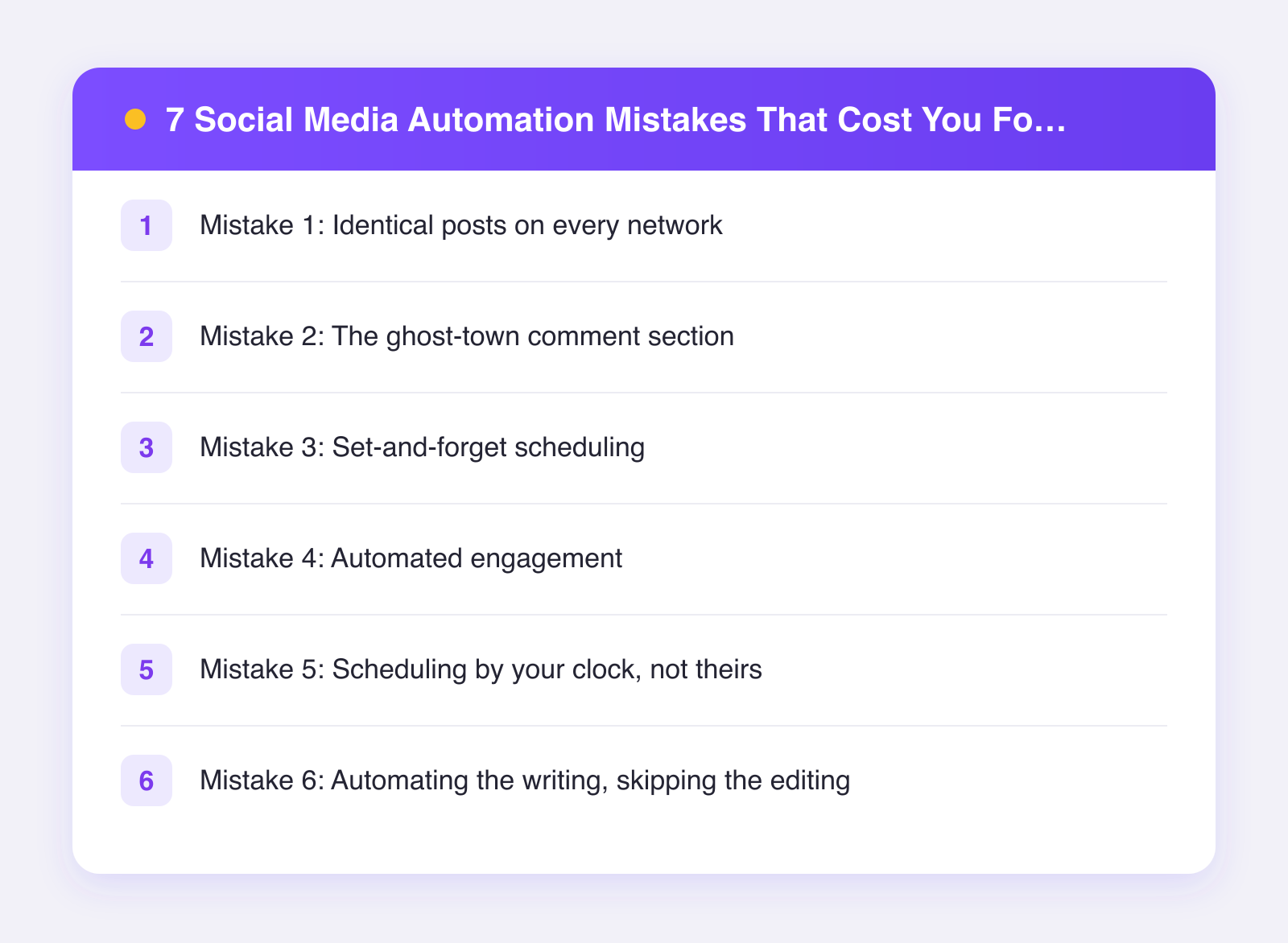
Mistake 1: Identical posts on every network
The most common one by far. One caption, blasted verbatim to every platform: LinkedIn hashtags on Bluesky, a caption that says "link in bio" on X where the link could just be in the post, a wall of text on TikTok.
Audiences read this instantly as "this account doesn't actually live here," and they engage accordingly.
The fix: adapt, don't copy. The idea stays the same; the length, tone, and format change per network. It takes minutes per post by hand, and less with help. Plumefy's AI captions exist for exactly this: describe your post once, get a draft fitted to each network's tone and length, edit, schedule. Our guide on cross-posting without sounding robotic covers the craft in detail.
Mistake 2: The ghost-town comment section
Posts go out on schedule for months. Under them: unanswered questions, ignored compliments, tumbleweeds. The account publishes but never listens.
This is the mistake that actually costs followers, because it breaks the implicit deal of social media: talk to me and I will talk back. People stop commenting on accounts that never reply, and platforms tend to show quiet posts to fewer people.
The fix: never automate conversation, and budget human minutes for it daily. Ten minutes a day of real replies does more for an account than an eleventh scheduled post ever will. Show up especially in the first hour after posting, when replies are most visible and most valuable.
Mistake 3: Set-and-forget scheduling
A queue loaded in March, still firing in June. Nobody has checked the analytics, the same format keeps shipping whether it works or not, and one day a chirpy promo lands in the middle of somber breaking news.
The fix: automation needs a human check-in loop. Fifteen minutes a week: skim what is scheduled for the next few days, skim what the numbers say about last week, adjust. A queue is cruise control, not a self-driving car.
Mistake 4: Automated engagement
Auto-likes, auto-follows, comment bots leaving "Love this! 🔥" on strangers' posts. It reads as spam because it is spam, and most platforms prohibit it outright, which puts your account at risk for engagement that convinces no one.
The fix: just don't. There is no safe version. Real engagement in ten honest minutes beats a thousand botted gestures.
Mistake 5: Scheduling by your clock, not theirs
Everything posts at 9 a.m. your time because that is when you loaded the queue, while half your audience is asleep. Or every network gets the same time slot even though your audiences on each behave differently.
The fix: check each platform's native audience-activity stats, stagger your posting times per network, and treat it as an experiment you revisit monthly. Our posting schedule guide has starting points per platform.
Mistake 6: Automating the writing, skipping the editing
AI drafts shipped raw, no human pass. The account develops that unmistakable beige quality: grammatically perfect, emotionally vacant, interchangeable with a thousand others.
The fix: AI may draft; a human always approves. Sixty seconds per post to cut the filler opener, insert one specific detail only you know, and delete anything you would never say out loud. This is the entire difference between AI-assisted and AI-generated.
Mistake 7: Measuring output instead of outcomes
The automation is working, in the sense that posts are shipping. Thirty posts went out this month! But nobody asks what happened next, so the account optimizes for volume while engagement quietly slides.
The fix: pick two or three numbers that represent real outcomes, like saves, replies, link clicks, or follower growth, and review them weekly. Combined analytics help here; Plumefy pulls performance across your connected networks into one view, so the weekly check-in from Mistake 3 takes minutes instead of a tour of five dashboards. You can try Plumefy free and set up that loop with a couple of accounts.
The pattern behind all seven
Read the list again and one theme emerges: every mistake is automation replacing judgment or conversation, and every fix is automation handling repetition while humans keep the judgment and the conversation. Schedule the posts. Adapt them per network. Check the numbers. And when a human talks to your account, make sure a human answers.
Get that split right and automation gives you its real gift: hours back every week, spent on the parts of social media that actually grow an audience.
FAQ
Is it a mistake to schedule everything in advance?
Scheduling everything is fine; ignoring everything after scheduling is the mistake. Keep the weekly check-in and stay willing to reshuffle around timely moments, and a fully scheduled account is indistinguishable from a manually run one.
How do I know if my cross-posts read as lazy?
Open each network as a viewer and look at your post next to native content. Wrong-length captions, other platforms' conventions, or instructions that make no sense there (like "link in bio" where links work) are the tells.
What is a healthy amount of daily human time?
For most solo creators and small brands, ten to twenty minutes of genuine replies and community time daily, on top of batched writing sessions. If automation is not buying you at least that much time back, revisit your setup.
Are engagement pods the same mistake as engagement bots?
They rent the same false signal with extra steps. Coordinated fake engagement tends to correlate poorly with real reach, and platforms increasingly discount it. The effort is better spent making one post genuinely worth sharing.
Post everywhere, once.
Start on the free plan — no card needed, upgrade when you need scheduling.
Start free