Content Pillars: How to Pick Yours (and When to Change Them)
How to choose 3-5 content pillars that fit your brand: mine audience questions, add proof and personality, then test and rotate pillars as you learn.

"Just post consistently" is easy advice to give and hard advice to follow. The missing piece is usually not discipline. It is a decision: what are you actually about?
Content pillars answer that question. They are the three to five recurring themes your account keeps coming back to. Pick good ones and every posting day gets easier, because you are never starting from a blank page. You are filling in a slot.
Here is how to choose pillars that fit your brand, plus how to know when one has gone stale.
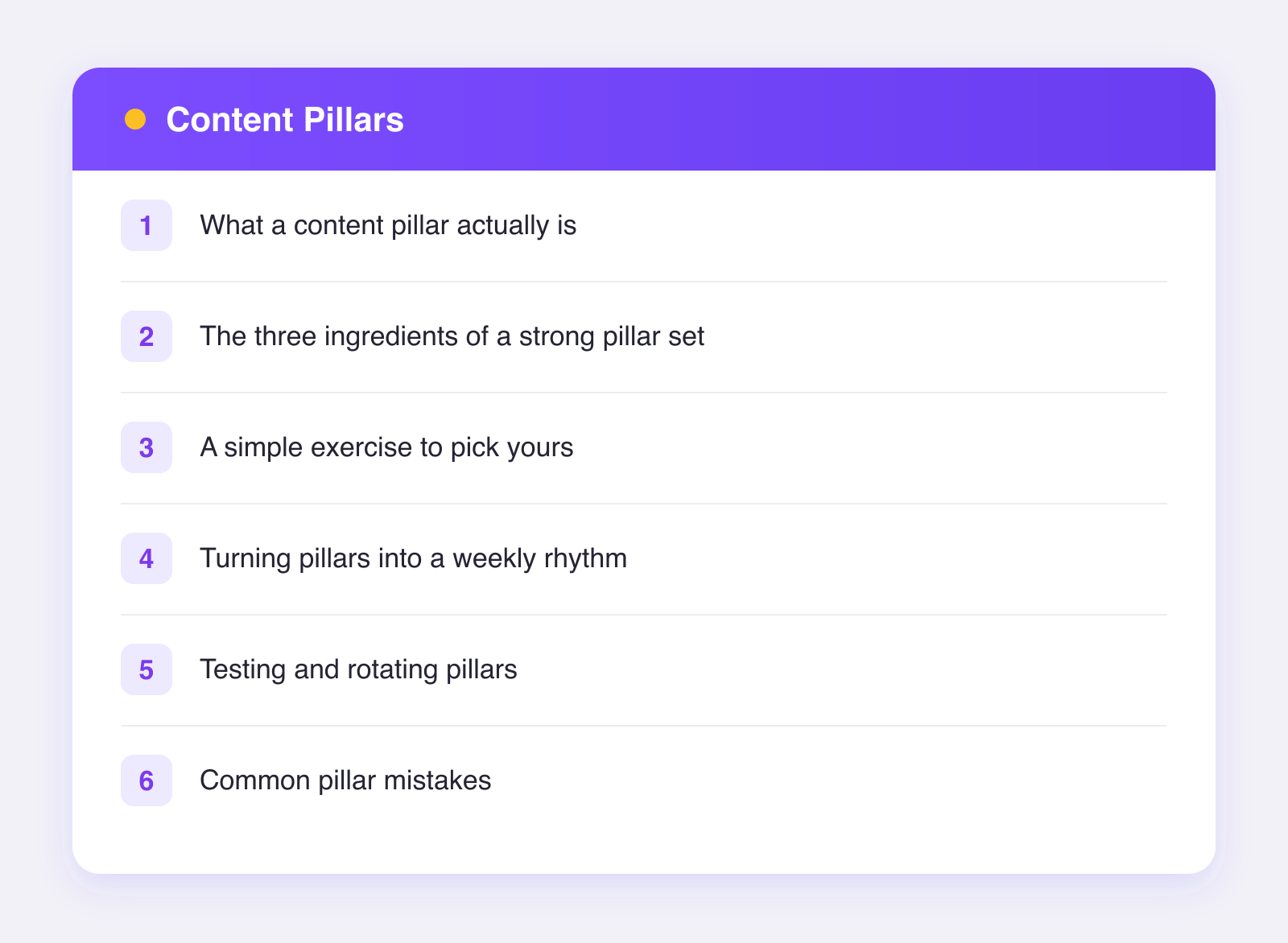
What a content pillar actually is
A pillar is a theme, not a format. "Carousels" is not a pillar. "Answering the questions our customers ask before they buy" is a pillar that can become a carousel, a video, a text post, or a thread.
Good pillars share three traits:
- Your audience cares about them. They map to real questions, goals, or frustrations.
- You can speak on them with authority. You have experience, results, or a real point of view.
- They can generate dozens of posts. A pillar that runs dry in three posts was a topic, not a pillar.
The three ingredients of a strong pillar set
Most balanced pillar sets draw from three sources. Aim for at least one pillar from each.
1. Audience questions
What do people ask you in DMs, sales calls, and support emails? Every recurring question is a pillar candidate, because the demand is proven. If you sell accounting software, "plain-English answers to small business tax questions" will never run out of material.
2. Proof
People follow brands that show their work. A proof pillar covers results, process, behind-the-scenes, and lessons learned. It is how strangers come to trust you without a sales pitch. Case walkthroughs, before-and-afters, and "here is what we changed and why" posts all live here.
3. Personality
The pillar most brands skip, and the one that makes people actually like you. Opinions, stories, humor, the founder's take on industry news. It does not need to dominate your calendar, but without it you are a FAQ page with a logo.
A simple exercise to pick yours
Block 45 minutes and work through this:
- List 20 questions your audience has asked you. Real ones, from real channels.
- List 10 things you can prove. Results, numbers you are allowed to share, processes you have refined.
- List 5 opinions you hold that some people in your industry would disagree with.
- Cluster the lists into themes. You will usually see 4-6 natural groups.
- Cut to 3-5. Keep the clusters where audience interest and your authority overlap most.
Name each pillar in one sentence, like "We demystify pricing for first-time freelancers." If you cannot name it in a sentence, it is too vague to guide your writing.
Turning pillars into a weekly rhythm
Pillars only pay off when they meet a schedule. Assign each pillar a rough share of your calendar. A common split for a four-pillar set:
| Pillar type | Share of posts | Example slot |
|---|---|---|
| Audience questions | 40% | Mon, Thu |
| Proof | 30% | Tue |
| Personality | 20% | Fri |
| Promotion | 10% | Occasional |
Notice promotion gets a slot too. Pillars are not a vow of silence about your product; they just keep the ratio honest.
This structure is also what makes batching work. When you sit down to write a week of content, you are answering four small prompts instead of one giant "what should I post" question. Pair your pillars with a content calendar template and the weekly plan nearly writes itself. If you manage several platforms, a scheduler like Plumefy lets you plan the whole pillar rotation once and push it to every network from one calendar.
Testing and rotating pillars
Pillars are a hypothesis, not a constitution. Review them quarterly:
- Look at engagement by pillar, not by post. One viral post does not validate a pillar; consistent above-average performance does.
- Check your energy. A pillar you dread writing will show it. Reluctance is data.
- Watch for drift. If your business changed focus, your pillars should follow.
When a pillar underperforms for a full quarter, replace it with your next best candidate from the original exercise. Change one pillar at a time so you can tell what caused any shift. And keep a mix of durable and timely themes; our comparison of evergreen vs trending content digs into why the durable ones should carry most of the weight.
Common pillar mistakes
- Too many pillars. Seven pillars is zero pillars. The constraint is the point.
- Pillars only you care about. "Our company news" is rarely a pillar your audience asked for.
- Identical pillars to every competitor. If your set could be swapped with any rival's, add a personality pillar with actual opinions.
- Never revisiting them. A pillar set from two years ago is describing a brand that no longer exists.
FAQ
How many content pillars should I have?
Three to five. Fewer than three gets repetitive fast; more than five stops guiding your decisions. Start with three and earn your way to five.
Should every platform have the same pillars?
Usually yes, with different emphasis. Your proof pillar might dominate LinkedIn while personality leads on TikTok. Same themes, different mix. Tools that let you customize captions per platform, like Plumefy with its per-platform AI captions on Pro, make this easy to keep up; you can try Plumefy free and test the workflow yourself.
How long should I test a new pillar before judging it?
A full quarter, or at least 10-12 posts. Individual posts are noisy. You are judging the theme, and themes need repetitions to show their real performance.
Can promotion be a pillar?
Yes, as long as it stays a minority of your output. Making it an explicit pillar with a capped share is healthier than sprinkling sales posts in guiltily whenever revenue dips.
Post everywhere, once.
Start on the free plan — no card needed, upgrade when you need scheduling.
Start free