Does Cross-Posting Hurt Your Reach in 2026? The New Originality Rules
No, if it is your own video. The 2026 Instagram, X and YouTube rules target reposts of others. A watermark from another app is what costs reach.

Part of our guide: How to Post to Multiple Social Media Platforms at Once. Related tool: Cross-posting tool.
In 2026 three of the biggest platforms told creators the same thing in different words: original content gets the reach, copies do not. Instagram stopped recommending aggregator accounts' photos and carousels in April. X rebuilt its creator payouts around "original content" in August. YouTube changed how Shorts are recommended in October to cut the reach of re-uploads.
If you film one video and post it to TikTok, Reels and Shorts, that sounds like a threat. It mostly is not. The rules are aimed at people who repost other creators' work, and the platforms' own wording says so. What can still cost you reach is how you move your video between apps, not the fact that it exists on more than one.
The short version: posting your own video to several networks is not "unoriginal" on any major platform. X's rules say re-uploading from another platform is fine if "you are the author of that content". Facebook's say "You can share the same content across any of your Pages or profiles." YouTube's October update targets "content re-uploaded from other creators". What Instagram and Facebook do penalize is a visible watermark from another app, which is exactly what you get when you save a TikTok and upload it to Reels. So export a clean file, upload it natively to each app, and write a caption for each. The only large dataset we found, from a cross-posting tool's 203,691 cross-posts, shows views on the original app stayed flat (101% of before) after creators started cross-posting.
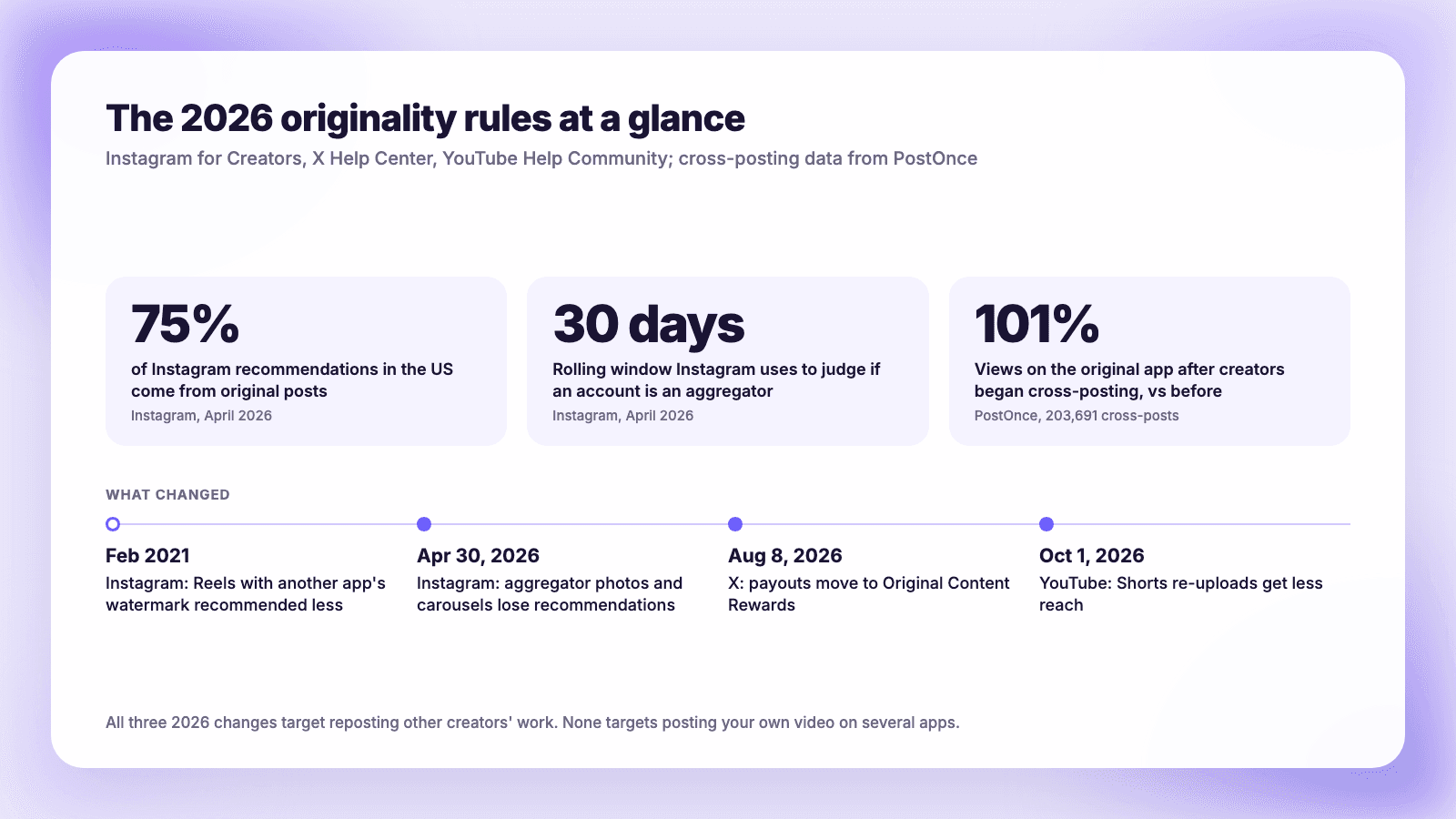
What changed in 2026
Each platform changed something different, so it helps to look at them one at a time.
| When | Platform | What changed |
|---|---|---|
| February 2021 | Reels with a watermark or logo from another app recommended less | |
| April 2024 | Copies of Reels replaced by the original in recommendations; aggregators removed | |
| July 2025 | Accounts that repeatedly reuse others' content lose monetization and reach | |
| April 30, 2026 | The same rules extended to photos and carousels | |
| August 8, 2026 | X | Revenue Sharing replaced by Original Content Rewards, from September 8 |
| October 1, 2026 | YouTube | Shorts recommendations changed to reduce reach of re-uploads |
Instagram: photos and carousels join Reels
On April 30, 2026 Instagram announced on its creators blog that "accounts that primarily post unoriginal content in photos or carousel posts, in addition to reels, will no longer be shown in places where we recommend content." It added that original content keeps growing, "with 75% of recommendations in the US now coming from original posts."
The rule works on accounts, not single posts. An account becomes eligible again "when a significant percentage of their recently posted photos, carousels, and reels are considered original in a 30-day period," and you can check where you stand in Account Status in your settings. Instagram was also clear that the change "does not impact how we show people content from accounts they follow."
X: payouts only for original posts
X replaced its Revenue Sharing program with Original Content Rewards. TechCrunch reported that applications opened on September 8, with thresholds of 500 verified followers and 500,000 Home Timeline impressions from verified users in 90 days. X's Allegra Jacchia said the old program "had reached a point where its incentives were misaligned."
YouTube Shorts: re-uploads get less reach
On October 1, 2026 YouTube posted Prioritizing original content on Shorts in its Help Community. It said it is updating recommendations "to further prioritize original content and reduce the reach of content re-uploaded from other creators without adding anything of your own." Channels "primarily aggregating or re-uploading other creators' videos without significant changes will likely see less distribution within the Shorts feed." The post had drawn 960 replies when we read it.
Does posting your own video everywhere count as unoriginal?
No. This is the question most creators actually have, and every platform that has written about it draws the line at whose content it is, not how many apps it appears on.
- X is the most explicit. Its Original Content Rewards help page lists "Cross-platform reposts" as not original, defined as "Content taken from other platforms and reposted by someone other than the original creator." It also excludes content "downloaded from X or another platform and reuploaded onto X (unless you are the author of that content)."
- Facebook says it plainly in its unoriginal content guidance: "Pages and profiles receive the greatest distribution when they consist primarily of original content that you filmed or created. You can share the same content across any of your Pages or profiles."
- YouTube aimed its Shorts change at "other creators' videos". Android Authority's reading was that "creators clipping their own long-form videos likely won't be affected."
- Instagram defines original content as "work that you wholly created or reflects your unique perspective," starting with "Photos or videos you took." Its duplicate detection works on copies it finds on Instagram: "when we find two or more identical pieces of content on Instagram, we will only recommend the original one," as its 2024 originality post put it.
- TikTok's Integrity and Authenticity guidelines say "Content is also ineligible for the FYF if it includes unoriginal or reused material without anything new." Your own video is not reused material taken from someone else.
Adam Mosseri, who runs Instagram, addressed the worry directly in a September 2024 post: "One big misconception I hear is that sharing videos created on third party apps will hurt your reach." His answer: "this is not true. Just make sure to remove any watermarks, as those can have an impact on reach."
That last sentence is the real risk.
The watermark problem
When you download a video from TikTok, the app stamps its logo and your username on it. Upload that file to Instagram or Facebook and you have posted something both companies have said for years they recommend less.
- In February 2021 Instagram said Reels that "have a watermark or logo" would not be recommended as often, as The Verge reported at the time. Instagram told the site that user surveys showed people had a "less satisfying" experience with content recycled from other apps.
- Instagram's 2024 post lists "has no visible watermarks" among the conditions for content to be eligible for its recommendation system at all.
- Facebook's 2025 guidance says: "Avoid using visible third party watermarks and content that is visibly recycled from other apps or sources."
Two details are easy to miss. First, adding your own watermark does not make a copy original. Facebook says "simply stitching together clips or adding your watermark does not qualify as meaningful enhancement," and Instagram lists "just adding a border, watermark, subtitles, or a credit in the captions" as not enough. Second, the penalty is about recommendations to non-followers. Your followers still see the post.
How much reach does a watermark cost? No platform has published a number, and we did not find an independent study that measured it. The honest answer is "less than a clean upload would get, by an amount nobody has disclosed." Since removing the problem costs nothing, it is not worth testing on your own account. Our guide to cross-posting Reels, TikToks and Shorts without watermarks covers the workflow.
What counts as original on each platform
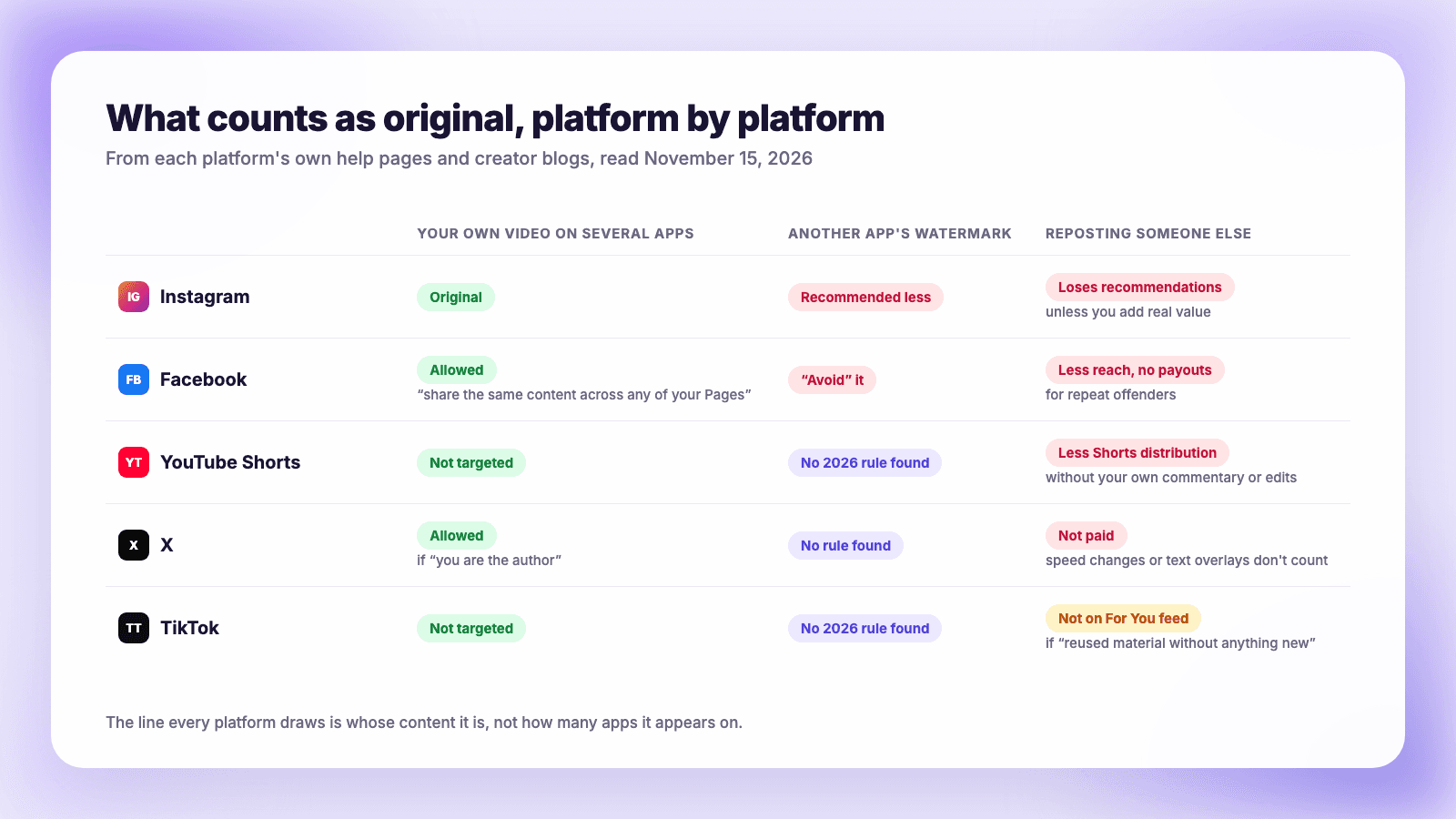
The platforms use different words, but they agree on the edges. This table quotes or closely follows each platform's own pages.
| Platform | Your own video on several apps | Another app's watermark | Reposting someone else's content |
|---|---|---|---|
| Original ("Photos or videos you took") | Recommended less | Not recommended unless you add "real value"; aggregators lose recommendations | |
| Allowed ("share the same content across any of your Pages") | "Avoid" it | Repeat offenders lose monetization and get "reduced distribution on everything they share" | |
| YouTube Shorts | Not targeted | No 2026 rule found | Less distribution in the Shorts feed without "your own original commentary, unique edits, or storytelling" |
| X | Allowed if "you are the author" | No rule found | Not paid; minimal edits like "adjusting video speed" or "placing a text overlay" do not count |
| TikTok | Not targeted | No 2026 rule found | Not eligible for the For You feed if it is "reused material without anything new" |
One YouTube rule deserves a separate mention because it is about monetization, not reach. YouTube's reused content policy applies to the whole channel, and it says "if we cannot clearly tell that you made the content, monetization may be removed from your entire channel." If your Shorts are your own clips from TikTok, it helps if that is obvious: your face, your voice, the same name across your accounts. The same policy notes that "Content that primarily features the uploading creator in the video" is allowed to monetize.
What the data says about cross-posting
Platforms have not published reach data on cross-posted content, so the numbers here come from scheduling tools that see their customers' results. Treat them as one company's data, not independent research. Plumefy publishes this article and is also a cross-posting tool, so we are pointing to a competitor's figures because they are the largest we found.
PostOnce, a cross-posting tool, published statistics from 203,691 cross-posts by its customers, updated November 10, 2026. Two findings answer the question in the title.
Cross-posting did not hurt the original account. For accounts with at least five videos in the 60 days before and after their first cross-post, median views per video on the original app after starting were 101% of before. By platform:
| Original app | Views per video after starting to cross-post |
|---|---|
| 102.1% of before | |
| TikTok | 101.9% of before |
| YouTube | 95.9% of before |
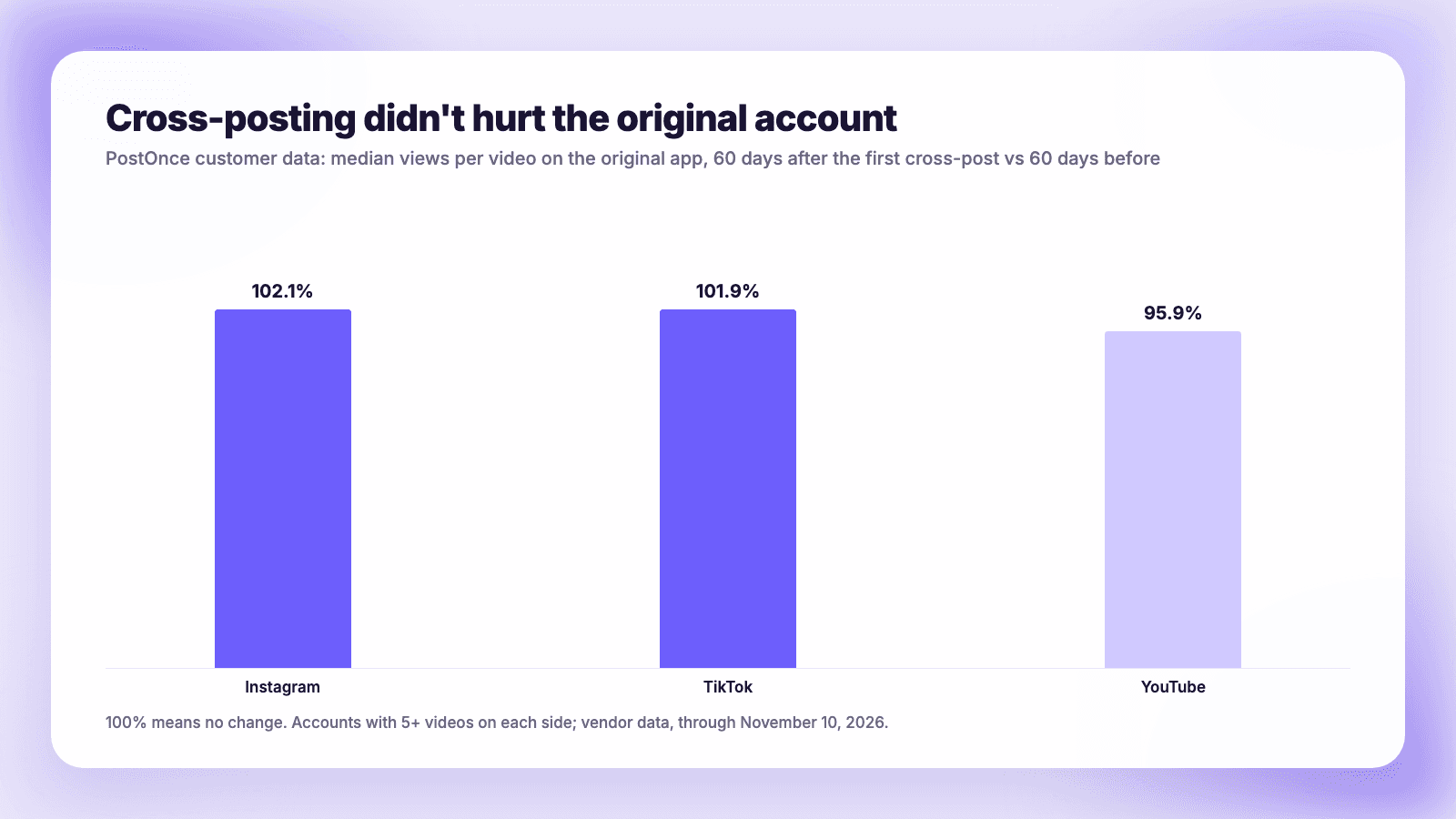
YouTube's small dip is the one number to watch, but it sits within a few percent, and PostOnce notes its method "favours the before side" because older videos had longer to collect views.
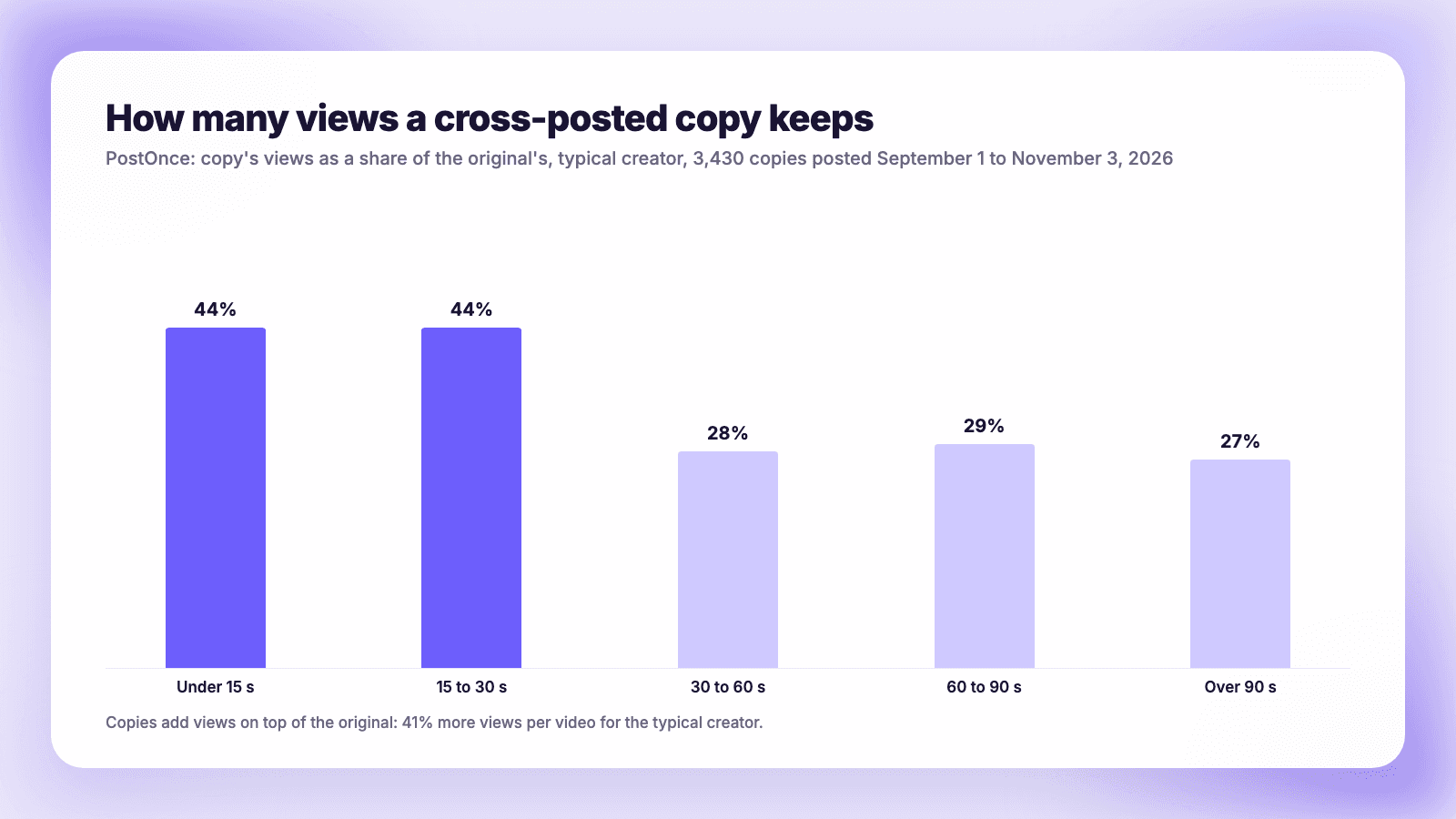
The copies added views. For the typical creator, copies on other networks added 41% more views per video, and "about 3 in 10 at least doubled their views." Short videos travelled best: copies of videos under 30 seconds kept 44% of the original's views, while longer ones kept 27 to 29%.
A second tool, ShortSync, reports that 70% of the 90,667 uploads its 9,367 creators made in the year to November 15, 2026 went to two or more platforms. Cross-posting your own video is the normal way creators work now.
The anecdotes that say otherwise
You will find creators who blame cross-posting for a drop. One asked on r/socialmedia in April 2025 whether TikTok punished them: "I noticed that once I started posting the same videos to YouTube shorts, my TikTok channel and its viewership dropped." No platform has said it does this, and TikTok's rules target reused material from someone else. A single account's drop has many possible causes.
The more common experience in 2026 threads is the opposite. On a September 2026 r/socialmedia thread, u/No-Perspective872 wrote: "It's fine to post exactly the same content everywhere. That's what I do and I have grown to almost 250k followers across channels in 6 months." In an April 2026 thread, u/Icy-Reporter-2002 described what actually matters: "small adjustments (different hook, trimming for the native pace of each platform, removing TikTok watermarks), takes like 20 minutes extra per video and makes a real difference."
How to cross-post safely in 2026
None of the 2026 changes require you to make a different video for every app. They require you to post your own work cleanly. If you edit Reels on a computer, Instagram Edits on desktop exports without a watermark, which is the main thing to avoid.
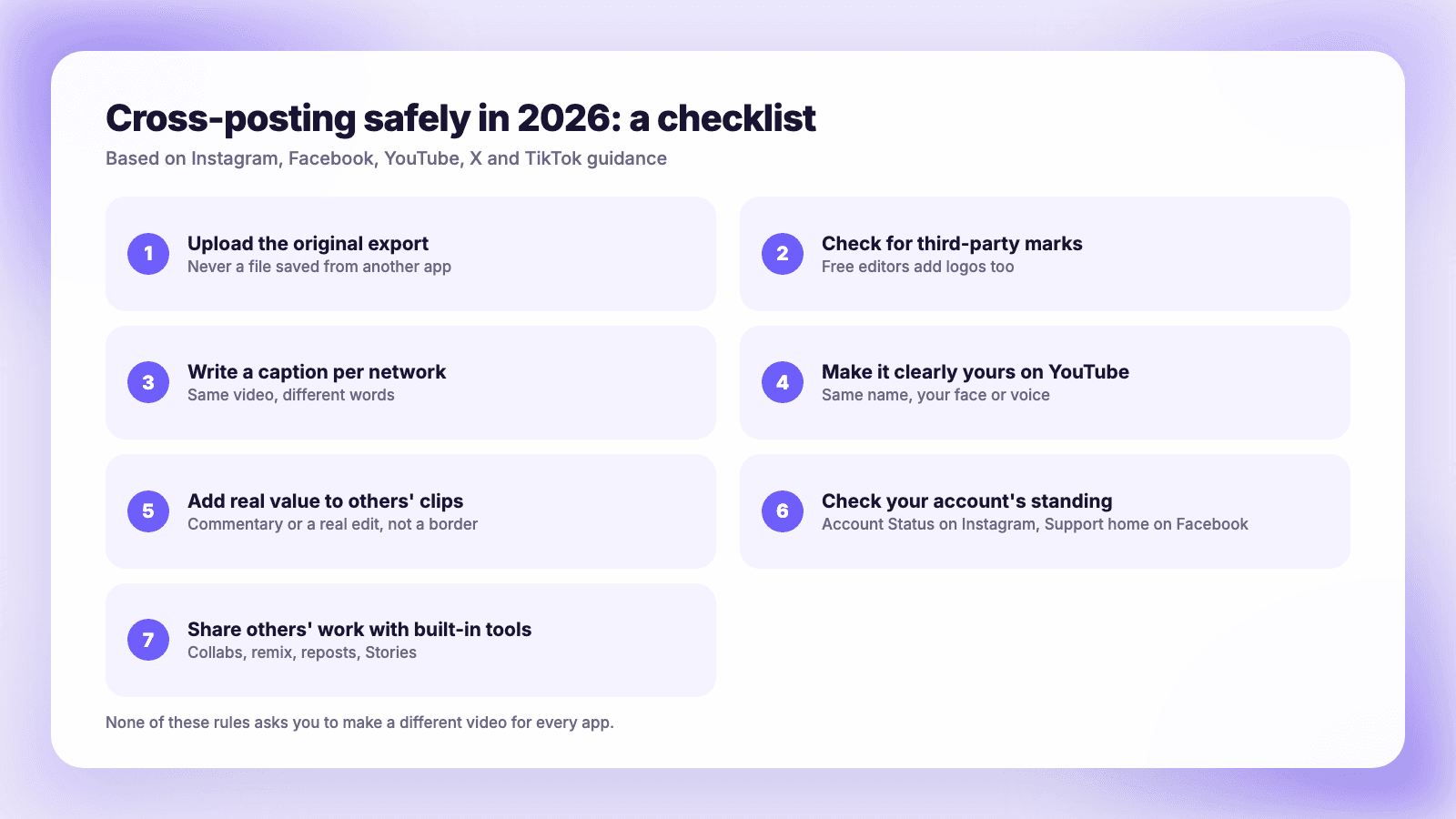
- Upload your original export, never a downloaded copy. Keep the file from your editor or camera roll and upload that to each app. A video saved from TikTok carries TikTok's watermark.
- Check for other apps' marks. Free editors can add their own logo. Instagram and Facebook treat any visible third-party watermark the same way.
- Write a caption for each network. The video can be identical. A TikTok caption written for search, a Shorts title, and a LinkedIn intro are different jobs. Our guide to cross-posting without sounding robotic has examples.
- Make it obviously yours on YouTube. Use the same name everywhere, and if you can, keep your face or voice in the video. That is what YouTube's reviewers look for under the reused content policy.
- Do not mix in other people's clips without adding something. Reaction, commentary or a real edit is fine everywhere. A border, a speed change or a credit in the caption is not.
- Check your account's standing. Instagram's Account Status shows whether you can be recommended to non-followers, and Facebook's Support home screen shows whether you are "at risk of content recommendation or monetization penalties." Instagram lets you appeal from there.
- Use the share tools for other people's work. Instagram suggests collabs, remix, Story shares and reposts, which credit the original creator and do not count against you.
If you post the same video to several apps every week, a tool saves the repetitive part. Plumefy's cross-posting tool takes one upload of your original file and publishes it natively to TikTok, Instagram, YouTube and the other networks you connect, with a caption written for each by AI that you can edit before it goes out. Because it uploads your file rather than a downloaded copy, there is no other app's watermark to remove. If you are still choosing where to post, TikTok vs Reels vs Shorts compares the three, and how to cross-post from Instagram to TikTok covers that route step by step.
FAQ
Does cross-posting hurt your reach in 2026?
Not when it is your own video uploaded as a clean file. The 2026 changes on Instagram, X and YouTube Shorts target reposting other creators' content. A watermark from another app can reduce reach on Instagram and Facebook, so upload your original export.
Will Instagram penalize me for posting a video that is already on TikTok?
Not for that alone. Mosseri has said sharing videos made in other apps does not hurt reach, but "make sure to remove any watermarks, as those can have an impact on reach." Instagram's duplicate detection looks for identical copies on Instagram, not on other apps.
Can I earn from X's Original Content Rewards with videos I also post elsewhere?
Yes, according to X's help page. It excludes content downloaded from another platform and re-uploaded "unless you are the author of that content," and defines cross-platform reposts as content posted "by someone other than the original creator."
Does the YouTube Shorts originality update affect clips from my own long videos?
YouTube's October 2026 post targets "content re-uploaded from other creators without adding anything of your own." Clipping your own videos is not what it describes. For monetization, make sure reviewers can tell the content is yours.
Does adding my own watermark make a repost original?
No. Facebook and Instagram both say a watermark, border or credit is not a meaningful change. Commentary, a voiceover, a real edit or new information is.
Post everywhere, once.
Start on the free plan. No card needed; upgrade when you need scheduling.
Start free